Why ROC Licensing Matters in Arizona
Arizona law requires contractors performing work valued over $1,000 to carry an active ROC license, liability insurance, and post a surety bond.[1] That threshold includes nearly every plumbing job beyond basic fixture swaps. Water heater replacement, repiping, slab leak repair, and sewer line work all fall well above the $1,000 mark.
The ROC verifies four years of documented trade experience, confirms passage of both a trade-specific exam and the Arizona Statutes and Rules Exam, and validates that the contractor maintains an active bond.[5] Unlicensed contractors skip all three requirements.
They don't carry bonds to cover mistakes. They haven't proven competency through testing. And they often lack liability insurance despite what they claim on the phone.
Phoenix's slab-on-grade construction raises the stakes. Your plumbing doesn't run through an accessible basement — it's encased in concrete or buried in caliche soil. An unlicensed plumber who misdiagnoses a slab leak and cuts into the wrong section leaves you with unnecessary trenching costs and foundation damage. When that contractor vanishes, the ROC bond won't help you because he was never bonded to begin with.
Arizona's Contractor Bond Limitations
The surety bond required by the ROC ranges from $4,000 for a single trade residential license to $15,000 for a dual residential-commercial license.[1] That bond is not insurance. It's a limited fund available to homeowners who win judgments against licensed contractors.
If your plumber causes $30,000 in foundation damage from a botched repipe, the bond covers at most $15,000. You're pursuing the contractor personally for the rest, which is why verifying liability insurance separately matters.
Arizona does not require contractors to carry workers' compensation insurance unless they have employees. A solo plumber working on your property who falls through an attic access or gets injured moving a water heater can sue you directly if he's uninsured. Ask for a current certificate of liability insurance naming you as an additional insured before work begins.
Understanding Arizona Plumbing License Classifications
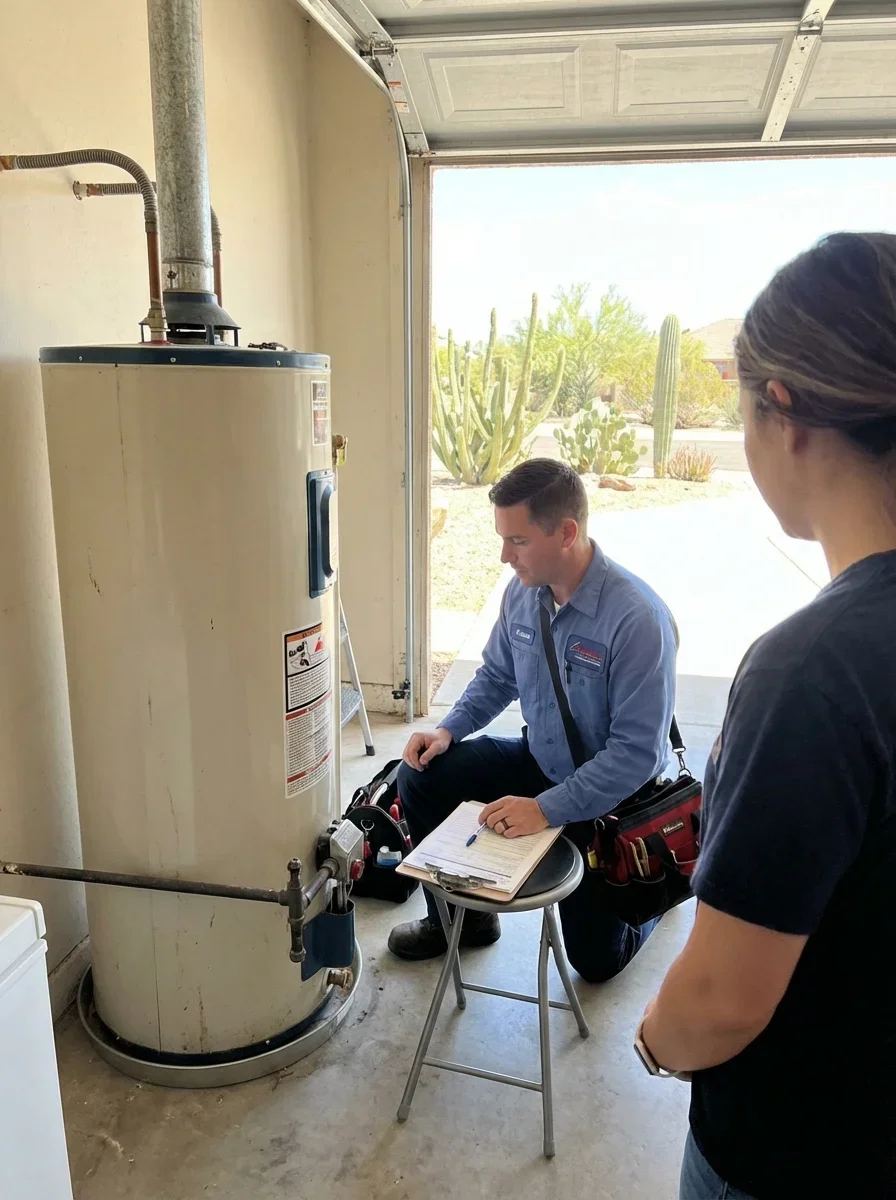
The ROC issues three distinct plumbing contractor licenses, each with different scope limitations.[1] Hiring a contractor with the wrong classification voids your legal protections even if the work is competent.
| License Type | Scope | Bond Required | Typical Use Cases |
|---|---|---|---|
| R-37R (Residential) | Single/multi-family homes only | $4,000 | Water heaters, repiping, slab leaks, drain cleaning |
| C-37 (Commercial) | Commercial/industrial buildings only | $4,000 | Office buildings, retail spaces, manufacturing facilities |
| D-37 (Dual) | Both residential and commercial | $15,000 | Large companies serving both markets |
R-37R (Residential Plumbing) covers installation and repair of water supply lines, gas piping, sewage systems, fixtures, vents, and fire protection systems in single-family and multi-family residential buildings.[2] This license applies to the vast majority of Phoenix homeowners dealing with leak detection, drain cleaning, and water heater work.
An R-37R contractor cannot legally work on commercial buildings, medical gas systems, or industrial plumbing.
C-37 (Commercial Plumbing) authorizes work in commercial and industrial settings — office buildings, retail spaces, manufacturing facilities, and high-rise structures.[3] A commercial-only plumber can repair the restrooms in a shopping center but cannot legally touch residential plumbing in your home. The experience requirements and exam difficulty mirror the residential license, but the scope is entirely different.
D-37 (Dual Residential-Commercial) combines both classifications into one license. Dual-license holders can work on any plumbing project, residential or commercial, without restriction. This classification requires higher bonding ($15,000 vs. $4,000) and often signals a larger company with commercial contracts and residential service divisions.
Journeyman and Apprentice Licensing in Phoenix
The City of Phoenix adds another layer: any plumbing work requiring a permit must be performed by a licensed Journeyman or Apprentice, not just supervised by a licensed contractor.[4] A Journeyman license requires four years of verifiable experience (confirmed by union card or notarized employer letter) and remains valid for three years. Apprentice licenses are valid for one year and require ongoing supervision.
This distinction matters when the contractor sends a crew instead of showing up personally.
If the actual technician cutting into your slab doesn't hold a valid Phoenix Journeyman license, the permit is invalid and the work doesn't meet code. Even if the company itself is ROC-licensed. Ask to see individual Journeyman credentials for whoever is physically doing the work, especially on major projects like repiping or sewer line replacement.
How to Verify a Plumber's ROC License
The Arizona Registrar of Contractors maintains a public database at roc.az.gov where you can verify any license in under two minutes. You need either the contractor's license number (format: ROC123456) or the exact business name as registered.
Search results show the license status (active, inactive, suspended, revoked), issue and expiration dates, bonding amount, and any disciplinary actions or complaints filed. Active status and a bond expiration date in the future are non-negotiable minimums. A license that expired three months ago means the contractor is currently operating illegally, even if they held the license for 20 years prior.
The complaint history section lists formal actions taken by the ROC: citations, fines, license suspensions, and resolved disputes.
One complaint over ten years isn't disqualifying. A pattern of similar complaints (three homeowners reporting abandoned jobs, five cases of unpermitted work) tells you everything you need to know.
What License Numbers Actually Tell You
ROC license numbers follow a sequential format. Lower numbers (ROC100000-ROC150000) often indicate contractors licensed in the 1990s or early 2000s. Higher numbers (ROC320000+) point to recent applicants.
Longevity isn't everything. A contractor who's been licensed since 2002 but has eight complaint resolutions may be worse than a two-year licensee with a clean record.
Check the qualifying party name (the individual who passed the exams and holds the license). If the company changed qualifying parties multiple times, it often means the original licensed individual left and someone else had to qualify the business. Not inherently bad, but it signals turnover worth asking about.
Red Flags That Signal Unlicensed or Problem Contractors
Cash-only pricing with no written contract. Licensed contractors provide itemized written estimates before work begins and accept multiple payment methods. A plumber who quotes $800 cash over the phone but $1,200 "if you need a receipt" is dodging the ROC's $1,000 licensing threshold and won't be pulling permits.
Reluctance to provide ROC number upfront. Any legitimate plumber will give you their license number immediately. It's printed on their truck, business cards, and estimates. Responses like "I'll get you that later" or "my office handles that" mean they don't have one.
No permit for work that obviously requires one. Slab leak repair involving excavation, water heater replacement, gas line work, and repiping all require City of Phoenix permits. A contractor who says "we don't need a permit for this" is either wrong or lying.
Unpermitted plumbing work can void your homeowner's insurance and complicate resale inspections.
Warning Signs of Unlicensed Contractors:
- Cash-only pricing or significant discount for "no receipt"
- Refuses to provide ROC license number before starting work
- Claims permits aren't needed for major work (water heaters, repiping, slab leaks)
- No company branding on vehicle or business cards
- Pressure tactics or "emergency" pricing to force immediate decisions
- Can't provide proof of liability insurance
- Offers in-house financing with no credit check and rates above 20%
High-Pressure Sales Tactics and Financing Red Flags
Licensed contractors compete on reputation and quality, not fear. A plumber who diagnoses a water heater as "about to explode" and pressures you to sign today is manufacturing urgency.
Phoenix's hard water (300+ ppm calcium carbonate) does accelerate corrosion and scale buildup in tank water heaters, but catastrophic failures are rare with annual maintenance. Second opinions cost nothing and weed out scammers.
In-house financing offered with no credit check and same-day approval often comes with interest rates above 20%. Licensed contractors work with reputable third-party lenders or accept major credit cards. Predatory financing schemes target homeowners facing emergency plumbing situations who aren't thinking clearly about total costs.
What Happens When You Hire an Unlicensed Plumber
Arizona law bars unlicensed contractors from suing homeowners for payment, even if the work was completed perfectly.[1] You can refuse to pay an unlicensed plumber's invoice and they have no legal recourse.
That sounds like consumer protection until you realize it also means you have no legal recourse when they damage your property.
If an unlicensed contractor causes a slab leak while attempting to repair a different issue, you cannot file a ROC complaint because there's no license to suspend. You can't claim against a surety bond that doesn't exist. Your only option is small claims court (capped at $3,500 in Arizona) or a civil lawsuit, which costs more in attorney fees than most plumbing jobs are worth.
Homeowner's insurance typically excludes damage caused by unlicensed contractors. Your policy covers sudden pipe bursts from freezing or age, but it won't cover foundation damage from an unlicensed plumber who jackhammered the wrong section of your slab. You're paying out of pocket for both the original job done wrong and the licensed contractor you should have hired initially to fix it.
Permit and Code Compliance Issues
Unpermitted plumbing work becomes your problem when you sell the home. Title companies and buyers' inspectors routinely check permit records against major system upgrades.
A water heater replacement or repipe job with no corresponding permit raises immediate red flags. You'll either need to pay a licensed contractor to bring the work up to code and permit it retroactively (expensive) or accept a lower sale price to compensate the buyer's risk.
The International Residential Code adopted by Phoenix requires specific materials, installation methods, and inspection points for plumbing work. An unlicensed contractor who runs PEX supply lines without proper manifold configurations or uses incorrect fittings creates code violations that won't surface until the next inspector looks. Licensed contractors know these requirements because they're tested on them and face license suspension for violations.[5]
Beyond the License: Other Credentials That Matter
ROC licensing confirms minimum competency and legal authority to operate. Additional certifications signal specialized expertise that matters for specific Phoenix plumbing challenges.
Master Plumber certification from the Plumbing-Heating-Cooling Contractors Association (PHCC) or similar trade organizations requires additional testing and continuing education beyond ROC requirements. Not every ROC-licensed contractor holds a Master Plumber credential, and it's not legally required, but it indicates a commitment to professional development.
Backflow prevention certification from the American Backflow Prevention Association (ABPA) matters if you're installing water filtration systems or dealing with irrigation system cross-contamination. Phoenix requires annual backflow testing on commercial properties and recommends it for residential systems with sprinklers or water softeners.
Manufacturer certifications for specific equipment (Rheem, Bradford White, Navien) mean the plumber has factory training on those brands. If you're investing in a tankless water heater, a contractor with Navien or Rinnai certification brings specialized troubleshooting knowledge that generic training doesn't cover.
Insurance Verification Beyond the Basics
Request a Certificate of Insurance (COI) showing both general liability and property damage coverage with limits of at least $1 million per occurrence. The certificate should list you as an additional insured and name your property address.
Call the insurance company listed on the COI to verify the policy is current. Forged certificates circulate constantly.
Workers' compensation insurance isn't required for contractors with no employees, but it's mandatory for companies with crews. Ask specifically whether the technicians coming to your property are covered under workers' comp or if they're classified as independent subcontractors. If they're subs, they should each carry their own liability insurance, which you can verify the same way.
Questions to Ask Before Signing a Contract
Your first question should be "What's your ROC license number?" followed immediately by a lookup at roc.az.gov while you're still on the phone. Write down the license number on every estimate and verify it matches the name on the proposal.
Ask how long the specific technician doing the work has been with the company and whether they hold a Phoenix Journeyman license.[4] Companies with high turnover send inexperienced techs on complex jobs like slab leak detection where mistakes cost thousands.
A Journeyman with eight years at the same company brings continuity and accountability.
Request a detailed written estimate breaking out labor, materials, permits, and disposal fees. Lump-sum bids that say "$4,200 to repipe house" with no detail make it impossible to compare quotes or identify markup. Itemized estimates show whether you're paying $150 for a water heater shutoff valve that costs $12 at the supply house.
Warranty and Guarantee Specifics
Ask what the warranty covers and for how long. "One-year parts and labor" sounds standard until you read the fine print excluding corrosion damage, hard water scale, or anything caused by "improper water conditions."
Phoenix's aggressive water chemistry (300+ ppm calcium carbonate) causes scale buildup on every fixture. A warranty excluding hard water damage is worthless here.
Understanding plumbing warranties in Arizona requires knowing that manufacturer warranties on equipment (water heaters, tankless units, fixtures) are separate from the contractor's workmanship warranty. A 10-year tank warranty doesn't cover the labor to replace it when the tank fails in year nine. Ask what the labor warranty covers specifically and get it in writing as part of the contract.
When to Verify Licensing Mid-Project
Smart homeowners verify credentials before hiring. Cautious homeowners verify again when the scope changes.
If your plumber finds additional damage during a drain cleaning and quotes another $2,400 to replace a sewer line section, that's a new contract triggering the $1,000 ROC threshold again.
Pull up roc.az.gov and check that the license is still active before approving change orders. Licenses expire, get suspended for non-payment, or are revoked for violations while jobs are in progress. A contractor whose license was active when you signed but suspended before the final invoice is operating illegally for the second half of your project.
The ROC database updates daily. License statuses change in real time as bonds lapse, insurance cancels, or disciplinary actions conclude. Checking once at the start and once at final payment catches problems before you've paid in full.
What the ROC Can and Can't Do for You
The ROC investigates complaints against licensed contractors and has authority to suspend or revoke licenses, assess fines, and order restitution up to the bonded amount.[1] Filing a formal complaint triggers an investigation if the contractor is licensed. The process takes 60-120 days and requires documentation: contracts, invoices, photos, correspondence.
The ROC cannot help with unlicensed contractors because there's no license to suspend.
They can refer you to file criminal charges for contracting without a license, but that's a misdemeanor prosecution through the county attorney, not a fast resolution to your plumbing problem. The ROC also cannot force a contractor to return calls, show up to finish a job, or meet deadlines. Those are contractual disputes handled in civil court.
Winning a ROC complaint and receiving a restitution order still requires the contractor to pay. If the company dissolved and the individual has no assets, a judgment is worthless. The surety bond provides a backup, but only up to the bonded amount, and you're competing with other claimants if multiple complaints exist.
Licensing Requirements for Common Phoenix Plumbing Jobs

Water heater replacement requires a plumbing permit regardless of tank or tankless configuration.[4] The installer must hold an ROC license and pull the permit before work begins.
No permit means no inspection, and uninspected work voids manufacturer warranties on most equipment. The permit fee is typically $50-$150 depending on complexity. If your quote doesn't include it, ask why.
Repiping projects that replace copper supply lines with PEX or CPVC require both plumbing permits and multiple inspections at rough-in and final stages. The contractor should schedule inspections and provide you copies of signed-off permits at project completion. Those permits become part of your home's permanent record and prove the work was done to code when you sell.
Slab leak repairs involving excavation or concrete removal require permits and coordination with structural engineers if the leak compromised foundation integrity. Any contractor who suggests "just patching it from above" without investigating the cause or pulling permits is creating future problems.
Phoenix's combination of caliche soil and slab-on-grade construction means slab leaks often signal larger foundation movement or copper corrosion patterns requiring comprehensive solutions like whole-house repiping.
Phoenix-Specific Warning: The city's hard water (300+ ppm calcium carbonate) and caliche soil create unique plumbing challenges. Licensed contractors understand how these conditions accelerate pipe corrosion and scale buildup. An out-of-state plumber or unlicensed handyman won't recognize corrosion patterns specific to Arizona's geology and water chemistry — mistakes that cost thousands in foundation repairs.
Gas Line Work and Specialized Licensing
Gas line installation or repair requires an ROC plumbing license (gas piping is included in the R-37R scope) plus additional certification for natural gas systems in many cases.[2] Southwest Gas requires contractors working on their infrastructure to complete company-specific training. A plumber licensed for water systems but unfamiliar with gas-specific codes creates life-safety risks.
Gas permits in Phoenix require pressure testing and inspection before the gas company will restore service.
An unlicensed contractor who reconnects your water heater gas line without testing can cause leaks that lead to explosions. Recognizing gas leak signs is critical, but preventing them starts with hiring properly licensed contractors who follow testing protocols.
The ROC License Lookup Tool: Step-by-Step
Navigate to roc.az.gov and click "License Lookup" in the top menu. You can search by license number (ROC######), business name, or qualifying party name. Business name searches require exact matches: "Smith Plumbing LLC" won't find "Smith Plumbing Inc."
The results page shows license status in green (active) or red (inactive, suspended, revoked). Verify the expiration dates for both the license and the bond. A license expiring in six months is fine. One that expired yesterday is not.
Scroll to the complaint history section. Each entry shows the complaint date, resolution date, violation description, and any fines or restitution ordered. Click through to read full details on serious violations. Multiple complaints involving the same issue (abandoned jobs, substandard work, permit violations) reveal patterns you can't see from a single entry.
The contact information section lists the business address, phone, and qualifying party. Cross-reference this with the estimate you received. If the address on the license is a UPS Store mailbox but the estimate lists a different physical location, ask why.
What to Do If You've Already Hired an Unlicensed Plumber
Stop payment immediately if work is still in progress. Arizona law allows you to cancel contracts with unlicensed contractors without penalty and the contractor has no legal standing to demand payment.[1]
Document everything. Take photos of work completed, save text messages and emails, keep any receipts or invoices provided.
Hire a licensed contractor to evaluate the work before making final payment. A professional inspection costs $100-$200 and identifies code violations, incorrect materials, and potential damage the unlicensed plumber caused. You're paying for this anyway when you sell the house. Better to find problems now when you can still withhold payment.
File a complaint with the ROC even though the contractor is unlicensed. The ROC tracks unlicensed operators and refers cases to the Arizona Attorney General for criminal prosecution. Your complaint becomes part of a pattern that can lead to charges, fines, and injunctions preventing the individual from advertising contractor services.
If you've already paid in full and discovered problems afterward, small claims court ($3,500 limit) or civil court are your only options. Consult with an attorney before filing. Many plumbing disputes cost more to litigate than the damage amount. Some contractors operate as fly-by-night LLCs specifically to be judgment-proof.
How Licensed Contractors Differ in Practice
A licensed plumber shows up in a marked vehicle with company branding, not a personal pickup truck with no signage. Legitimate companies invest in branding because they're building a reputation they intend to protect. They carry tablets or phones for digital invoicing and accept credit cards, not just cash or personal checks.
Licensed contractors provide detailed estimates on company letterhead listing the ROC number, physical business address, and contact information.
They explain what they're doing and why, rather than creating urgency through fear. When they recommend replacing your water heater instead of repairing it, they show you the manufacturer date code and explain Phoenix's hard water impact on tank longevity.
They schedule work around permit inspections and factor permit fees into quotes. They don't suggest shortcuts or offer discounts for skipping inspections. They carry proper tools and equipment for the job, not borrowed Harbor Freight kits that break mid-project.
Most importantly, they're still in business when you call back six months later because a warranty issue surfaced. Their license number hasn't changed, their bond is still active, and the person who answers the phone knows your address before you finish explaining the problem.
- Arizona Registrar of Contractors. "License Classifications." https://roc.az.gov/license-classifications. Accessed April 07, 2026.
- Arizona Registrar of Contractors. "Residential Plumbing (R-37R)." https://roc.az.gov/residential-plumbing-r-37r. Accessed April 07, 2026.
- Arizona Registrar of Contractors. "Commercial Plumbing (C-37)." https://roc.az.gov/commercial-plumbing-c-37. Accessed April 07, 2026.
- City of Phoenix. "Journeyman and Apprentice Licensing." https://www.phoenix.gov/administration/departments/pdd/registration-licensing/journeyman-apprentice.html. Accessed April 07, 2026.
- Arizona Registrar of Contractors. "AZ Statutes and Rules Training." https://roc.az.gov/az-statutes-and-rules-training. Accessed April 07, 2026.
- Arizona@Work (AZ Job Connection). "Plumbing Technician Certificate Training Program." https://www.azjobconnection.gov/etp/public/institution_programs/23171. Accessed April 07, 2026.