Understanding Arizona's Plumbing License Classifications
Arizona issues three distinct plumbing contractor licenses, and the differences matter when you're comparing bids. The R-37 Specialty Residential license covers plumbing installation, repair, and maintenance in residential structures — single-family homes, duplexes, and condos.[1]
If you're getting a water heater replaced in your Phoenix home or fixing a slab leak under your kitchen, this is the license classification you'll see most often.
The C-37 Specialty Commercial license applies to commercial buildings — office complexes, retail spaces, industrial facilities. The trade knowledge overlaps, but commercial plumbing involves different code requirements, system sizing, and installation practices. The CR-37 Dual License allows contractors to work on both residential and commercial projects, which is common among larger plumbing companies that serve diverse clients.
| License Type | Covers | Initial Fee | Renewal Fee |
|---|---|---|---|
| R-37 Specialty Residential | Single-family homes, duplexes, condos | $720 | $540 |
| C-37 Specialty Commercial | Office buildings, retail, industrial facilities | $580 | $480 |
| CR-37 Dual License | Both residential and commercial projects | $850 | $650 |
Initial license fees run $720 for R-37, $580 for C-37, and $850 for CR-37, with biennial renewals at $540, $480, and $650 respectively.[5] These aren't trivial costs, and they signal a contractor's commitment to staying compliant. Every license requires a bond and proof of ongoing compliance with ROC classification requirements for any work valued over $1,000.[6]
One detail homeowners often miss: the license classification tells you what the contractor is qualified to do, but it doesn't tell you what they're good at.
A contractor might hold an R-37 and CR-37 but specialize almost exclusively in drain cleaning or hydro jetting. Ask about their specific experience with the type of work you need, not just whether their license allows it.
What It Takes to Earn an Arizona ROC Plumbing License
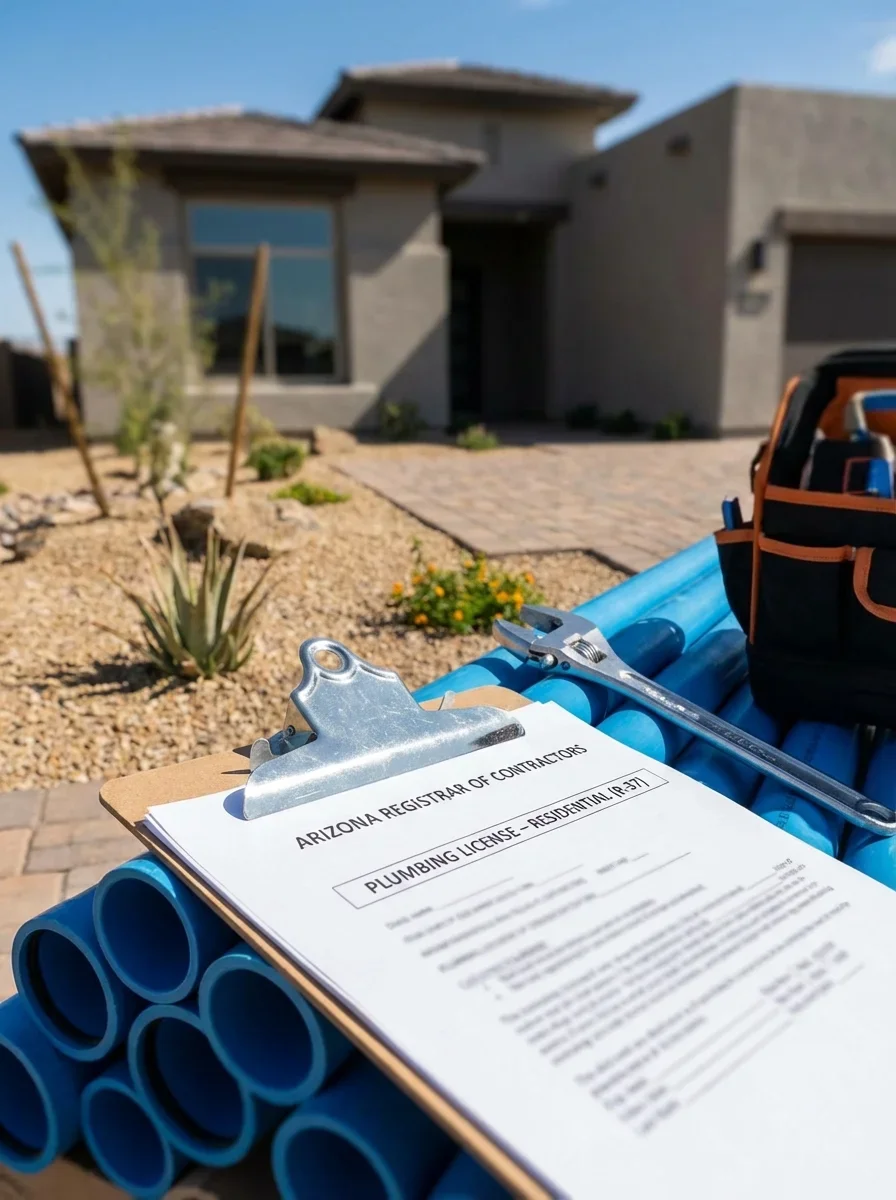
Getting an ROC plumbing license isn't a weekend course. Applicants must document four years of practical or management trade experience, with at least two of those years falling within the last decade.[3] Technical training from accredited institutions can substitute for up to two years of that experience, so some contractors combine apprenticeships with formal education.[2]
Once the experience requirement is satisfied, applicants face two exams.
The Arizona Statutes and Rules Exam (SRE), administered through GMetrix, tests knowledge of contractor law, ROC regulations, and business practices. The PSI trade exam is specific to plumbing codes, installation practices, and safety standards. Both require a minimum passing score of 70%.[4]
Why the Experience Requirement Matters
Four years in the field means a licensed plumber has seen how Arizona's hard water (often exceeding 300 ppm calcium carbonate) accelerates corrosion in copper supply lines. They've dealt with caliche soil that turns a straightforward sewer line replacement into a multi-day excavation project. They've diagnosed pinhole leaks in homes built before 2000, where copper pipes and aggressive water chemistry create predictable failure patterns.
This isn't theoretical knowledge.
An experienced plumber knows that Phoenix's summer heat pushes water heaters to fail at higher rates between June and August, when incoming water temperatures spike and the units work overtime. They understand why slab leak repair costs more in Arizona than most states. Every plumbing line runs under or through the slab in slab-on-grade construction, and accessing those lines means breaking concrete.
How to Verify an Arizona ROC Plumbing License
The ROC maintains a public database at roc.az.gov where you can verify any contractor's license status in under a minute. You'll need either the contractor's name or license number. The lookup tool shows:
- License classification (R-37, C-37, CR-37)
- Current status (active, inactive, suspended, revoked)
- Qualifying party (the individual who passed the exams and meets experience requirements)
- Complaint history (if any)
- Bond and insurance information
Active status is non-negotiable.
If the license is inactive, suspended, or revoked, the contractor legally cannot perform work over $1,000 or pull permits. Some homeowners skip this step because a contractor has been in business for years or comes recommended by a neighbor. License status changes. A contractor who was licensed last year might have let their renewal lapse or faced disciplinary action.
You want to see the qualifying party's name. This is the person whose experience and exam scores back the license. If that individual leaves the company, the license can become invalid until a new qualifying party steps in and meets ROC requirements. Larger companies sometimes list multiple qualifying parties to maintain continuity, but confirm the current roster matches what's on file.
The $30,000 Recovery Fund and Why It Exists
Arizona's Residential Contractor Recovery Fund exists because even licensed contractors sometimes fail to complete work, abandon jobs mid-project, or create damage through negligence. If you've hired a licensed plumber and the work results in financial loss that can't be recovered through the courts or the contractor's bond, you can file a claim with the Recovery Fund for up to $30,000.
Here's the critical qualifier: the contractor must have held a valid ROC license at the time the work was performed.
If you hired an unlicensed contractor to save a few hundred dollars on a water heater installation, the Recovery Fund doesn't apply. You have no recourse beyond small claims court, and even winning a judgment doesn't guarantee collection.
Know This Before You Sign: The bond required for plumbing licenses (typically $4,000 to $15,000) is a separate protection from the Recovery Fund. If you're planning a $25,000 whole-home repipe, that bond won't cover the full job if the contractor fails. Structure payments to minimize exposure — avoid large upfront deposits and hold final payment until permits are closed.
The bond required for plumbing licenses (typically $4,000 to $15,000 depending on classification) is a separate protection mechanism, but it's often exhausted quickly if multiple claims arise against a contractor. The Recovery Fund acts as a backstop. It's not a guarantee that you'll recoup every dollar lost, but it's a layer of protection that simply doesn't exist when you hire outside the licensing system.
Most homeowners don't know this fund exists until they need it. By then, if they didn't verify the license upfront, it's too late.
What Happens When You Hire an Unlicensed Plumber
Arizona law is unambiguous: performing contracting work over $1,000 without an ROC license is a class 1 misdemeanor, and in some cases can escalate to a felony.[6] The law targets the contractor, not the homeowner, but that doesn't insulate you from consequences.
If an unlicensed contractor damages your home during a repiping project or botches a sewer line repair, you can't file a complaint with the ROC. You can't access the Recovery Fund. Your homeowner's insurance may deny claims related to unpermitted or unlicensed work.
When you sell your home, unpermitted plumbing modifications can surface during inspection and derail the sale or force you to bring everything up to code at your expense.
The handyman exemption allows unlicensed individuals to perform work under $1,000 without requiring permits. That's fine for minor repairs: replacing a toilet fill valve, fixing a dripping faucet, installing a new showerhead. But once the project crosses into territory that requires a permit (most gas line work, anything involving main water lines, sewer connections, or water heater installations), the exemption disappears.
Some unlicensed contractors operate by staying just under the $1,000 threshold or by convincing homeowners that permits aren't necessary. Both approaches leave you exposed. When choosing between a licensed plumber and an unlicensed handyman for a $2,000 job, you're not just comparing hourly rates. You're comparing legal protection, insurance coverage, and the ability to enforce accountability if something goes wrong.
Why Phoenix's Hard Water Makes Licensing More Important
Phoenix water regularly tests above 300 ppm calcium carbonate. Firmly in the "very hard" category.
Over time, this mineral-rich water accelerates corrosion in copper supply lines, particularly in homes built before 2000. Scale buildup reduces water heater efficiency by 20-30% over five years, forcing the unit to work harder and fail sooner.
An experienced, licensed plumber knows this. They'll recommend water softener installation not as an upsell, but because they've seen what Arizona water does to plumbing systems. They'll flag aging copper lines during a slab leak inspection and explain why repiping with PEX makes sense before you face multiple pinhole leaks. They understand that hard water scale shortens the lifespan of tankless water heaters unless you commit to annual descaling maintenance.
Unlicensed contractors or out-of-state companies unfamiliar with Arizona conditions might miss these regional factors. They install equipment designed for softer water and don't account for accelerated wear. They underestimate how caliche soil affects excavation costs and timelines.
When the work fails prematurely, you're left paying twice. Once for the initial installation, again for the redo.
Regional expertise isn't listed on a license application, but the four-year experience requirement means licensed Arizona plumbers have worked through multiple monsoon seasons, dealt with summer pipe stress from thermal expansion, and seen firsthand why flat roofs and slab-on-grade construction create unique plumbing challenges.
How to Use the ROC License Check in Your Hiring Process
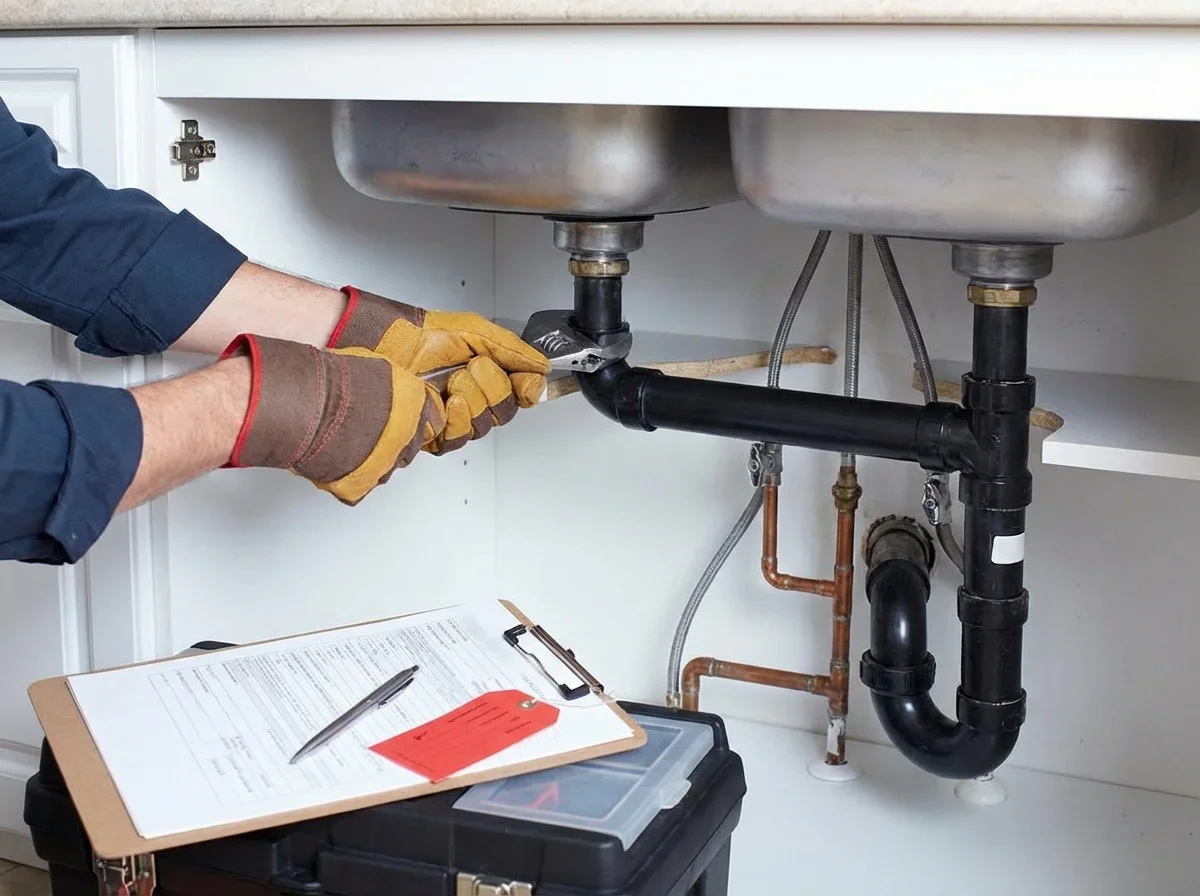
Before you sign a contract or hand over a deposit, verify the license. It takes less time than reading a Yelp review, and it's more reliable. Go to roc.az.gov, enter the contractor's name or license number, and confirm active status.
Then ask for proof of insurance.
Arizona doesn't require contractors to carry workers' compensation insurance, which is controversial and leaves homeowners potentially liable if an uninsured worker is injured on your property. General liability insurance should be standard. Request a copy of the certificate and verify it's current.
Next, check the bond amount. It's listed in the ROC database. For most residential plumbing licenses, bonds run $4,000 to $15,000. If you're planning a $25,000 whole-home repipe, that bond won't cover the full job if the contractor fails to complete it.
You might want to structure payments to minimize your exposure. Avoid large upfront deposits, pay in stages tied to completion milestones, and hold final payment until permits are closed and inspections pass.
Compare the license classification to the work you need. If you're hiring for emergency plumbing after a pipe bursts, confirm the contractor holds an active R-37 and has after-hours availability. If the job involves commercial property or mixed-use buildings, verify they hold the appropriate C-37 or CR-37 classification.
Finally, ask how long they've held the license. A contractor who earned their ROC license in 2025 isn't necessarily less skilled than one licensed since 2015, but there's value in knowing whether you're working with someone who's navigated multiple licensing renewals, maintained a clean complaint history, and built a track record under ROC oversight.
When Permits Are Required and What That Means for Licensing
Most plumbing work that requires a permit also requires a licensed contractor. Water heater replacements, sewer line repairs, gas line installations, repiping projects, and slab leak repairs all fall into permit-required territory in most Arizona municipalities.
Permits exist to ensure work meets the International Residential Code (IRC) with Arizona amendments. Inspectors verify that materials are code-compliant, installations meet safety standards, and the work won't create hazards down the line.
Unlicensed contractors can't pull permits in their own name.
Some work around this by using a licensed contractor's permit fraudulently or by convincing homeowners to pull the permit themselves as "owner-builder."
Both approaches are red flags. If a contractor suggests you pull the permit to save money, you're assuming legal responsibility for the work. If the installation fails inspection, you're the one who has to fix it. If the work causes damage, your homeowner's insurance may deny the claim because you acted as your own contractor without the qualifications to do so.
When Permits Are Required for Plumbing Work:
- Water heater replacements (tank or tankless)
- Sewer line repairs or replacements
- Gas line installations or modifications
- Whole-home repiping projects
- Slab leak repairs involving concrete penetration
- New fixture installations requiring drain/supply line extensions
- Backflow preventer installations
Licensed contractors handle permitting as part of the project. They submit plans, schedule inspections, and address any corrections needed to pass. The permit gets closed out when the work is approved, and that closed permit stays with your home's record. When you sell, buyers and their lenders will see that major plumbing work was done legally, with permits and inspections.
For projects that don't require permits (minor repairs, fixture replacements, drain cleaning), licensing requirements still apply once the work exceeds $1,000. The permit threshold and the licensing threshold aren't identical, and contractors sometimes conflate them to justify working without a license.
Don't accept that logic. The ROC sets the $1,000 limit for a reason, and it applies regardless of permit requirements.
Complaint History and What It Tells You
The ROC database shows if a contractor has faced complaints or disciplinary action. No contractor operates for decades without ever facing a complaint. It's unrealistic to expect perfection.
But the nature, frequency, and resolution of complaints matter.
A single complaint from five years ago that was resolved in the contractor's favor isn't a dealbreaker. Multiple complaints alleging incomplete work, failure to pull permits, or unlicensed employees performing licensed work are serious concerns. Suspended or revoked licenses (even if later reinstated) suggest problems with compliance, financial stability, or business practices.
Some complaints stem from misunderstandings or unrealistic homeowner expectations. Others reveal genuine issues with quality, professionalism, or ethics. Read through the complaint details if they're available. Look for patterns. A contractor who consistently faces complaints about poor communication or missed deadlines might still do good technical work but create frustrating project experiences.
The ROC investigates complaints and can impose penalties ranging from fines to license suspension or revocation. If a contractor has active complaints under investigation, discuss it before you sign a contract. Ask what the complaint involves and how they're addressing it.
Their response tells you as much as the complaint itself.
Arizona's Dual Residential/Commercial License and What It Signals
Contractors who hold a CR-37 dual license can work on both residential and commercial plumbing projects. This classification requires higher fees and often signals a larger operation with more resources. For homeowners, it doesn't necessarily mean better service. Some of the best residential plumbers focus exclusively on homes and hold only an R-37.
But dual-license contractors often have experience with larger, more complex systems. They've installed commercial water heaters with higher BTU ratings, dealt with multi-unit drain systems, and navigated commercial building codes. When that experience translates to residential work, it can be valuable for projects like whole-home repiping in larger properties or gas line installations for outdoor kitchens and pool heaters.
The dual license also indicates the contractor is serious about maintaining ROC compliance.
The higher fees, additional bonding requirements, and broader scope of work mean they're invested in staying licensed across multiple market segments. Not a guarantee of quality, but a data point worth considering alongside reviews, references, and project-specific experience.
Red Flags That a Plumber Isn't Properly Licensed

Some contractors operate in a gray area. They claim to be licensed but provide evasive answers when you ask for specifics. Others outright misrepresent their status. Here are the red flags that should send you to roc.az.gov immediately:
The contractor avoids giving you a license number or says they'll "get it to you later." Active contractors have their license number memorized and provide it without hesitation. It's on their business cards, website, invoices, and proposals.
They claim they're "working under" someone else's license but can't provide that person's name or license details. Licensed contractors can employ unlicensed workers, but they must supervise the work directly. If the qualifying party never shows up and you're dealing exclusively with unlicensed employees, that's a compliance violation.
The quote comes in suspiciously low compared to licensed competitors, and the contractor suggests skipping permits to "save time and money." Licensed contractors factor permit fees, inspection scheduling, and code-compliant materials into their bids.
If the price seems too good to be true, it often is.
They ask for a large upfront deposit (50% or more of the total job cost) before any work begins. Arizona law limits deposits to no more than one-third of the total contract price or $1,000, whichever is less, for projects under $3,000. Larger deposits on bigger jobs are negotiable, but excessive upfront payments reduce the contractor's incentive to complete the work.
They use vague contract language that doesn't specify materials, timelines, permit responsibility, or payment schedules. Licensed contractors use detailed contracts because they're protecting themselves as much as you. Ambiguous terms suggest inexperience or an intent to avoid accountability.
Why ROC Licensing Matters More for Certain Plumbing Jobs
Not all plumbing work carries the same risk. Replacing a toilet wax ring or installing a new kitchen faucet rarely goes catastrophically wrong, and the stakes are low enough that the handyman exemption makes sense for many homeowners.
But repiping an entire home, repairing a slab leak under your foundation, or replacing a water heater in a Phoenix summer when incoming water is already hot? These projects have consequences if done incorrectly.
A botched slab leak repair can undermine your foundation. An improperly installed water heater can leak, flood your home, or in worst-case scenarios involving gas units, create carbon monoxide hazards.
For high-stakes projects, ROC licensing isn't just about legal compliance. It's about working with someone who's demonstrated competence through testing, accumulated years of field experience, and operates under regulatory oversight that gives you recourse if things go wrong.
When comparing bids for major plumbing work, the cheapest option is rarely the safest. Licensed contractors charge more because they carry insurance, pay for bonding, invest in ongoing training, and factor permit costs into their pricing. Those expenses exist to protect you.
Choosing the low bid from an unlicensed contractor might save you $500 upfront, but it exposes you to risks worth tens of thousands if the job fails.
How to Ask About Licensing Without Being Awkward
Some homeowners hesitate to ask about licensing because they worry it seems confrontational or implies distrust. Any reputable contractor expects the question and answers it immediately.
Start with: "Can you provide your ROC license number so I can verify it before we move forward?" Frame it as a standard part of your vetting process, not a personal accusation. Licensed contractors appreciate working with informed homeowners who understand the system.
If they respond defensively or make excuses, that tells you something. If they provide the number and offer to pull up their license status right there on their phone, that's a good sign.
You're looking for transparency and confidence, not evasiveness.
Then ask: "Will you be pulling the permits for this work, and are those costs included in your bid?" This confirms they understand permit requirements and plan to operate legally. It also surfaces any hidden costs early.
Finally: "Do you carry general liability and workers' comp insurance, and can I get a copy of your certificate?" This isn't invasive. It's standard due diligence, and any contractor who balks at providing proof should raise concerns.
These three questions (license number, permit handling, insurance verification) take less than five minutes to ask and answer. They eliminate most unlicensed or underinsured contractors from your candidate pool before you waste time on detailed quotes.
What to Do If You Discover Your Plumber Isn't Licensed
If you've already hired a plumber and later discover they're unlicensed or their license is inactive, stop work immediately. Do not make any additional payments. Document everything: contracts, receipts, photos of completed work, communications.
Contact the ROC to file a complaint.
Even though your recourse is limited because you hired an unlicensed contractor, reporting them helps prevent the same situation from happening to other homeowners. The ROC can pursue criminal charges and civil penalties against contractors operating without licenses.
If work is incomplete or defective, you'll likely need to hire a licensed contractor to assess and fix the issues. This is where the lack of Recovery Fund access hurts most. You're paying twice, and you can't recover costs from the state.
Your homeowner's insurance may not cover damage caused by unlicensed work, but file a claim to document the issue. Some policies have provisions for negligent contractor work, though coverage varies.
If the unlicensed contractor refuses to refund deposits or remedy defective work, small claims court might be your only option. The maximum claim in Arizona is $3,500, so if your damages exceed that, you'll need to file in superior court, which requires more time and potentially legal representation.
The cleaner path: verify the license before the project starts. It's the single most effective way to avoid this entire scenario.
- Arizona Registrar of Contractors. "License Classifications." https://roc.az.gov/license-classifications. Accessed April 07, 2026.
- Arizona Registrar of Contractors. "Applying for a License." https://roc.az.gov/applying-license. Accessed April 07, 2026.
- Arizona Legislature. "32-1122 - Qualifications for license." https://www.azleg.gov/ars/32/01122.htm. Accessed April 07, 2026.
- Arizona Registrar of Contractors. "Exam Information." https://roc.az.gov/exams. Accessed April 07, 2026.
- Arizona Registrar of Contractors. "License Fees." https://roc.az.gov/license-fees. Accessed April 07, 2026.
- Arizona Department of Insurance and Financial Institutions. "Contractor License Classifications." https://azica.gov/divisions-securities/contractor-license-classifications. Accessed April 07, 2026.