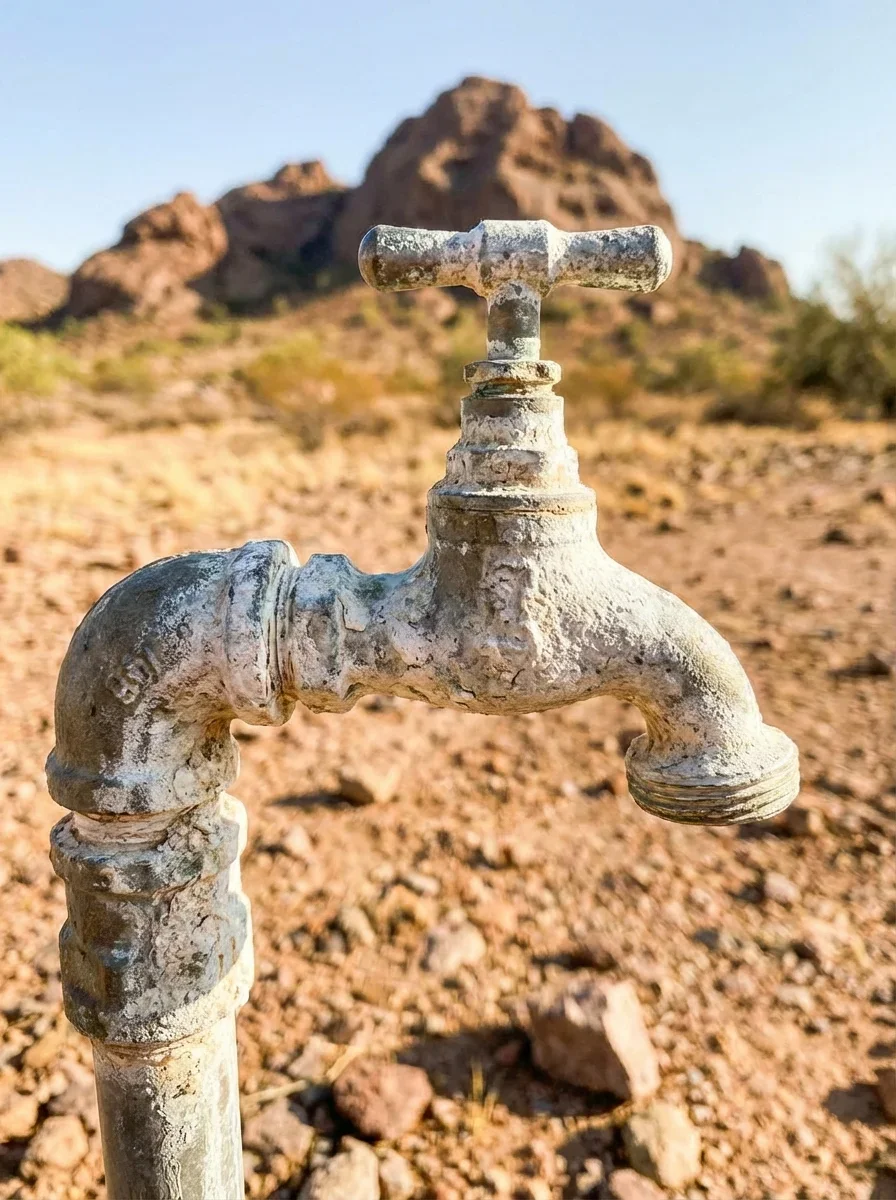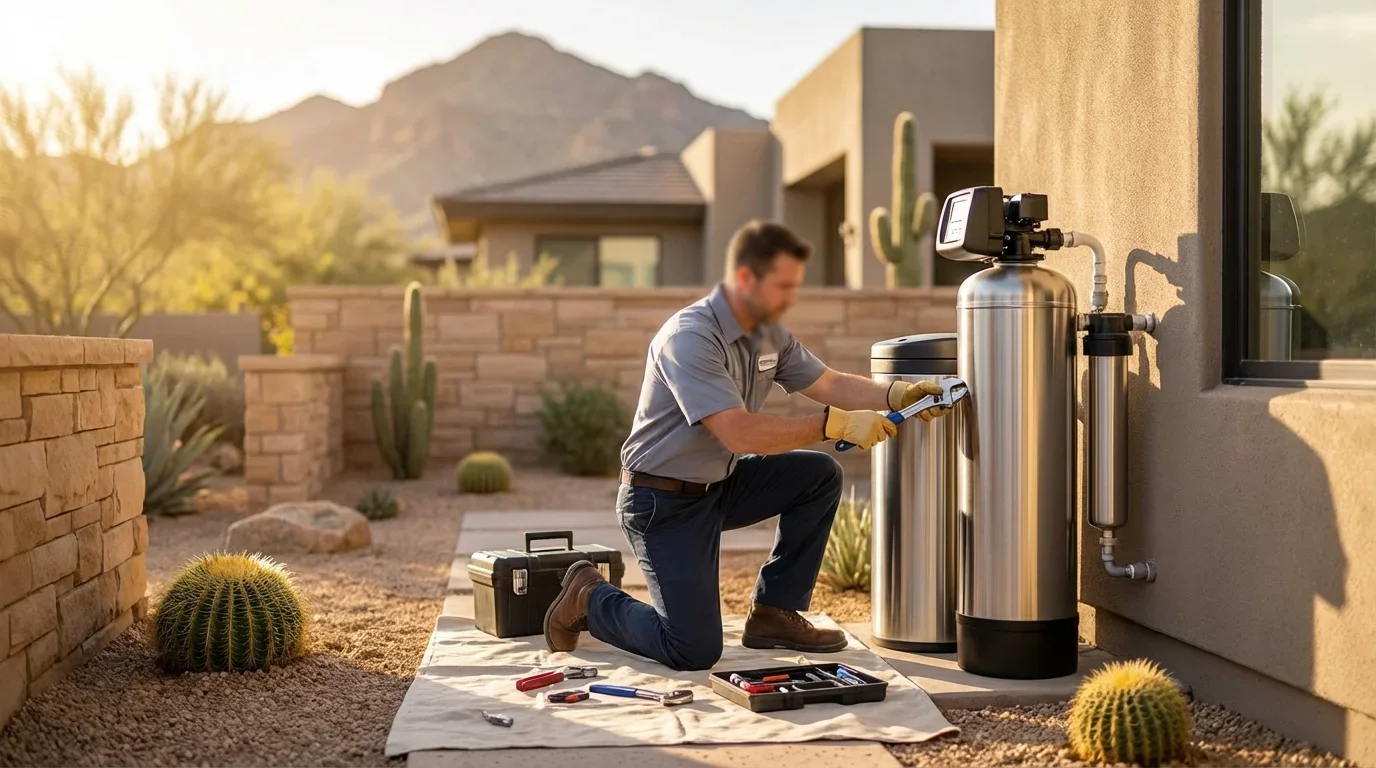
Stop Fighting Phoenix Hard Water Every Single Day
Hard water destroys appliances, leaves crusty buildup, and makes your skin feel terrible. Our water softener and filtration systems deliver cleaner drinking water and protect your home's plumbing investment.
- Eliminate scale buildup on fixtures and appliances
- Enjoy softer skin and cleaner dishes
- Pure drinking water straight from your tap
! Common Issues
Why Phoenix Water Needs Treatment
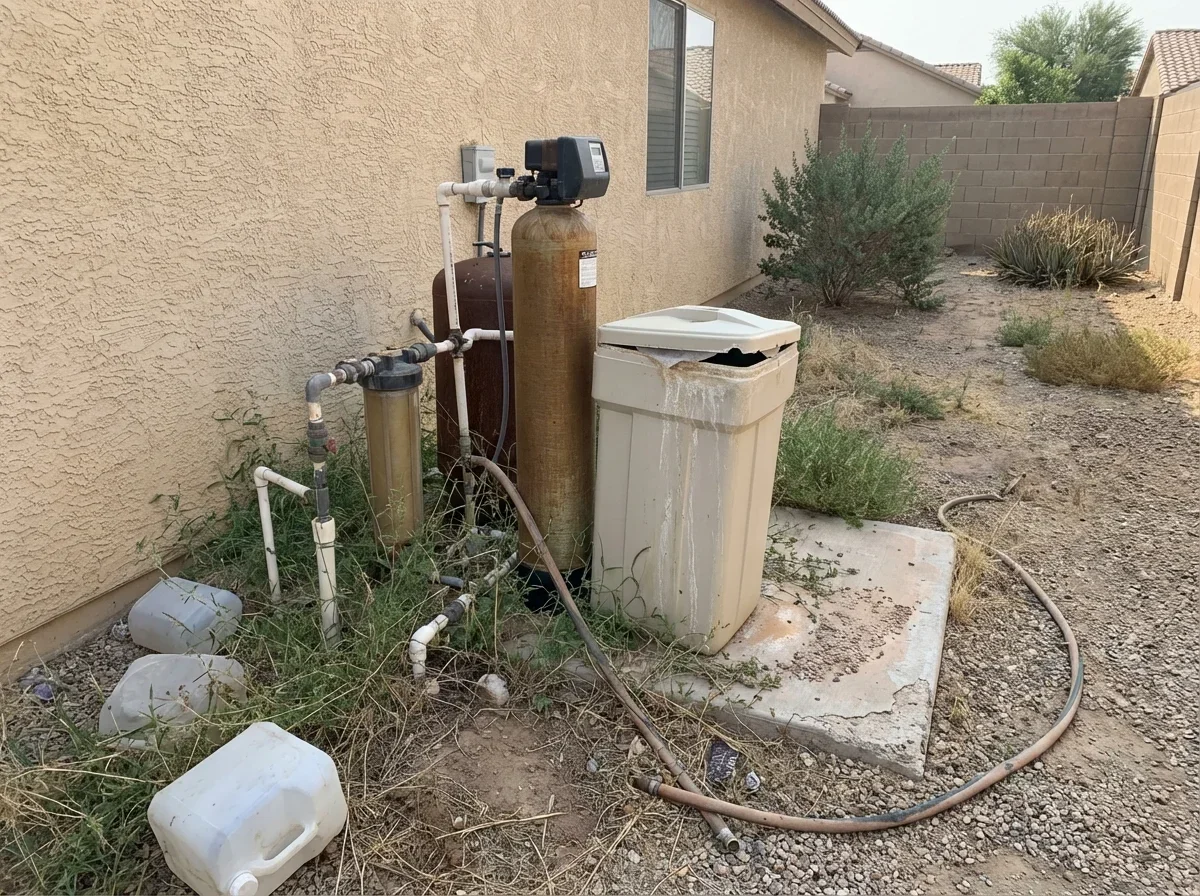
Phoenix Metro pulls water from the Salt, Verde, and Colorado rivers. All three sources are hard — really hard. The mineral content (calcium and magnesium) ranges from 12 to 16 grains per gallon depending on your neighborhood. That translates to 200-275 parts per million of dissolved rock.
You see it on your shower glass. That cloudy film that no amount of scrubbing removes. Your dishes come out of the dishwasher with white spots. Your skin feels tight and itchy even after moisturizing.
These aren't cosmetic annoyances — they're symptoms of a bigger problem hiding in your walls.
Inside your plumbing, mineral deposits build up on pipe walls, reducing flow and increasing pressure. Water heaters take the worst hit. The heating element becomes coated in scale, forcing the unit to work harder to heat water. That buildup reduces efficiency by 20-30% over five years and shortens the heater's lifespan.
Homeowners in Chandler and Gilbert replacing water heaters after 6-8 years often find two inches of sediment at the bottom.
Sound familiar? Your faucet aerators clog every few months. You replaced your dishwasher heating element twice. The water pressure in your master shower dropped to a trickle. Your plumber found scale inside the pipes during a repair.
Copper supply lines (standard in most Phoenix homes built before 2000) corrode faster in hard water. The minerals accelerate oxidation, leading to pinhole leaks in the slab. A slab leak repair runs $2,000-$6,000 depending on access.
Scale buildup in your water heater adds $300-$500 to your annual energy bills.
What Happens If You Wait
Ignoring hard water gets expensive. Scale reduces the diameter of your pipes, increasing pump work for your pressure system. Appliances fail early. That $1,200 washing machine you replaced after seven years? Hard water shortened its life by 30-40%.
Dishwashers, ice makers, and instant hot water dispensers all suffer the same fate.
The calcium deposits inside your water heater eventually flake off and settle at the bottom, causing the tank to crack or the heating element to burn out. Replacement costs $1,500-$3,000 installed. Softened water would have prevented it.
Your skin and hair pay a price too. Hard water prevents soap from lathering properly, leaving a film on your skin that clogs pores and causes dryness.
Tempe and Scottsdale dermatologists routinely recommend water softeners to patients with eczema and sensitive skin conditions.
$ Cost Guide
What Does Water Softener Installation Cost in Phoenix Metro?
Expect to pay $1,500 to $3,500 for a complete salt-based water softener installation in the Phoenix area. That includes the system, backflow prevention device, installation labor, and permitting.
The price varies based on system capacity, installation complexity, and whether you need additional plumbing modifications.
System Type and Capacity Pricing
| System Type | Equipment Cost | Installed Cost | Best For |
|---|---|---|---|
| Basic 32,000-grain salt softener | $600-$1,200 | $1,500-$2,200 | 3-4 person household, standard install |
| High-capacity 48,000-grain | $900-$1,600 | $2,000-$2,800 | 5+ people, high water usage |
| Premium smart softener (Wi-Fi, efficiency controls) | $1,400-$2,400 | $2,500-$3,500 | Tech-forward homeowners, vacation monitoring |
| Salt-free conditioner | $800-$1,500 | $1,400-$2,400 | Minimal maintenance, doesn't remove minerals |
| Reverse osmosis (drinking water only) | $400-$800 | $800-$1,200 | Under-sink, drinking/cooking |
| Whole-house filtration (sediment/carbon/UV) | $1,500-$3,500 | $2,000-$5,000 | Chlorine/taste/odor removal, sediment |
For Phoenix's extreme hardness levels, salt-based ion exchange systems deliver the best results. They physically remove calcium and magnesium from the water. Salt-free systems only condition minerals to reduce scaling. They don't remove hardness.
In water as hard as ours, conditioning isn't enough.
A typical Mesa household (3-4 people, 80 gallons per day per person) needs a 32,000-grain capacity system. Larger families in Gilbert or Surprise with irrigation systems and pools may need 48,000-64,000 grain units to avoid constant regeneration cycles.
Installation Complexity Factors
Basic installations run $800-$1,200 in labor. That covers tying into the main supply line after the shutoff (before any branch lines), installing the drain line for regeneration backwash, and mounting the system.
If your water line enters through a slab, expect higher costs. Cutting concrete and accessing the line adds $300-$600.
Backflow prevention is required by Phoenix code for all water treatment systems. The device (a dual-check valve or RPZ) costs $150-$300 and requires annual testing by a certified technician. Without it, you can't get a permit. Unpermitted work can void your homeowner's insurance.
Older homes may need electrical work. Modern softeners require a 110V outlet for the control valve. If your garage or utility area lacks one, adding an outlet runs $150-$300.
Some Glendale and Peoria homes built in the 1970s also need pressure regulator upgrades (code requires 80 PSI max for softeners). That's another $200-$400.
Ongoing Maintenance Costs
Salt refills every 6-8 weeks cost $5-$10 per 40-pound bag. Most systems use 3-4 bags per month, so budget $20-$40 monthly. You can buy in bulk at Costco or Home Depot to save 20-30%.
Annual service calls (resin cleaning, valve inspection, backflow testing) run $100-$200. Resin replacement every 10-15 years costs $400-$600.
Compare that to replacing a scale-damaged water heater every 7 years at $2,000 each. The softener pays for itself in extended appliance life alone.
| No Softener | With Softener | |
|---|---|---|
| Water heater lifespan | 6-8 years | 12-15 years |
| Annual energy cost (heater) | $500-$650 | $400-$500 |
| Dishwasher lifespan | 7 years | 10-12 years |
| Scale-related repairs (10 years) | $3,000-$5,000 | Near zero |
| Total 10-year cost | $6,000-$9,000 | $3,500-$4,500 |
> What to Expect
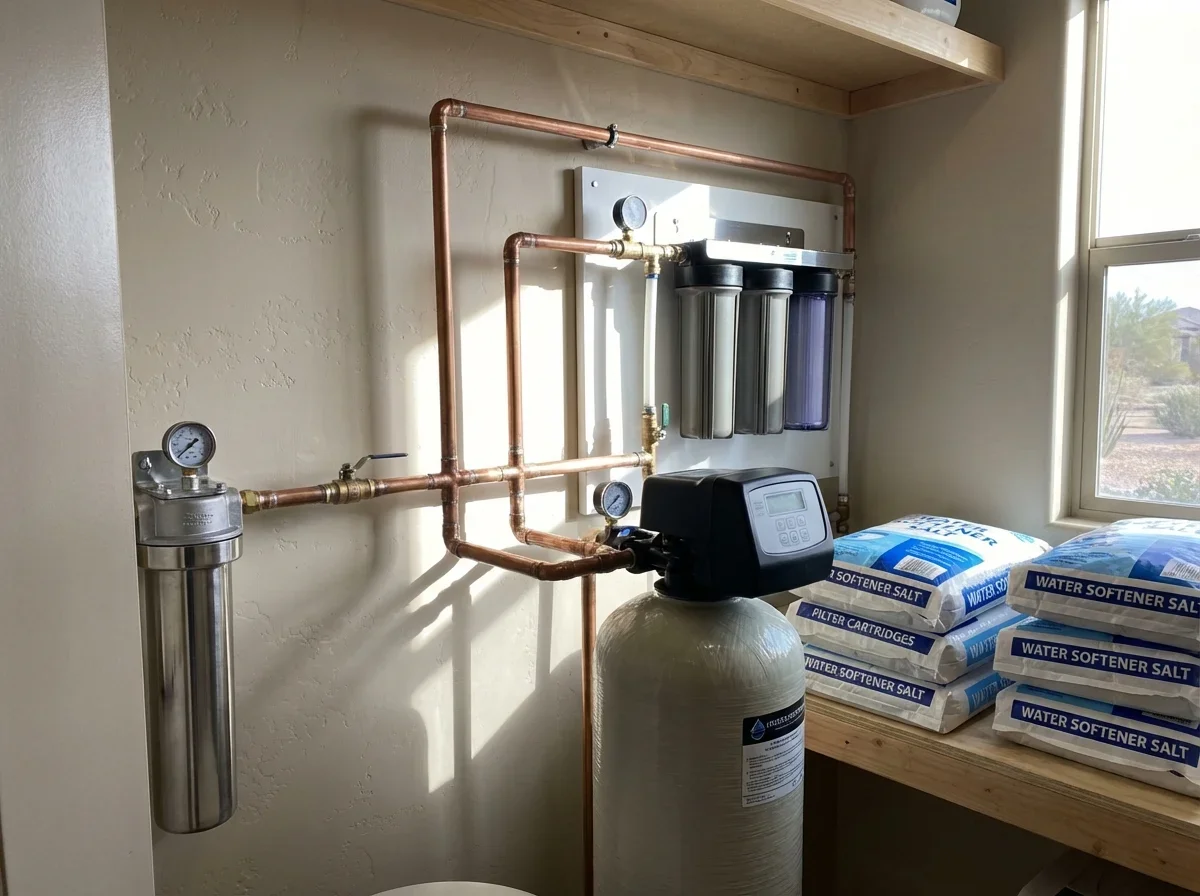
The Water Softener Installation Process
A professional installation takes 3-6 hours for a standard setup. Complex jobs (slab entry, multiple tap points, pre-filter additions) can stretch to a full day.
Here's what to expect.
1. Site Assessment and System Sizing
Your plumber performs a water test to confirm hardness levels and identify any secondary issues (iron, sulfur, chlorine). They measure your household's daily water usage and calculate peak flow rate to size the system properly.
Undersizing leads to hard water breakthrough during high-demand periods (morning showers, laundry day). Oversizing wastes salt and water during regeneration.
They also inspect your electrical setup, drain access, and main water line location. The softener needs to go on the main supply line before it branches to fixtures, but after the outdoor hose bibs. You don't need softened water for irrigation. It's a waste of salt.
2. Permitting and Code Requirements
Any plumbing work over $1,000 in Arizona requires an ROC-licensed plumber and a permit. Your contractor pulls the permit (typically $75-$150) and schedules the required backflow prevention device inspection.
The city or county inspector verifies the backflow valve is installed correctly and tests it annually thereafter.
Phoenix, Scottsdale, and Chandler enforce strict cross-connection control regulations. Irrigation systems, softeners, and any chemical injection systems must have backflow prevention to protect the municipal water supply.
Skipping this step can result in fines and mandatory removal of the system.
3. Installation Day
The plumber shuts off your main water supply and drains the system. They cut into the main line and install a bypass loop with shutoff valves. This lets you isolate the softener for maintenance without cutting water to the whole house. The softener inlet and outlet connect to this loop.
Next, they run a drain line from the softener to your exterior drain, utility sink, or sewer cleanout. This carries away the brine and hard minerals during regeneration cycles (usually every 3-7 days depending on usage). The drain line must have an air gap to prevent backflow.
They wire the control valve to a 110V outlet, program the regeneration schedule based on your household size, and fill the brine tank with salt. The system runs a manual regeneration cycle to flush out any manufacturing debris.
The plumber tests all connections for leaks and adjusts water pressure if needed.
4. Startup and Programming
Modern softeners use metered regeneration. They track water usage and regenerate only when needed, saving salt and water. Your plumber programs your household's water hardness, the number of people, and any specific timing preferences (most homeowners schedule regeneration for 2-3 AM to avoid disruption).
They test the hardness of the treated water with a test strip. Properly softened water should read 0-1 grains per gallon.
If it's higher, they adjust the salt dose or regeneration frequency.
Seasonal Considerations
Summer installations in Buckeye and Surprise see higher demand due to increased water usage (pools, landscaping). Plan ahead and schedule in spring or fall to avoid 2-3 week wait times.
Winter is the slowest season. You'll get faster service and sometimes better pricing.
✓ Choosing a Contractor
How to Choose a Water Treatment Contractor
Not all plumbers are qualified to install water softeners legally. Arizona law requires an active ROC license (R-37, C-37, or CR-37 plumbing classification) for any water treatment work exceeding $1,000.
Verify the license at roc.az.gov before signing a contract. Unlicensed work voids permits, complicates home sales, and leaves you with no recourse if something goes wrong.
Arizona ROC Licensing Requirements
The ROC requires water treatment installers to carry general liability insurance and a contractor's bond ($4,000-$15,000 depending on license type). The bond protects you if the contractor abandons the job or performs defective work, but it won't cover large claims.
Ask for proof of insurance. At least $500,000 general liability and $1,000,000 umbrella coverage. Get this before the work begins.
Backflow prevention device installation requires ADEQ certification. Your contractor must have a certified backflow technician on staff to test and certify the device. This is separate from the ROC license. Ask to see their certification number and confirm it's current.
Questions to Ask Before Hiring
What size system do you recommend and why? A good contractor calculates grain capacity based on your household size and water hardness, not a one-size-fits-all approach.
Will you pull a permit and schedule inspections? If they say permits aren't needed, walk away. Any water treatment installation over $1,000 requires a permit.
What brand do you install and what's the warranty? Reputable brands (Culligan, Kinetico, Fleck, GE) offer 10+ year warranties. Cheap imports fail within 3-5 years.
Who performs the backflow certification? They should have an ADEQ-certified technician on staff or a reliable subcontractor. Backflow testing is required annually. Ask if they offer a service plan.
What's included in the installation price? Confirm it covers the bypass loop, drain line, electrical connection, backflow device, salt, programming, and startup. Hidden costs kill project budgets.
Red Flags to Avoid
Contractors who push salt-free systems for Phoenix water hardness levels are either uninformed or prioritizing profit over performance. Salt-free conditioners don't remove minerals. They're not effective in water this hard.
Demand independent water test results before agreeing to a system type.
Be wary of door-to-door sales or high-pressure financing offers. Reputable water treatment companies don't cold-call. If they quote a price before testing your water or inspecting your plumbing, they're guessing.
Accurate quotes require on-site assessment.
Compare at least three licensed contractors. Look for online reviews mentioning permitting, backflow compliance, and post-installation support. A cheap installation without proper permits will cost you thousands more when you sell your home and the inspector flags unpermitted plumbing work.
Your water heater will thank you. Your appliances will last longer. Your skin will feel better. Your monthly energy bills will drop.
Choose a contractor who understands Phoenix water, follows code, and backs their work with a real warranty.
Top Contractors for Water Softener & Filtration
View all →

Frequently Asked Questions
Estimate Your Water Softener & Filtration Cost
Get an instant price range based on your project details.
Related Articles