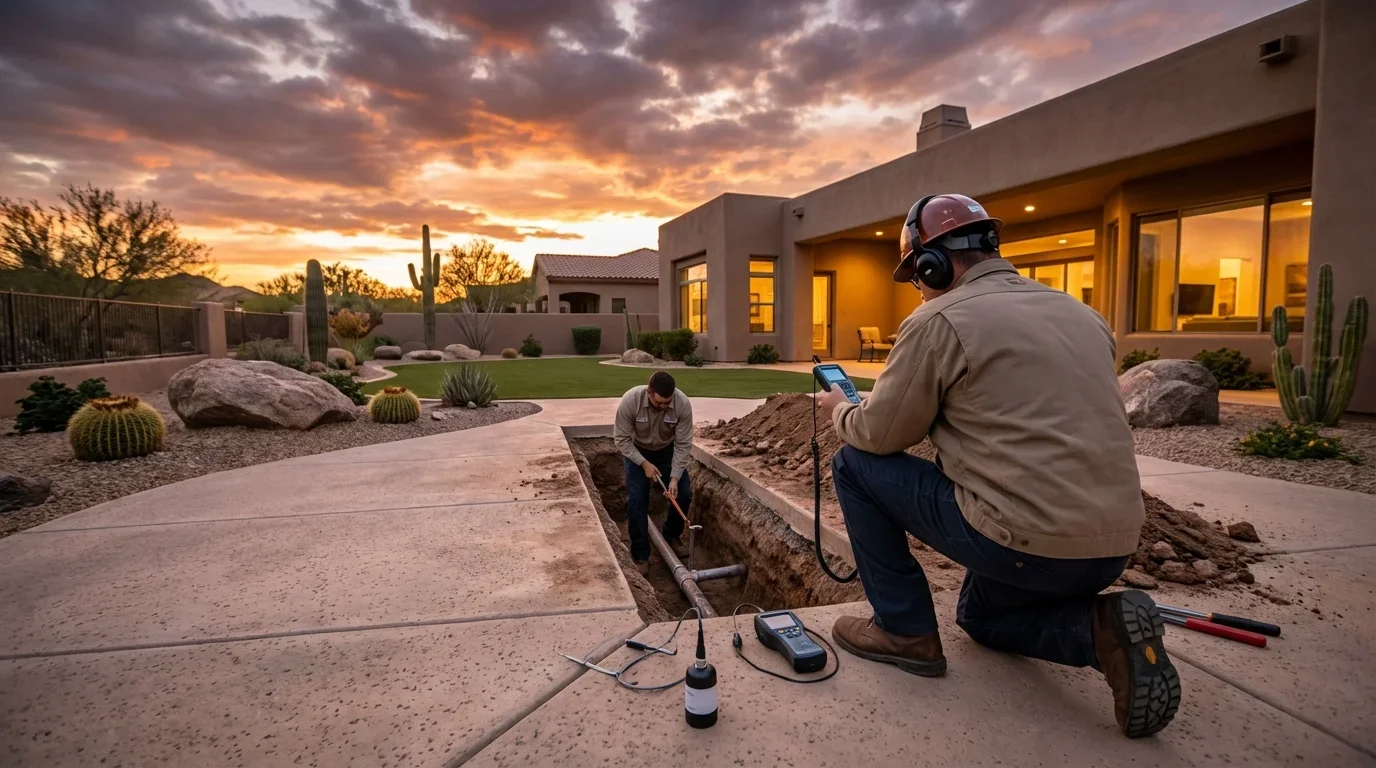
Slab leak detection and repair is critical for Phoenix homeowners with slab-on-grade foundations, where hidden water line leaks beneath concrete can cause extensive structural damage and water waste. Using electronic detection equipment and acoustic sensors, licensed plumbers pinpoint leak locations without unnecessary demolition, then provide targeted repairs through access points or trenchless methods. Early detection prevents foundation shifts, mold growth, and skyrocketing water bills common with undetected slab leaks.
! Common Issues
When Do You Need Slab Leak Detection?
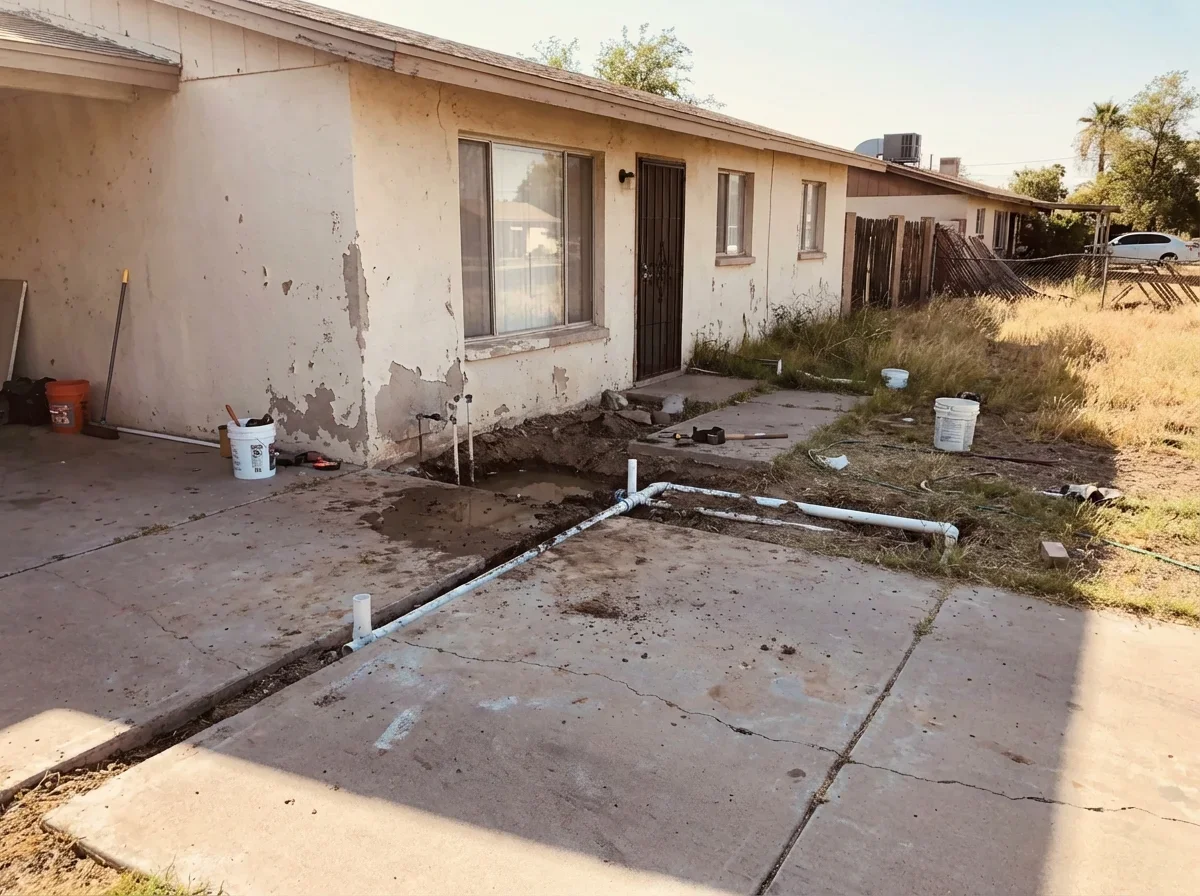
Your water meter spins when every faucet is off. That's the moment most Phoenix homeowners realize something's wrong—but by then, you've probably been paying for a hidden leak for months.
Slab leaks are brutal because they're invisible until they're expensive. Water escaping under your concrete foundation doesn't announce itself with a puddle. Instead, you get unexplained water bills, warm spots on tile floors, or the sound of running water when nothing's on.
Warning Signs in Phoenix Homes
You'll notice the money drain first. Summer water bills in Scottsdale should spike from landscape irrigation and pools—not from water disappearing into your foundation. If your bill jumped $50-$100 but your usage didn't change, you're losing water somewhere.
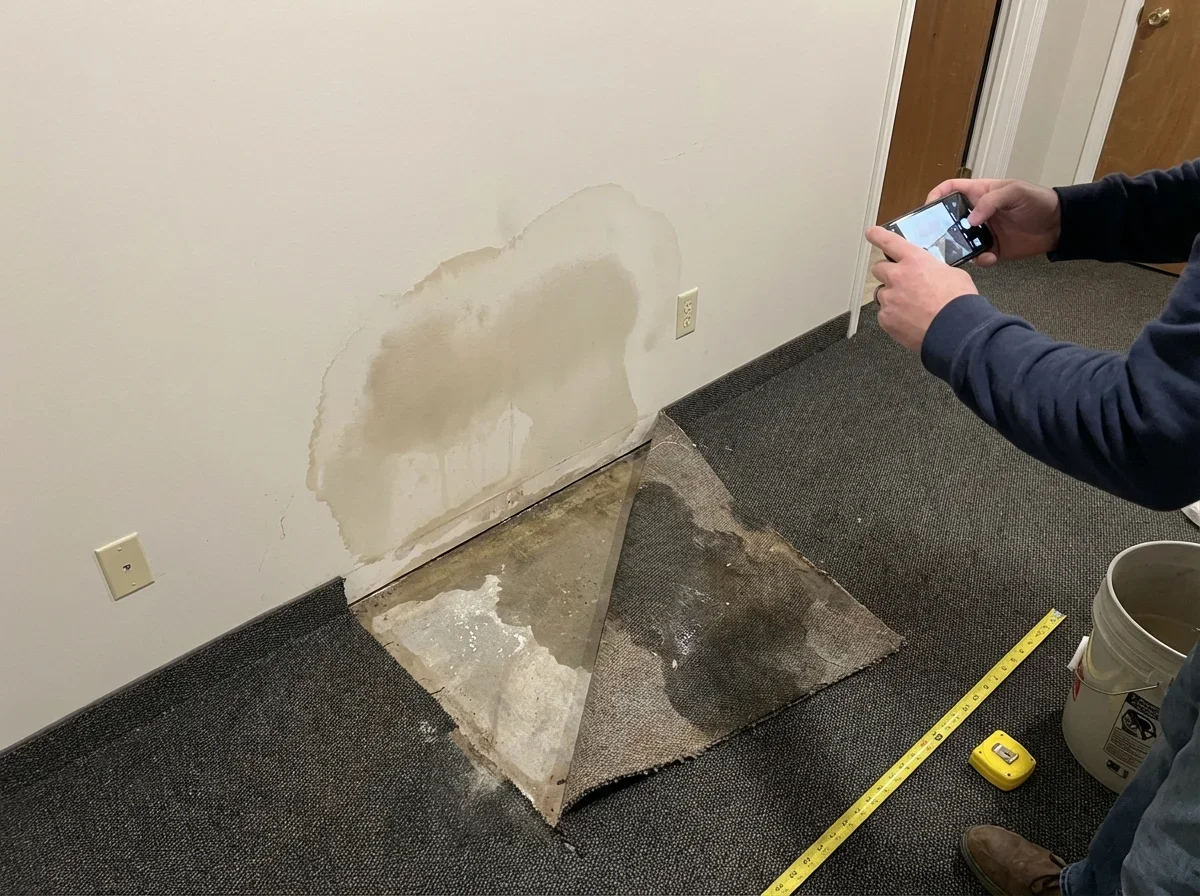
The floor tells the story. Walk barefoot through your house. A warm or damp spot on tile or concrete means hot water is leaking directly beneath. In Chandler's older neighborhoods with under-slab copper lines, these warm spots often appear near bathrooms or the water heater location.
Foundation cracks that weren't there six months ago? Settling caused by soil saturation from a persistent leak. You'll see it along baseboards or exterior stucco—hairline cracks that gradually widen.
The sound of running water when every fixture is off is the clearest tell. Stand near your water heater or main line. If you hear flow, you've got an active leak.
Sound familiar? Your Mesa water bill went from $120 to $280 over three months. You checked for running toilets. You cut back on showers. The bill stayed high. Now there's a warm spot near the hallway bathroom, and you're worried about foundation damage.
Hard Water and Copper Pipe Concerns
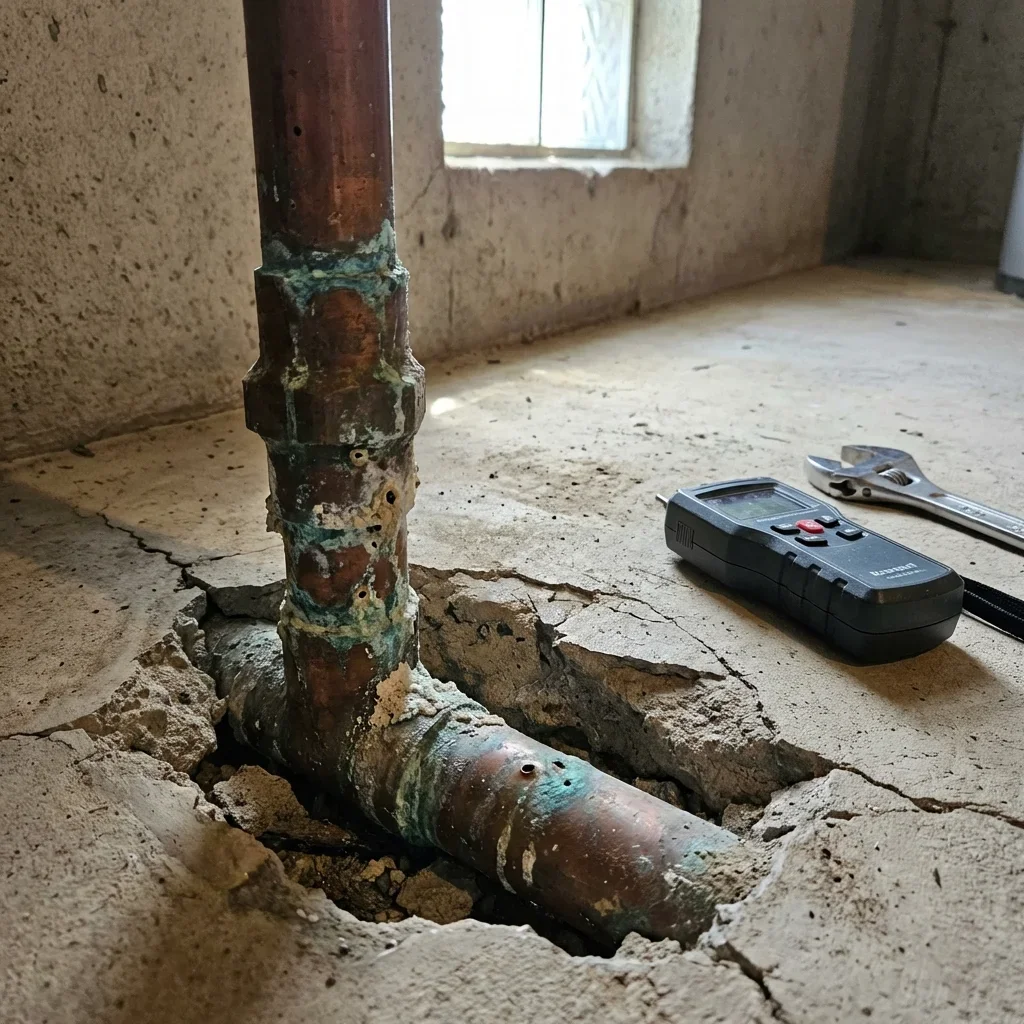
Phoenix Metro's notoriously hard water—over 300 ppm calcium carbonate—turns copper pipes into ticking time bombs. Homes built before 2000 almost universally have copper supply lines running under the slab. Decades of mineral-rich water flowing through creates pinhole leaks from the inside out.
Thermal expansion makes it worse. When ambient temps hit 115°F in Peoria and your attic space exceeds 150°F, the temperature differential between cold incoming water and superheated pipes causes expansion and contraction cycles that stress already-corroded copper.
Summer is peak season for slab leaks—not because of usage, but because of heat stress.
Homes in Tempe and central Phoenix built in the 1970s and 1980s are at highest risk. If your home still has original copper plumbing and you've never had a leak, you're statistically overdue. The question isn't if, but when.
$ Cost Guide
What Does Leak Detection & Slab Leak Repair Cost in Phoenix?
The detection visit runs $250-$800 depending on technology and complexity. The actual repair? That depends entirely on what they find and which fix makes sense for your home.
Detection Service Pricing
| Detection Method | Cost Range | Best For |
|---|---|---|
| Electronic/Acoustic Listening | $250-$400 | Locating active pressurized leaks in accessible areas |
| Thermal Imaging Camera | $400-$600 | Pinpointing hot water leaks through temperature differential |
| Tracer Gas Detection | $500-$800 | Complex layouts, multiple potential leak points, cold water lines |
Most contractors in Surprise and Glendale use a combination approach—starting with acoustic detection to narrow the area, then confirming with thermal imaging. You're paying for precision. A detection tech who can mark the exact spot within 6 inches saves you thousands in unnecessary concrete demolition.
Some companies offer free detection if you hire them for the repair. That sounds good until you realize you're locked into their repair quote with no ability to compare.
Better approach: pay the $400 for independent detection, get the exact location, then get three repair quotes.
Repair Method Cost Comparison
Here's where the real money shows up:
| Repair Method | Cost | Duration | Best Scenario | |---|---|---| | Epoxy Pipe Lining (Spot Repair) | $80-$250 per linear foot | 4-6 hours | Single isolated leak, pipe otherwise sound | | Jackhammer Access + Spot Repair | $500-$2,500 | 1-2 days | Accessible leak location, newer home, temporary fix | | Under-Slab Reroute (Partial) | $1,500-$3,000 | 2-3 days | Multiple leaks in one zone, avoid foundation demolition | | Whole-Home Repipe (Above-Slab) | $4,000-$8,000+ | 3-5 days | Old copper throughout, recurring leaks, long-term solution |
The math changes when you factor in the long game. A $1,200 spot repair on a 40-year-old copper line in Mesa buys you maybe 2-5 years before the next pinhole appears three feet away. A $5,000 repipe that reroutes all supply lines through the attic or walls eliminates under-slab risk permanently.
If your home was built before 1985 and still has original copper, most experienced contractors will recommend the reroute. You're not fixing one leak. You're preventing the next five.
Permits add $150-$300 for repipe work. The City of Phoenix requires permits for any plumbing work involving slab penetration or repiping[1]. Contractors include this in quotes, but confirm it's pulled before work starts.
Unpermitted repipe work becomes a nightmare during home sales.
> What to Expect
The Leak Detection & Repair Process
You're not hiring a contractor to jackhammer your floor and hope they find something. Professional leak detection follows a systematic process that confirms the leak exists, pinpoints the location, and determines the least-invasive repair.
Step 1: Non-Invasive Detection
The tech starts with your water meter. Everything off, meter still spinning? You've got an active leak. They'll measure flow rate to estimate severity—a slow spin means a pinhole leak, fast spin indicates a significant break.
Next comes acoustic detection. Using electronic amplification equipment, the tech listens through the slab at multiple points. Pressurized water escaping a pipe creates a distinct frequency.
They'll mark potential locations with tape, narrowing the search area to a few square feet.
For hot water leaks (the majority in Phoenix), thermal imaging cameras show exactly where heated water is radiating through the concrete. Temperature differentials of even 5-10 degrees appear as bright spots on the camera display.
Step 2: Confirming the Leak Location
Before anyone breaks concrete, the tech confirms the exact spot. Tracer gas detection works for tricky cases—a safe, detectable gas is introduced into the line under pressure, and a sensor identifies where it escapes. This method works for both hot and cold water lines and can detect leaks conventional methods miss.
Pressure testing isolates which line is leaking. The tech will shut off sections of your plumbing system and monitor pressure drop.
A line that can't hold pressure has a breach.
Total detection time: 1-3 hours for a typical single-leak scenario. Complex homes with multiple zones or suspected multiple leaks can take half a day.
Step 3: Repair Method Selection
Here's where experience matters. A good contractor explains your options with honest tradeoffs.
Epoxy lining works if the leak is isolated and the rest of the pipe is sound. The tech accesses the damaged section (usually through an exterior wall or cleanout), cleans the pipe interior, and applies an epoxy coating that seals the pinhole from inside. No concrete demolition, minimal disruption. It's a 4-6 hour job.
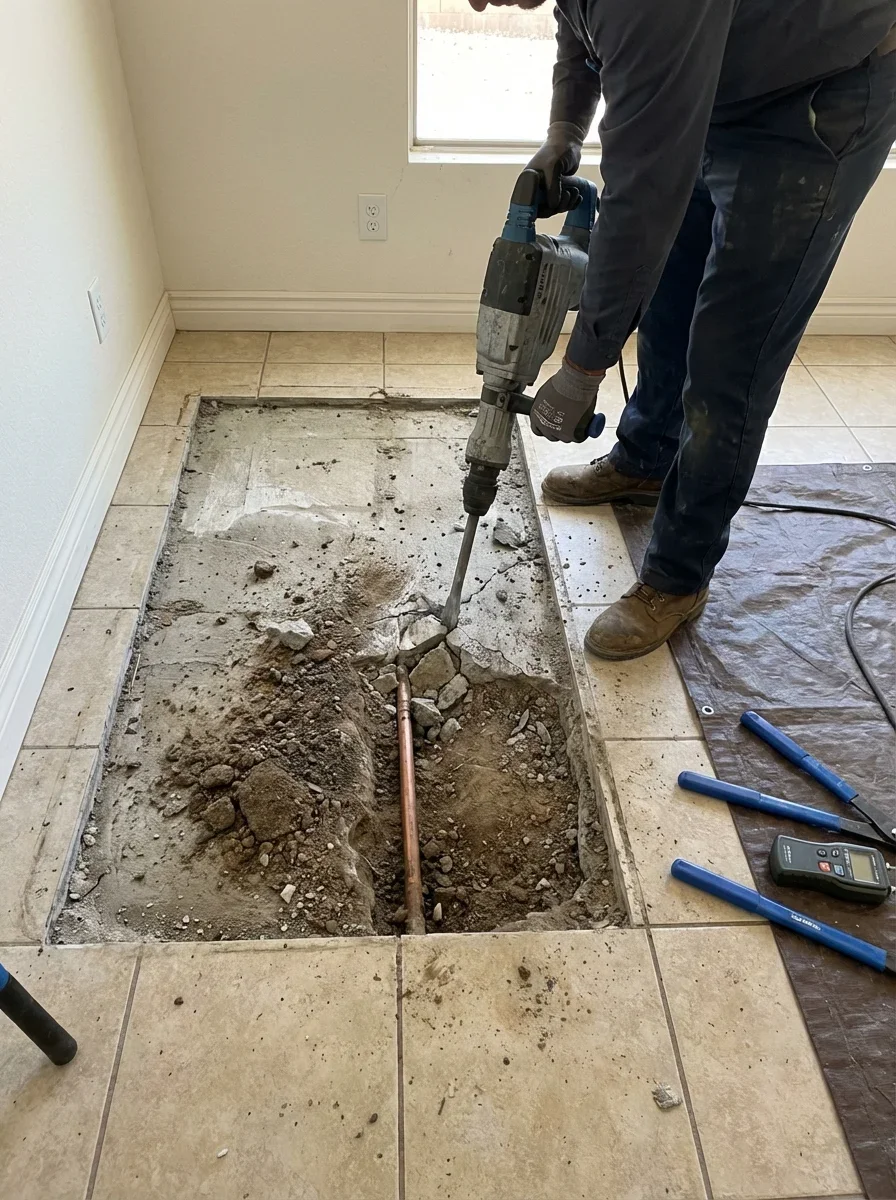
Jackhammer access is necessary when epoxy won't work—larger breaks, corroded pipe that won't hold a lining, or locations where access from above isn't possible. The crew cuts a precise section of concrete (typically 2x3 feet), repairs or replaces the damaged pipe section, pressure tests, then patches concrete and flooring.
Budget 1-2 days including drying time for concrete.
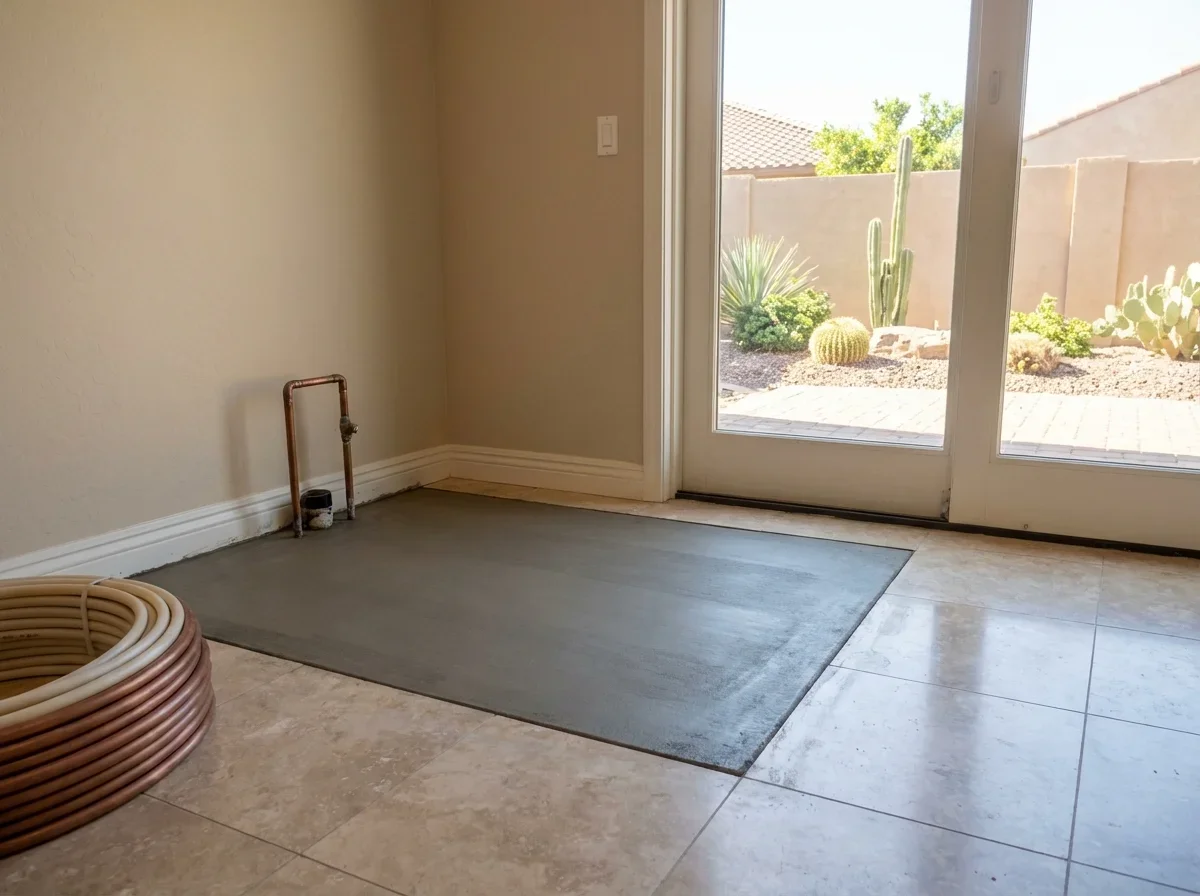
Under-slab rerouting abandons the leaking line entirely. New supply lines are run through attic space, interior walls, or along exterior walls—anywhere but under the slab. For Gilbert homes with tile floors and no attic access, this might mean surface-mounted PEX lines in closets or utility areas.
More invasive short-term, but it eliminates future under-slab failures.
Step 4: Repair and Restoration
Whichever method you choose, the final steps include pressure testing the repair (waiting for 30+ minutes under full pressure to confirm no leaks), restoring concrete if accessed, and matching flooring. Tile matching is nearly impossible for older homes—most contractors patch with concrete and warn you'll need to refloor that area if aesthetics matter.
Drying time for concrete patches: 24-48 hours minimum before walking on it, 7 days before replacing flooring. Summer heat in Buckeye accelerates drying. Winter might add a day.
✓ Choosing a Contractor
How to Choose a Leak Detection & Repair Contractor
Every plumber claims they can find leaks. The difference between a $600 bill and a $6,000 disaster comes down to technology, experience, and licensing.
Required Licensing in Arizona
Verify an active Arizona Registrar of Contractors (ROC) license before anyone touches your plumbing. The ROC license number should appear on every quote and invoice. Check current status at roc.az.gov—you're looking for "active" status with no disciplinary actions.
Plumbing contractors need a K-37 (residential plumbing) or K-38 (commercial plumbing) classification. A general contractor license (B or R without plumbing classification) is not enough for specialized leak detection and repair work.
Insurance verification is critical because Arizona doesn't require contractors to carry workers compensation insurance. If an uninsured worker is injured on your property, you're liable.
Ask for certificates of liability insurance and workers comp before work starts.
Detection Technology and Experience
Ask what detection equipment they use. "We'll figure it out when we get there" is a red flag.
Professional leak detection companies own thermal imaging cameras ($3,000-$8,000 equipment investment), electronic amplification systems, and tracer gas detection kits.
How many slab leaks do they handle monthly? You want a contractor who does this weekly, not someone who occasionally takes a leak detection call. Experience with Phoenix-area homes built in different eras matters—a tech who understands how 1970s Scottsdale block construction differs from 1990s Gilbert frame homes will troubleshoot faster and more accurately.
Questions to ask before hiring:
- What detection methods do you use, and how do you decide which approach fits my situation?
- How many slab leak repairs have you completed in the past year?
- Do you pull permits for repipe work, and is that cost included in your quote?
- What's your recommendation—spot repair or reroute—and why?
- If you find multiple leaks or damaged pipe beyond the initial location, how does that change the scope and cost?
- What warranty do you provide on detection accuracy and repair work?
Red flags to avoid:
- Pressure to decide immediately without getting competing quotes
- Unwillingness to provide written estimates breaking down detection vs. repair costs
- No mention of permits for work that requires them
- "Free detection" offers that lock you into their repair pricing
- Recommendations that don't match your home's age and condition (pushing a $1,200 spot repair on 45-year-old copper is short-term thinking)
The best leak detection contractors in Chandler and Mesa will tell you honestly whether your home needs a repair or a repipe. They know that recommending a $5,000 solution when a $1,500 fix works gets them a bad reputation.
Conversely, they won't patch a leak on failing pipe just to get a quick job—because they'll be back in 18 months doing it again.
Compare at least three licensed contractors. Detection methods and technology should be similar—what differentiates them is repair philosophy, warranty terms, and project timeline. Someone who can start tomorrow might be desperate for work. Someone booked two weeks out is probably doing quality repairs that generate referrals.
Top Contractors for Leak Detection & Slab Leak Repair
View all →


Frequently Asked Questions
- City of Phoenix. "Plumbing Code Information." https://up.codes/viewer/phoenix/2021_plumbing_code. Accessed April 07, 2026.
Estimate Your Leak Detection & Slab Leak Repair Cost
Get an instant price range based on your project details.
Related Articles