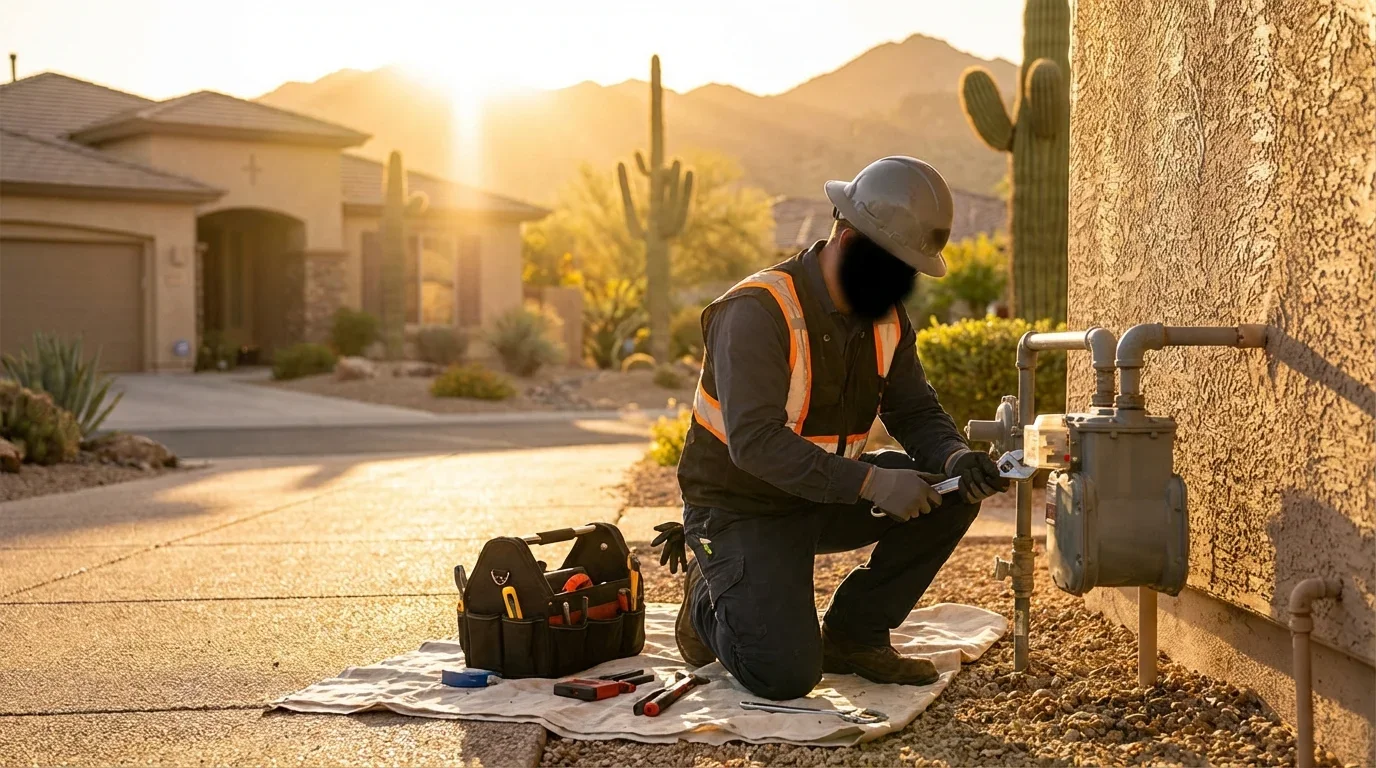
Safe Gas Lines Keep Your Phoenix Home Running Right
Whether you're adding a pool heater, outdoor kitchen, or need emergency leak repair, proper gas line work isn't optional—it's critical for your family's safety.
- Licensed installation for appliances and outdoor features
- Fast leak detection and pressure testing
- Code-compliant repairs that pass inspection every time
! Common Issues
Signs You Need Gas Line Service in Phoenix
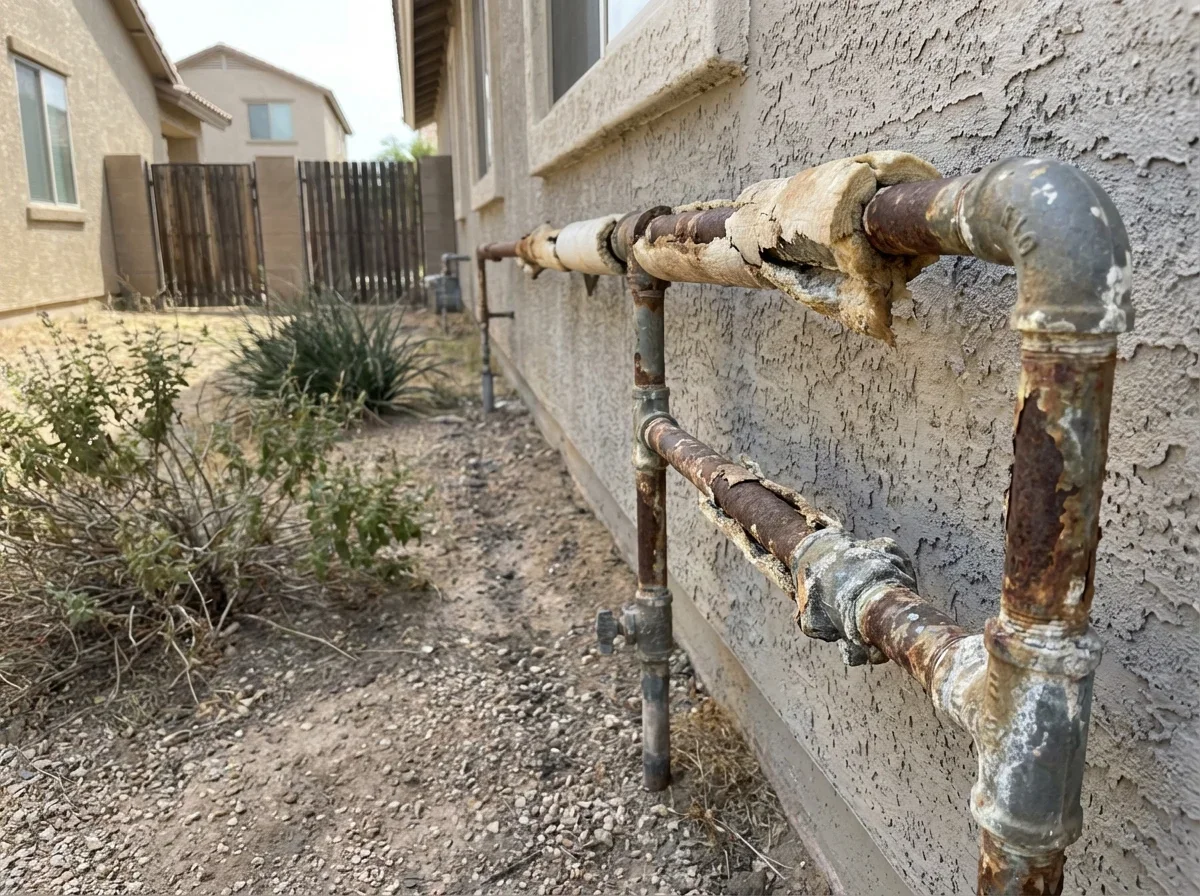
You're catching a whiff of rotten eggs near your water heater. Not every time, just occasionally. Maybe your gas dryer takes longer to heat up than it used to. Or you're planning that outdoor kitchen in Gilbert and learned the hard way that running a gas line isn't a DIY weekend project—Phoenix requires permits, pressure testing, and inspections before Southwest Gas will turn on service.[1]
Gas line problems escalate fast. A slow leak you ignore this month becomes a $3,000 emergency excavation next month when your meter gets red-tagged. The pool heater hookup your handyman cousin attempted? It failed the city inspection, and now you're paying a licensed contractor to rip it out and start over—plus re-permitting fees.
Phoenix homeowners call for gas line service in three scenarios: new installations (outdoor kitchens, fire pits, pool heaters, whole-home conversions from electric), repairs and leak detection (smell of gas, appliances not firing properly, failed pressure tests), and compliance fixes (unpermitted work discovered during home sales, inspection failures, outdated materials).
The urgency depends on the problem.
Smelling gas near your meter or appliances? That's a call-the-fire-department-then-call-a-plumber emergency. Planning a backyard transformation in Scottsdale with a built-in BBQ island and fire table? That's a scheduled project—but one that requires an ROC-licensed plumber with R-37, C-37, or CR-37 credentials. Arizona doesn't issue separate gas fitter licenses; gas line work falls under plumbing licensing.
Sound familiar? You're renovating your backyard in Chandler. You want a fire pit and gas grill hookup. You called a handyman who quoted $800. Then you learned Phoenix requires permits, inspections, and pressure testing per the International Fuel Gas Code. Now you're looking for someone who does it right the first time.
Here's what makes this worse: caliche soil. That calcium carbonate hardpan layer common across the Phoenix metro turns simple trenching into jackhammer work. Buried gas lines require 12-inch minimum depth for coated metal pipe or 18 inches for PE (polyethylene) piping—and if your yard has caliche at 18 inches, you're paying for the privilege of cutting through it.[2]
Ignoring a suspected gas leak? You're risking explosion, carbon monoxide poisoning, and voided homeowner's insurance if there's an incident with a known unreported leak.
Proceeding with unpermitted gas line work? You're risking failed inspections, expensive rework, and complications when you sell the home.
$ Cost Guide
What Does Gas Line Installation Cost in Phoenix?
Gas line pricing in Phoenix breaks into two categories: appliance hookups (connecting an appliance to an existing gas line nearby) and new line runs (trenching and installing new pipe from your meter or main line to a new location).
Appliance Hookup Costs
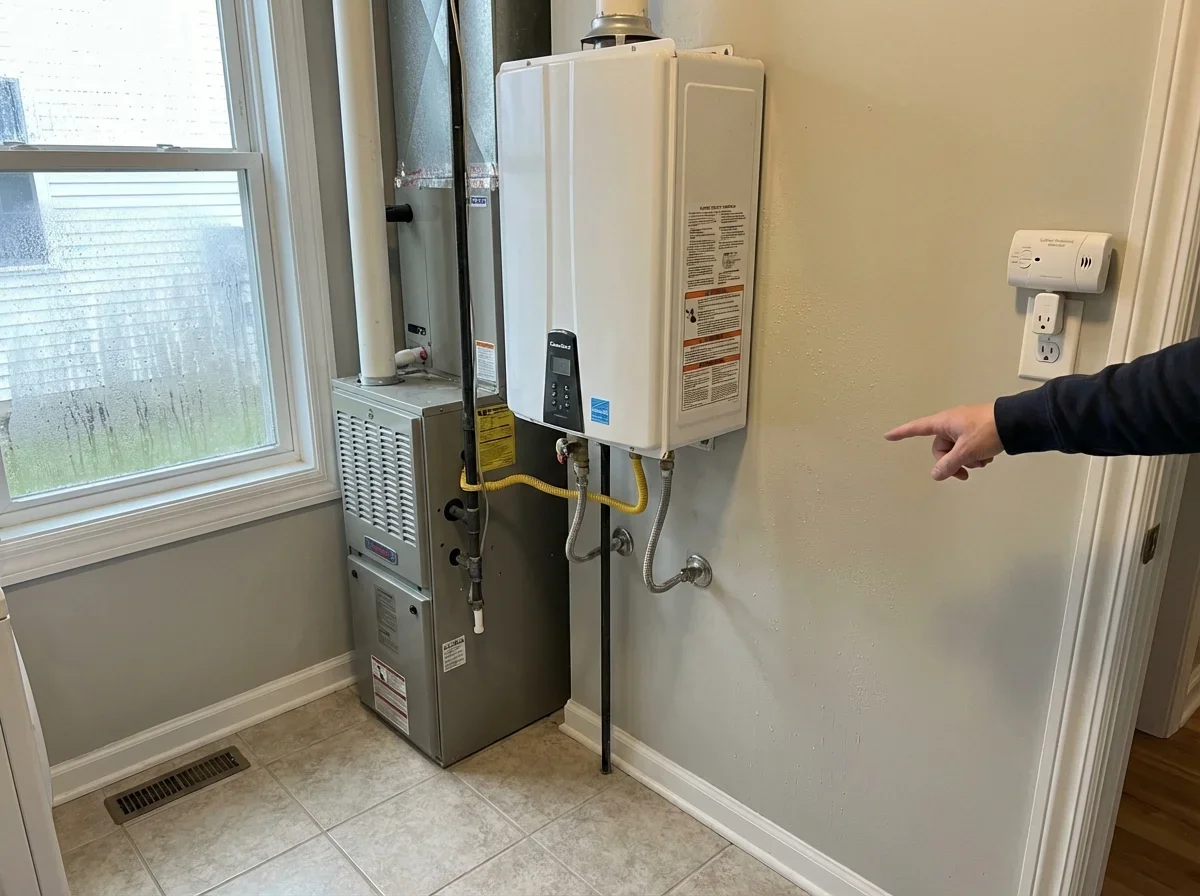
Connecting a gas dryer, range, or water heater to an existing gas stub-out runs $350-$750 depending on complexity and materials. If the existing line is properly sized and within 6 feet, you're on the low end. If the contractor needs to upsize the line, add a pressure regulator, or run flexible connector through a wall, you're closer to $750.
Pool heater hookups run $600-$1,200 because they typically require longer runs (20-40 feet from the meter or existing line) and permit inspections in most Phoenix-area cities.
Outdoor Kitchen and Fire Feature Costs
Here's where projects get expensive—and where most homeowners underestimate costs.
| Project Type | Line Run Distance | Typical Cost |
|---|---|---|
| Single BBQ hookup | 20-40 feet | $800-$1,500 |
| Fire pit/fire table | 30-50 feet | $1,200-$2,200 |
| Full outdoor kitchen (grill + side burner + fire feature) | 50-100 feet | $2,500-$5,000 |
| Whole-home conversion (electric to gas appliances) | Multiple runs + meter upgrade | $4,000-$8,000+ |
The big cost drivers: trenching distance, caliche soil conditions, permit fees ($150-$300 depending on municipality), pressure testing requirements, and inspection scheduling.
In Mesa or Surprise, if your outdoor kitchen is 80 feet from your gas meter and the trench crosses caliche hardpan, you're paying $40-$60 per linear foot just for excavation before the pipe work begins.
DIY vs. Professional Reality
| DIY / Unlicensed | ROC-Licensed Plumber | |
|---|---|---|
| Cost | $200-$500 in materials | $800-$5,000 installed |
| Permits | Usually skipped (illegal for work over $1,000) | Pulled, inspected, approved |
| Pressure Testing | Rarely done correctly | Mandatory per IFGC[1] |
| Warranty | None | 1-2 years on labor, manufacturer warranty on materials |
| Result | May work initially, fails inspection during home sale | Code-compliant, insurable, resale-ready |
Phoenix and most Valley cities require permits for new gas line installations. The inspection will fail unpermitted work—and you'll pay twice. Once for the handyman who did it wrong, again for the licensed contractor who rips it out and does it correctly.
Natural gas work in Phoenix operates at 7-10 PSI at the meter, stepping down to 0.5 PSI at appliances. Pressure testing must hold for 15 minutes with no drop. If you don't know what you're doing, you're creating a safety hazard.
> What to Expect
The Gas Line Installation Process in Phoenix
Initial Assessment and Permitting
A licensed plumber visits your property to evaluate the project. They measure the distance from your meter or existing gas line to the new appliance location, assess soil conditions (critical in Phoenix—caliche changes everything), and calculate required pipe sizing based on BTU demand and pressure drop over distance.
They pull permits through the city—Phoenix, Tempe, Chandler, and most Valley municipalities require permits for new gas line installations.
Permit costs vary ($150-$300 typically), and inspections are mandatory before the gas utility will authorize service.[1]
Trenching and Line Placement
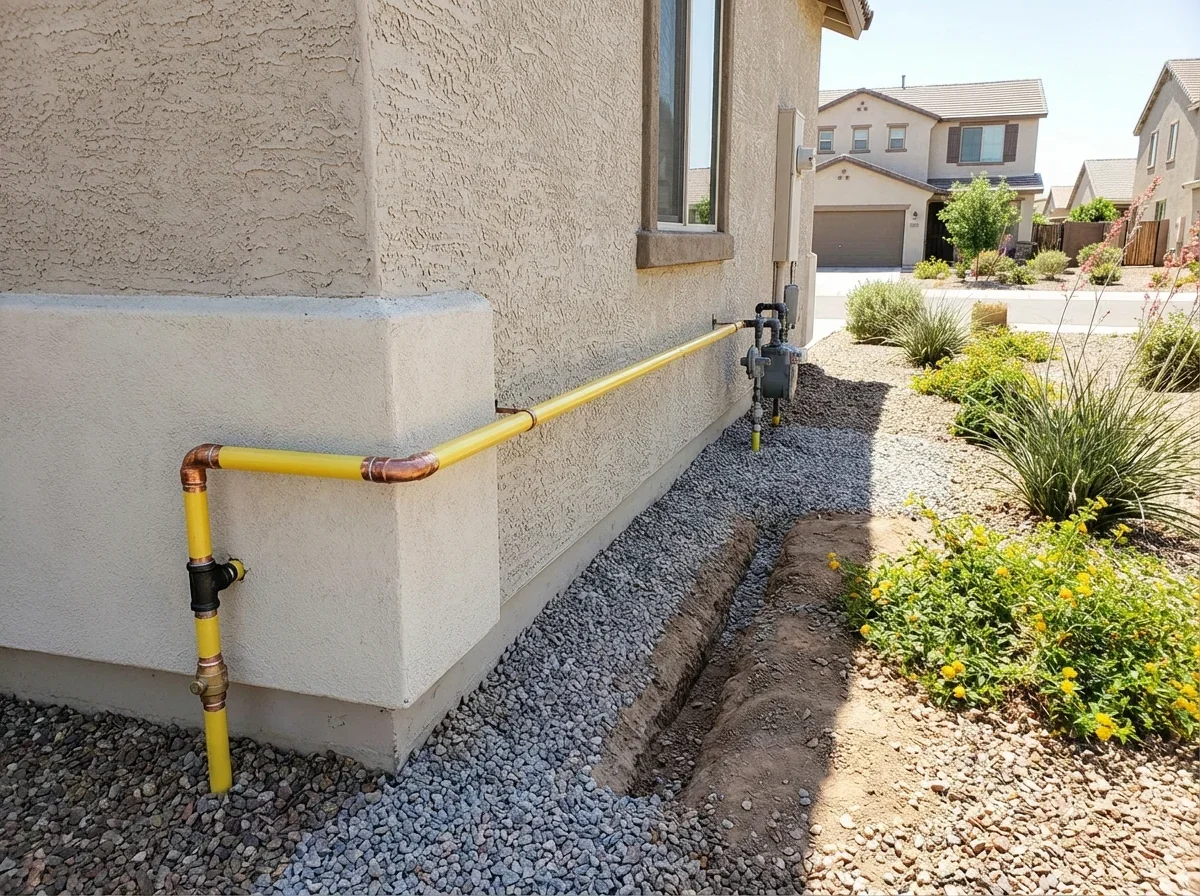
If you're adding an outdoor kitchen or fire pit, the contractor trenches from the gas source to the new location. Metal pipe (black iron or CSST—corrugated stainless steel tubing) buried in Phoenix requires factory coating and a minimum 12-inch depth. PE (polyethylene) pipe requires 18-inch depth, approved transition fittings at the above-ground connection, and a yellow insulated copper tracer wire for future locating.[2]
Trenching through caliche in Peoria or Glendale can add days to the project timeline.
Contractors often bring in jackhammers or mini excavators for hardpan that hand tools can't penetrate.
Above-ground runs (inside homes, along exterior walls) use black iron pipe with threaded fittings or CSST flexible connectors. CSST requires bonding and grounding per the National Electrical Code—another inspection checkpoint.
Pressure Testing and Final Inspection
Before covering any buried pipe, the contractor pressure-tests the entire run. They pressurize the system to 15-20 PSI (higher than operating pressure), isolate it, and monitor for pressure drop over 15 minutes. No drop means no leaks. Any drop triggers leak detection (soap solution or electronic sniffer) and repair before proceeding.
The city inspector verifies proper pipe sizing, burial depth, support spacing, bonding/grounding on CSST, and successful pressure test results.
Once approved, the contractor covers the trench, connects appliances, and coordinates with Southwest Gas (or your propane provider) for final meter connection and service activation.
Timeline: Simple appliance hookups take 2-4 hours. Outdoor kitchen projects with 50+ feet of trenching and multiple appliances can take 3-5 days depending on soil conditions and inspection scheduling. Inspections in Phoenix typically happen within 2-3 business days of request during non-summer months, longer during peak construction season (spring/fall).
✓ Choosing a Contractor
How to Choose a Gas Line Contractor in Phoenix
Arizona ROC Licensing Requirements
Gas line work in Arizona requires an active ROC plumbing license: R-37 (residential plumbing), C-37 (commercial plumbing), or CR-37 (dual residential/commercial). Verify the license at roc.az.gov before signing anything.
Arizona doesn't issue separate gas fitter licenses—if someone claims they're a "licensed gas fitter" but doesn't hold a plumbing ROC, walk away.
The ROC bond is only $4,000-$15,000 depending on license type. It won't cover a $30,000 explosion claim from a botched installation. Which brings us to insurance.
Insurance and Code Compliance
Ask for proof of general liability insurance ($1M minimum) and verify it's current. Arizona doesn't require contractors to carry workers' compensation insurance unless they have employees—controversial, but true. If a contractor's helper gets hurt on your property and there's no workers' comp, your homeowner's insurance becomes the target.
Red flags:
- Refuses to pull permits ("we can save you money")
- Quotes significantly below market (see pricing section—if it sounds too cheap, it's unlicensed or cutting corners)
- Can't provide proof of insurance
- Doesn't mention pressure testing or inspections
Experience with Local Inspection Standards
Phoenix, Scottsdale, Mesa, and other Valley cities adopt the International Fuel Gas Code but with local amendments and interpretation differences.[1] A contractor experienced with Phoenix inspections knows what inspectors look for: proper pipe support spacing, bonding/grounding on CSST, tracer wire on buried PE, approved transition fittings, and documented pressure test results.
Questions to ask:
- How many gas line projects have you completed in [your city] in the past year?
- What's your inspection pass rate? (Should be 95%+)
- Do you handle permit applications and inspection scheduling?
- What's your warranty on labor and materials?
- Can you provide references from outdoor kitchen or fire pit projects similar to mine?
Contractors familiar with Phoenix-area soil conditions will account for caliche excavation in their estimates.
If someone quotes $1,200 for an 80-foot line run in Gilbert without mentioning soil conditions, they haven't done this before—or they're lowballing to win the job and will hit you with change orders when they hit hardpan.
Natural gas vs. propane matters too. If you're in Southwest Gas service areas (most of Phoenix, Scottsdale, Tempe, Mesa, Chandler), you're connecting to natural gas infrastructure. Rural Buckeye or county-island properties often run on propane tanks. The installation requirements differ—propane operates at higher pressure (varies by regulator setup), requires different appliance conversions, and involves tank placement and setback regulations.
The right contractor walks you through fuel type implications, appliance compatibility, and long-term operating costs.
The wrong contractor just runs pipe and hands you a bill.
Top Contractors for Gas Line Services
View all →


Frequently Asked Questions
- City of Phoenix. "Building Construction Codes." https://www.phoenix.gov/administration/departments/pdd/tools-resources/codes-ordinance/building-code.html. Accessed April 07, 2026.
- Pinal County Community Development Department. "RESIDENTIAL GAS PIPE INSTALLATION." https://www.pinal.gov/DocumentCenter/View/442/009---What-Are-the-Residential-Gas-Piping-Installation-Requirements-PDF. Accessed April 07, 2026.
Estimate Your Gas Line Services Cost
Get an instant price range based on your project details.
Related Articles