No Hot Water at All
When you turn on the tap and only cold water comes out, the problem is usually total — either the heating mechanism has failed completely, or the unit isn't getting the power or fuel it needs to heat water in the first place.
For electric water heaters, the most common culprit is a tripped circuit breaker or blown fuse. Phoenix summer electrical loads push panels to their limits, and water heaters on the same circuit as other high-draw appliances can trip repeatedly. Check your breaker panel first — if the breaker for the water heater is in the off or middle position, flip it fully off then back on.
If it trips again immediately, you have a short circuit inside the tank or a failed heating element drawing too much current.
Electric heating elements themselves fail frequently in Phoenix due to sediment buildup. The lower element sits in a bed of calcium carbonate and minerals that settle to the tank bottom, and once buried, the element overheats and burns out. Replacing a single element runs $150-$250 for parts and labor, but if one element has failed, the other typically isn't far behind — especially if the tank is over six years old. Most contractors recommend replacing both elements at once to avoid a second service call within months.
Gas water heaters lose heating capacity when the pilot light goes out or the thermocouple fails. The thermocouple is a safety device that senses whether the pilot flame is lit. If it doesn't detect heat, it shuts off gas flow to prevent leaks. Phoenix's hard water causes mineral deposits to build up around the pilot assembly, and thermocouples corroded by calcium often fail to hold a pilot light.
Thermocouple replacement costs $100-$175 and takes about 30 minutes.
If the pilot lights but the burner doesn't ignite, the gas control valve may have failed. These valves regulate gas flow and maintain water temperature. When they fail, they typically need full replacement ($300-$500 including labor). Gas control valves in Phoenix tend to fail after 7-10 years due to constant cycling in our hot climate. Incoming water is warmer in summer, which means the burner cycles more frequently than in cooler regions, wearing out components faster.
| Component | Electric Water Heater | Gas Water Heater |
|---|---|---|
| Most Common Failure | Heating element burnout from sediment | Thermocouple failure from mineral buildup |
| Typical Repair Cost | $150-$250 per element | $100-$175 for thermocouple |
| Lifespan in Phoenix | 6-8 years for elements | 7-10 years for gas control valve |
| Emergency Check | Circuit breaker position | Pilot light status |
When to Check Your ROC-Licensed Contractor's Gas Certification
Any work on gas components requires a contractor licensed by the Arizona Registrar of Contractors (ROC) with a K-38 plumbing license or equivalent gas fitting certification. Gas line work falls under Arizona Administrative Code R20-5-417[3], which requires compliance with manufacturer instructions and ANSI Z21.10.3-2004 standards for gas-fired water heaters.[5]
If a contractor suggests replacing a gas valve or pilot assembly, verify their license status at roc.az.gov.
Unlicensed gas work is illegal in Arizona and voids most homeowners insurance policies if something goes wrong.
Hot Water Runs Out Too Quickly
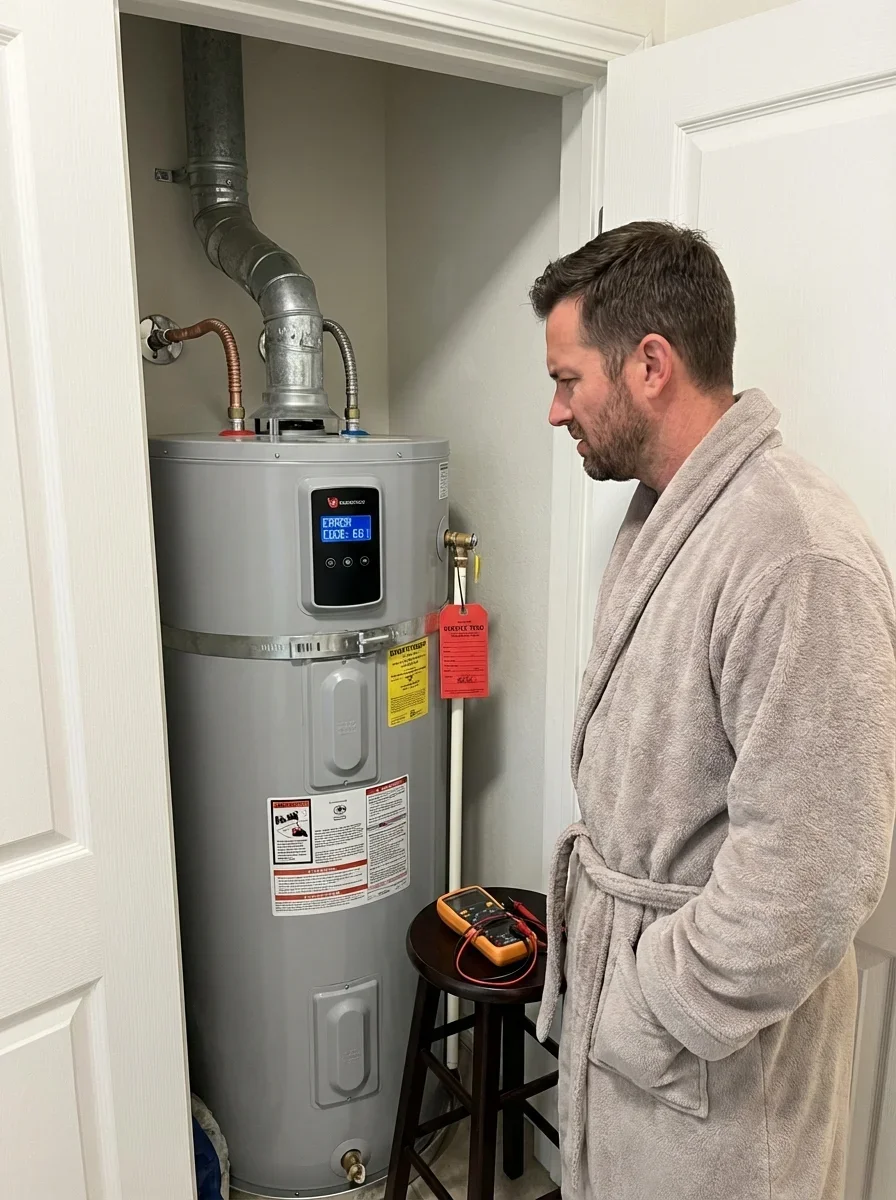
If you get hot water but it only lasts for one shower, or the second person in line gets lukewarm water at best, your tank isn't keeping up with demand.
This usually points to sediment buildup reducing the tank's effective capacity.
Phoenix water carries more dissolved minerals than almost any major metro in the U.S. As water heats, calcium and magnesium precipitate out and sink to the tank bottom, forming a layer of sediment that can grow to 3-6 inches thick over five years. That sediment displaces water volume — a 50-gallon tank with four inches of sediment might only hold 38-40 gallons of usable hot water. Worse, the sediment insulates the water from the heating element or burner, making the unit work harder and longer to reach temperature.
Flushing the tank removes sediment temporarily, but if the buildup is severe, chunks of calcified mineral can clog the drain valve or damage the dip tube (the pipe that carries cold water to the tank bottom). Flushing costs $100-$150 when done during routine maintenance. But if the tank hasn't been flushed in over three years, many Phoenix plumbers recommend skipping it. The sediment is often so compacted that forcing it out can crack the tank liner or dislodge scale that clogs supply lines downstream.
A failing lower heating element (in electric units) also causes hot water to run out fast. The lower element does most of the heating work, and when it fails, only the small upper portion of the tank stays hot.
You'll get 10-15 gallons of hot water, then the temperature drops sharply.
If the dip tube has broken or deteriorated, cold water entering the tank mixes directly with hot water at the top instead of sinking to the bottom where it should be heated. This creates lukewarm water almost immediately. Dip tubes in Phoenix often fail after 8-10 years due to chlorine and mineral exposure. Replacement runs $150-$250, but it requires draining the tank completely. If the tank is old enough to have a failed dip tube, many contractors recommend replacing the entire unit rather than invest in repairs.
Discolored or Rusty Water
When you see brown, yellow, or rust-colored water coming from hot taps only, the tank's anode rod has likely been consumed and the steel tank is now corroding from the inside.
The anode rod is a sacrificial component — a magnesium or aluminum rod suspended in the tank that corrodes preferentially, protecting the steel tank liner from rust. Phoenix's hard water consumes anode rods in 3-5 years, about half the lifespan typical in soft-water regions.
Once the anode is gone, rust forms on the tank walls and flakes into the water supply.
Replacing the anode rod costs $150-$200 and can extend tank life by another 3-5 years, but only if you catch it before rust begins. Once you see discolored water, the tank liner is already compromised. At that stage, anode replacement is often wasted money — the tank will likely start leaking within 12-18 months regardless.
If rusty water comes from both hot and cold taps, the problem is your supply pipes, not the water heater. Copper pipes in pre-2000 Phoenix homes develop pinhole leaks and internal corrosion from hard water exposure, especially in underslab lines that stay hot year-round. That's a repiping issue, not a water heater problem.
Sediment at the bottom of the tank can also cause discolored water when the burner or element stirs it up during heating cycles. The water may look cloudy, tan, or have visible particles floating in it.
Flushing may help temporarily, but recurring sediment discoloration usually means the tank is near end-of-life.
Warning: Once you see rust-colored water from hot taps only, your tank liner is already corroding. Anode rod replacement at this stage rarely prevents a leak — expect tank failure within 12-18 months and plan for replacement accordingly.
Strange Noises (Popping, Rumbling, Banging)
Loud popping, rumbling, or banging sounds from your water heater are almost always caused by sediment buildup on the tank bottom. As water heats beneath the sediment layer, it boils and percolates up through the mineral crust, creating the popping sound.
This noise is more common in Phoenix than nearly anywhere else because our water deposits sediment so aggressively.
The sound itself isn't dangerous, but it indicates the tank is working much harder than it should. The sediment layer insulates the water from the heat source, forcing longer heating cycles and higher energy bills. Tanks that rumble constantly often fail within 1-2 years as the extra stress degrades components.
Flushing the tank can quiet the noise if caught early, but if the popping has been going on for months, the sediment is usually too compacted to flush cleanly. Some homeowners report that flushing an old tank actually made the noise worse, likely because it broke loose chunks of scale that then clanged around inside.
A sharp banging sound when you turn off a hot water tap points to water hammer — pressure shock when water flow stops suddenly. This isn't a water heater problem, but rather an issue with your home's plumbing. Water hammer arrestors ($75-$150 installed per fixture) or a thermal expansion tank ($200-$350) usually solve it.
When Noise Indicates a Pressure Issue
If you hear hissing or a high-pitched whine near the top of the tank, check the temperature and pressure relief (TPR) valve. All water heaters in Phoenix must have an AGA or UL approved pressure relief valve installed on the hot side per city code,[4] and these valves sometimes weep or hiss when they're starting to fail or when tank pressure runs too high.
A faulty TPR valve is a safety issue.
These devices prevent tank explosions by releasing pressure if temperature or PSI exceed safe limits. Replacement costs $125-$200.
Water Leaking from the Tank
Any visible water pooling around the base of your water heater demands immediate attention. Small leaks turn into floods fast, and a catastrophic tank failure can dump 40-50 gallons of water into your home in minutes.
Leaks from the top of the tank usually trace to loose pipe connections, a faulty TPR valve, or a corroded cold water inlet nipple. These are repairable — tightening connections or replacing the valve or nipple runs $100-$200. If water is dripping from around the top fitting threads, you may just need new pipe dope or Teflon tape. Some homeowners successfully tighten loose connections themselves, but if you're unsure about working around a pressurized tank, call a plumber.
Verify their license at roc.az.gov before they arrive.
Leaks from the bottom are almost always terminal. They indicate the tank itself has corroded through, and there's no repair for a rusted-out steel tank. Once the inner liner fails, the leak will only get worse.
You need a full water heater replacement, not a repair.
Water heaters installed in garages or on exterior walls in Phoenix sometimes develop condensation that looks like a leak but isn't. If you see moisture on the outside of the tank but can't identify an active drip, wipe the tank dry and check again in a few hours. Condensation forms when hot tank surfaces meet cooler air during winter mornings, and it evaporates as temperatures rise.
True leaks don't stop. Condensation does.
Phoenix's slab-on-grade construction means most water heaters sit directly on concrete floors. If the tank is leaking, you'll often see water spreading across the slab before you see the source. Check the overflow pan (if installed) and trace water back to its origin. Some modern homes have pan drains piped to the exterior, so a leak may drain outside without obvious interior evidence — until the tank is empty and you're out of hot water.
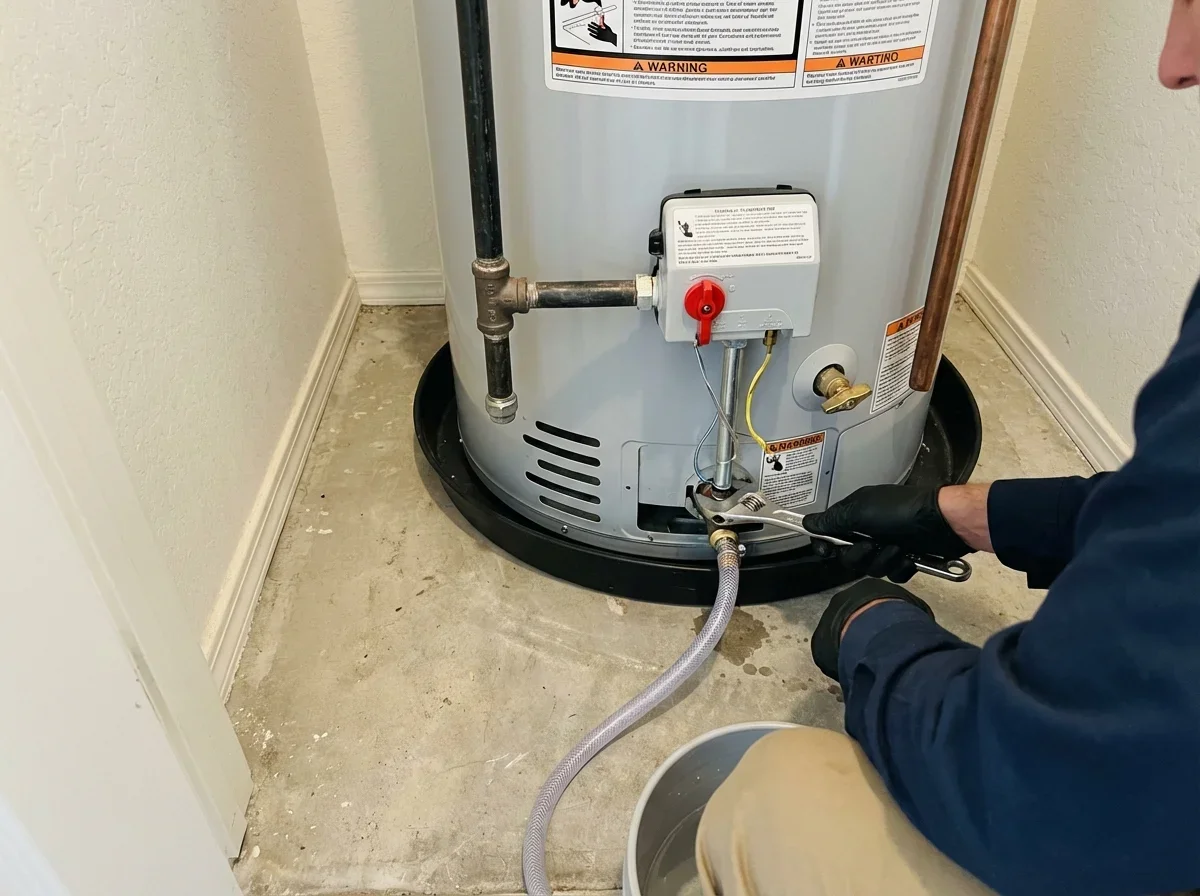
Pilot Light Won't Stay Lit (Gas Water Heaters)
If you light the pilot and it goes out as soon as you release the control knob, the thermocouple has likely failed.
This is one of the most common gas water heater problems in Phoenix, and it's a straightforward fix.
The thermocouple sits in the pilot flame and generates a tiny electrical current when heated. That current signals the gas valve that it's safe to stay open. When the thermocouple wears out or becomes coated in mineral scale, it stops generating sufficient voltage and the gas valve cuts off fuel flow. Thermocouples degrade faster in Phoenix than in humid climates because hard water spray and mineral dust coat the pilot assembly over time.
Replacing a thermocouple costs $100-$175 and takes about 30 minutes. Some experienced homeowners do it themselves — the part costs $15-$25 at hardware stores and installation requires only a wrench and matches. But if you're uncomfortable working with gas appliances, hire a licensed plumber.
Gas work done incorrectly can create carbon monoxide hazards or gas leaks.
If the pilot lights but the burner doesn't kick on when hot water is needed, the problem is usually the gas control valve or the thermostat. Gas valves fail after years of constant cycling, and replacement costs $300-$500. At that price point on a water heater over eight years old, most contractors recommend replacement rather than repair — you're investing $500 in a tank that may fail in other ways within 18 months.
Air in the gas line after a utility shutoff can also prevent the pilot from staying lit. If your gas service was interrupted for any reason, it may take several attempts to purge air from the line and establish a steady pilot. Hold the pilot button down for 60 seconds (not the usual 30) on the first light attempt to give the thermocouple time to heat fully.
Lukewarm Water (Not Hot Enough)
If your water is warm but never gets truly hot, the thermostat is likely set too low, failed, or the upper heating element (on electric models) has burned out.
Phoenix building code and manufacturer guidelines typically recommend setting residential water heater thermostats to 120°F to prevent scalding and minimize energy use.
But if your thermostat is set to 120°F and the water still feels lukewarm, something else is wrong.
Electric water heaters have two thermostats and two elements — one at the top of the tank, one at the bottom. The upper element heats first and hands off to the lower element once the top portion of the tank reaches temperature. If the upper element or thermostat fails, the lower element never gets the signal to heat, and you end up with lukewarm water.
Upper element replacement costs $150-$250.
Sediment buildup also reduces heating efficiency to the point where water never gets fully hot. A tank insulated by 4-6 inches of mineral scale at the bottom may run continuously but never reach setpoint temperature because the heat can't transfer through the sediment layer.
Gas water heaters with lukewarm output often have a failing gas control valve that isn't opening fully or a clogged burner that can't generate enough heat. Natural gas burners in Phoenix accumulate dust and debris faster than in humid regions because our air is dry and carries more particulate. A burner cleaning costs $100-$150, but if the gas control valve is failing, you're looking at $300-$500 for replacement.
If the water was hot last week and is suddenly lukewarm, check your circuit breaker (electric) or gas shutoff valve (gas). A tripped breaker or partially closed gas valve will reduce heating capacity without shutting the unit down completely.
Some homeowners discover that a family member accidentally bumped the thermostat dial, or that a utility worker turned down the gas valve during a service call and forgot to turn it back up.
Oversized or Undersized for Your Household
Sometimes the water isn't hot enough because the tank is too small for your household's demand. A 40-gallon tank might be adequate for two people, but add a third person or install a high-flow showerhead and you'll run out of hot water mid-shower. This isn't a failure — it's a capacity mismatch.
Phoenix homes built in the 1980s and 1990s often have 40-gallon tanks that made sense for the era's low-flow fixtures but can't keep up with modern demands.
Upgrading to a 50-gallon tank or switching to a tankless system solves the problem. See our guide on tankless vs. tank water heaters for capacity planning specific to Phoenix climate and water conditions.
When to Repair vs. Replace Your Water Heater
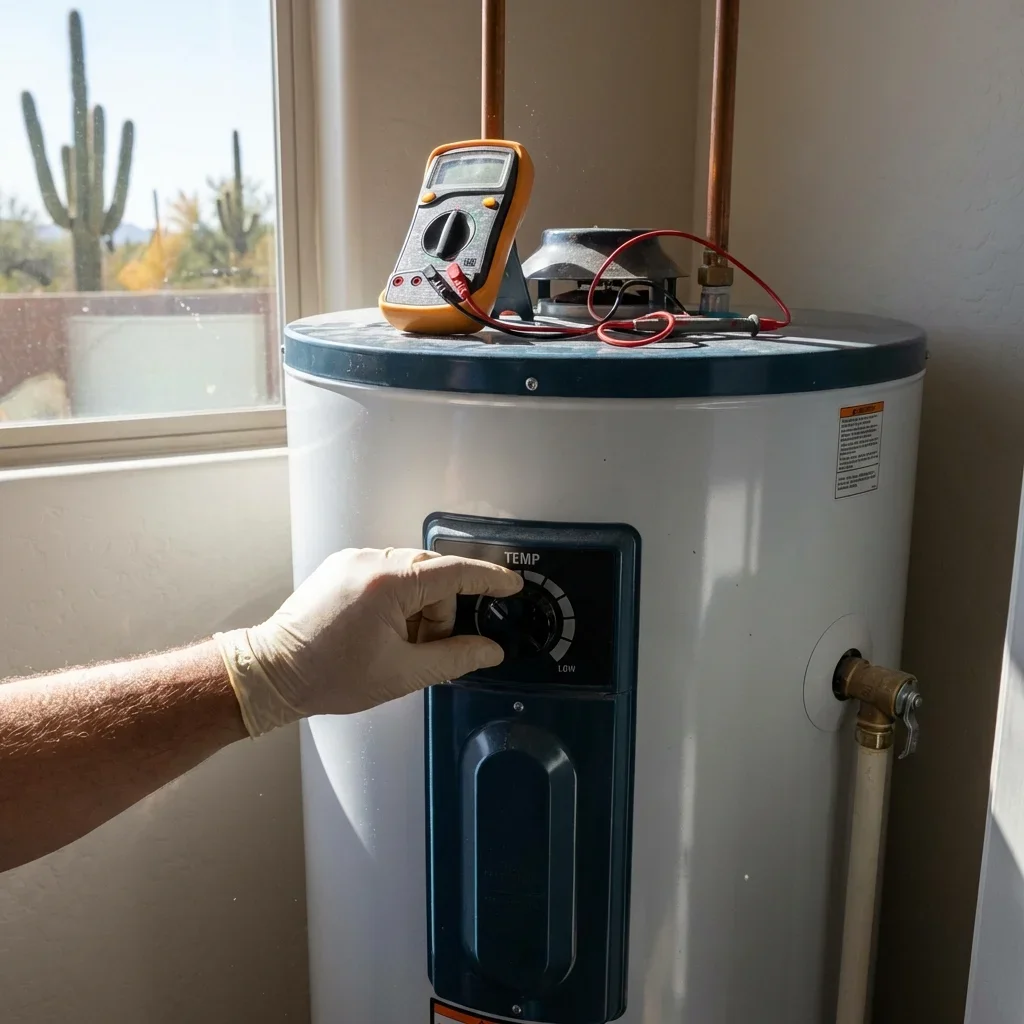
The decision to repair or replace comes down to three factors: the age of the unit, the cost of the repair, and your plans for the home.
Tanks under five years old are usually worth repairing unless the tank itself is leaking. Element replacements, thermocouple swaps, and valve repairs on newer units make financial sense — you're extending the life of a tank that should have another 5-8 years left.
Most manufacturers warranty tanks for 6-12 years depending on the model, so repairs during the warranty period are often partially or fully covered.
Tanks 6-10 years old fall into a gray zone. A $200 repair might buy you 2-3 more years, or the tank might spring a leak six months later and you're out the repair cost plus the replacement cost. Many Phoenix plumbers use this rule: if the repair costs more than 50% of a new tank's installed price, replace instead of repair.
A new 50-gallon tank installed runs $1,200-$1,800 in Phoenix depending on the model, so repairs over $600-$900 tilt the economics toward replacement.
Tanks over 10 years old should usually be replaced rather than repaired, period. A 12-year-old tank with a failed element might be repairable for $200, but the anode rod is consumed, sediment has reduced capacity, the tank liner is degrading, and you're likely months away from another failure. You'll spend $200 now and $1,500 in eight months when the tank starts leaking.
Replace it proactively and avoid the emergency.
Quick Decision Guide: Repair or Replace?
- Under 5 years + minor repair ($150-$250) = Repair
- 6-10 years + repair cost over 50% of new tank = Replace
- Over 10 years + any repair needed = Replace
- Any age + tank leaking from bottom = Replace immediately
- Warranty still active + covered repair = Repair
Phoenix's hard water reduces tank lifespan significantly compared to national averages. A tank rated for 12 years in normal conditions may only last 8-10 years here. If your tank is approaching 10 years old and you're facing any repair over $150, replacement is almost always the smarter financial decision.
Energy efficiency is another consideration. Water heaters manufactured before 2015 use significantly more energy than current models due to updated federal efficiency standards. A new tank can cut your water heating costs by 15-25%, which partially offsets the replacement cost over time. And if you're considering selling your home in the next few years, a new water heater is a selling point — home inspectors flag aging tanks, and buyers often negotiate credits or demand replacement before closing.
Before deciding, get a quote for both repair and replacement from a licensed contractor. Many Phoenix plumbers offer free estimates and will walk you through the cost-benefit analysis specific to your situation.
Verify the contractor's ROC license status at roc.az.gov and confirm they carry general liability insurance.
Phoenix-Specific Water Heater Problems
Beyond the common failures that happen everywhere, Phoenix homeowners deal with issues specific to our climate and water quality.
Thermal expansion causes pressure buildup in closed plumbing systems, and Phoenix building code requires thermal expansion tanks on all new water heater installations since the mid-2000s. When water heats, it expands — and in a closed system (one with a backflow preventer or pressure-reducing valve), that expanded water has nowhere to go except back into the tank, increasing pressure. Over time, high pressure degrades the TPR valve, stresses tank seams, and can cause leaks at pipe joints.
If your home was built or replumbed after 2005, you should have an expansion tank installed near the water heater. If not, adding one costs $200-$350 and prevents a cascade of pressure-related problems.
UV degradation affects water heaters installed in outdoor utility areas or garages with sun exposure. Phoenix's intense UV radiation breaks down plastic components, rubber hoses, and insulation faster than in most climates. Water heaters installed outside (common in older Arizona homes) should have insulated jackets and UV-resistant covers on exposed pipes and valves.
Direct sun exposure can reduce a tank's lifespan by 2-3 years just from heat stress and component degradation.
Calcium buildup in gas burners is more aggressive here than in humid regions. Natural gas burners rely on precise air-to-fuel ratios, and calcium deposits from hard water spray (or from minerals in Phoenix air) can clog burner orifices and reduce heating efficiency. Gas water heaters installed in garages near dryer vents or HVAC returns also accumulate lint and dust that clogs burners.
Annual maintenance cleanings keep burners operating efficiently and prevent incomplete combustion that wastes gas and generates carbon monoxide.
Phoenix's monsoon season (July-September) brings humidity spikes that can cause condensation on cold water supply lines and tank exteriors, leading homeowners to think they have a leak when they don't.
True leaks persist regardless of weather. Condensation appears during humid monsoon mornings and disappears by afternoon as temperatures climb and humidity drops.
What to Do When Your Water Heater Fails
If you wake up to no hot water, here's the fastest path to diagnosis and repair:
- Check the obvious first: circuit breaker for electric units, gas shutoff valve for gas units, thermostat setting
- Look for visible leaks around pipe connections, the TPR valve, and the tank base
- Listen for unusual sounds: popping, rumbling, or hissing
- Test the water temperature at the tap — lukewarm means partial failure, ice cold means total failure
- Note any discoloration in the water, which suggests internal corrosion
If you can't identify an obvious fix (tripped breaker, extinguished pilot), call a licensed plumber.
Water heater failures usually don't resolve on their own, and waiting often makes the problem worse. A failed element that keeps tripping the breaker can damage your electrical panel. A leaking tank that goes unnoticed overnight can flood your garage or utility room.
For true emergencies — water pouring from the tank, gas smell near the heater, electrical sparking — shut off the water supply and power/gas to the unit immediately and call an emergency plumber. Phoenix emergency plumbing rates run $150-$250 for the service call plus hourly labor, but preventing flood damage or a gas leak is worth the premium.
Most non-emergency water heater repairs in Phoenix cost $150-$500 depending on the component. Element replacements, thermocouple swaps, and valve repairs fall on the lower end. Gas control valve replacements and combination repairs run higher.
Full replacements cost $1,200-$2,500 installed depending on tank size and type.
If your water heater is over eight years old and you're facing a repair, get replacement quotes at the same time. Many Phoenix plumbing companies bundle water heater inspections with other service calls — if you're already paying for a plumber to come out for drain cleaning or leak detection, ask them to check your water heater's age and condition while they're there.
Catching problems early often means you can plan replacement on your timeline rather than dealing with an emergency when the tank fails at the worst possible moment.
- Industrial Commission of Arizona. "ADOSH - Boiler Safety Section." https://www.azica.gov/adosh-boiler-safety-section. Accessed April 07, 2026.
- Arizona Administrative Code, Industrial Commission of Arizona. "Ariz. Admin. Code § R20-5-430 - Forced Circulation Lined Hot Water Heaters." https://www.law.cornell.edu/regulations/arizona/Ariz-Admin-Code-SS-R20-5-430. Accessed April 07, 2026.
- Arizona Administrative Code, Industrial Commission of Arizona. "Section R20-5-417 - Maintenance and Operation of Boilers, Lined Hot Water Heaters." https://regulations.justia.com/states/arizona/title-20/chapter-5/article-4/r20-5-417/. Accessed April 07, 2026.
- City of Phoenix. "Water Heater Information." https://www.phoenix.gov/administration/departments/housing/section-8-housing/section-8-inspections/water-heater-information.html. Accessed April 07, 2026.
- Industrial Commission of Arizona, Division of Occupational Safety and Health. "Arizona Boiler Rules Applying to boilers, water heaters and pressure vessels." https://www.azica.gov/sites/default/files/ADOSH_Rules_Boilers_2009_rev2.pdf. Accessed April 07, 2026.