What Are Four Signs That Your Sewer Line Is Broken?
If you're dealing with more than one of these symptoms at the same time, your sewer line isn't just damaged — it's actively failing. Phoenix-specific conditions make these warning signs show up differently than they would in other markets, so you need to know what you're looking at.
Multiple drains backing up simultaneously is the clearest signal. When your kitchen sink gurgles while the shower drains, or your toilet bubbles when you run the washing machine, you're not dealing with isolated clogs. You're seeing the downstream effect of a blockage or break in your main sewer line. In Phoenix homes built on slab-on-grade foundations (nearly all of them), this means the problem is buried under concrete or caliche hardpan.
Not something you can snake away with a hardware store auger.
Sewage odor inside your home or yard means waste isn't making it to the city main. It's escaping through cracks, joint separations, or complete pipe failures. Phoenix's caliche soil doesn't absorb sewage like looser soils would. Instead, it pools near the break point, which is why you'll often smell it before you see standing water.
If the odor is coming from floor drains or cleanouts, the line is likely obstructed. If it's wafting up from your yard, you've got an active leak.
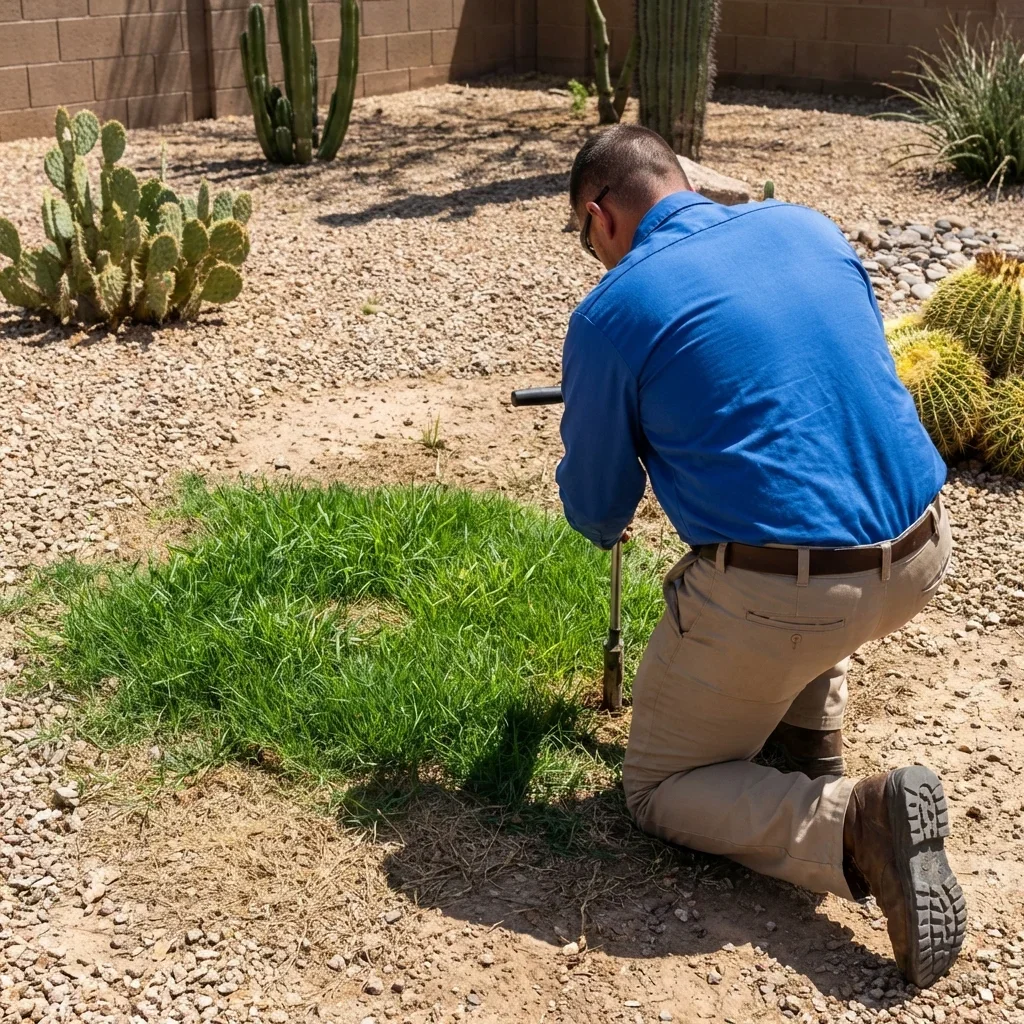
Soggy patches or unnaturally lush grass in your yard — especially during Phoenix's dry months when nothing should be green without irrigation — indicate sewage is leaking underground and fertilizing the soil. This is most obvious in May and June before monsoon season, when irrigation schedules are predictable and any unexplained moisture stands out. Mesquite and palo verde trees will send roots straight toward that moisture source, worsening the damage within weeks.
Foundation cracks, settling, or sinkholes developing near your sewer line path signal soil erosion from a sustained leak. Phoenix's clay-rich caliche expands and contracts with moisture changes, but when sewage continuously saturates the soil, it washes away support under your slab.
Homeowners in neighborhoods like Tempe and Mesa have reported foundation repairs costing $15,000–$30,000 after undetected sewer leaks undermined their slabs for months.
Critical Warning Signs Checklist:
- Multiple drains backing up or gurgling simultaneously
- Sewage odor inside home or in yard (especially during dry months)
- Unexplained wet spots or overly green grass patches
- Foundation cracks or settling near sewer line route
- Frequent drain clogs requiring professional service
- Pest activity near bathroom fixtures or floor drains
| Sign Type | Phoenix-Specific Factor | Urgency Level |
|---|---|---|
| Multiple slow drains | Caliche soil shifts during monsoon season worsen existing blockages | High - Schedule inspection within 1 week |
| Sewage odors in yard | Low-porosity caliche concentrates gas plumes instead of dispersing | High - Indicates active leak |
| Soggy yard patches | Most obvious May-June when irrigation is minimal | Medium - Monitor and test within 2 weeks |
| Foundation cracks | Caliche loses structure when saturated, washing away quickly | Critical - Immediate inspection required |
Slow Drains Across Multiple Fixtures
A single slow drain is a localized clog. Multiple slow drains throughout your house point to a main sewer line obstruction.
This is the symptom homeowners most often ignore until it becomes a full backup, and it's the one that shows up earliest in Phoenix's aging housing stock.
When your 1980s-era cast iron sewer line corrodes, the rough interior surface catches everything from toilet paper to cooking grease. The City of Phoenix requires a 2% minimum slope for sewer laterals under IRC Section P3005.2 — that's 2 feet of drop per 100 feet of run.[1] But caliche soil shifts and settles over decades, creating belly sags where waste pools instead of flowing. These low spots accumulate debris until the pipe is 70–80% blocked, at which point your bathtub takes five minutes to drain instead of 30 seconds.
The giveaway is how the slowness spreads. First it's the shower. Then the bathroom sink. Then the kitchen.
Homeowners who've dealt with this describe it as watching a slow-motion disaster unfold, where each week a new fixture joins the problem. That progression tells you the blockage is moving upstream toward the house as material accumulates.
Phoenix's monsoon season makes this worse. July through September brings rapid soil saturation and ground shift. If your sewer line already has root intrusion or micro-cracks, that ground movement can turn a partial obstruction into a complete blockage in days. This is why August and September see the highest volume of emergency sewer calls in the metro.
Lines that were "managing" suddenly fail under monsoon stress.
What a Sewer Camera Inspection Actually Shows
When you call a plumber about slow drains and they recommend a camera inspection, they're not upselling you. They're trying to see what's happening inside the pipe before they start cutting into your slab or excavating your yard.
A sewer camera inspection typically runs $150–$300 in Phoenix and takes 30–45 minutes.[3]
The camera feeds through a cleanout access point and travels the length of your sewer lateral, recording video as it goes. You'll see exactly where the pipe is damaged, what's causing the obstruction (roots, scale buildup, collapsed sections), and what material the line is made from. For Phoenix homes built before 1980, it's usually cast iron. Between 1980 and 2000, you'll find early ABS or copper drains. Post-2000 construction uses Schedule 40 PVC, which holds up better against our hard water and soil conditions.
A Phoenix plumber who's serious about the diagnosis will provide you with a digital recording of the inspection on a USB drive. This isn't just customer service. It's a timestamp record for insurance claims and future home sale disclosures.
Arizona ROC-licensed contractors performing sewer work over $1,000 are required to hold an R-37 (residential), C-37 (commercial), or CR-37 (dual) plumbing license, verifiable at roc.az.gov/contractor-search.[3] Make sure your inspector is licensed before they run that camera.
Gurgling Toilets and Drains
Gurgling sounds from your toilet when you run the shower aren't charming old-house quirks. They're air displacement warnings that tell you your sewer line is partially blocked and struggling to vent properly.
Phoenix plumbing systems are designed with vent stacks that allow sewer gases to escape through your roof, maintaining neutral air pressure in the drain lines. When a clog or break disrupts that system, air gets pushed back up through the nearest drain. Usually the toilet, since it has the largest and most direct connection to the main line.
If you hear gurgling from multiple fixtures at once, the obstruction is downstream of all of them, which means it's in your main sewer lateral between the house and the city connection point. In Phoenix, that lateral can be anywhere from 30 to 100 feet long depending on your lot layout and where the city main runs.
The farther the problem is from your house, the more expensive the repair.
The gurgling gets worse when you use high-volume fixtures. Flushing the toilet might trigger gurgling in the bathtub. Running the washing machine might cause the kitchen sink to bubble. That cross-fixture reaction tells you the entire system is backing up against an obstruction.
Homeowners who've lived through this describe it as feeling like the house's plumbing is fighting itself. Because it is.
Sewage Backup in Tubs, Showers, or Floor Drains
This is the nightmare scenario. Sewage backing up into your bathtub or shower means your main sewer line is completely blocked or broken. Waste has nowhere to go except back into your house, and it will take the path of least resistance.
Usually the lowest drain.
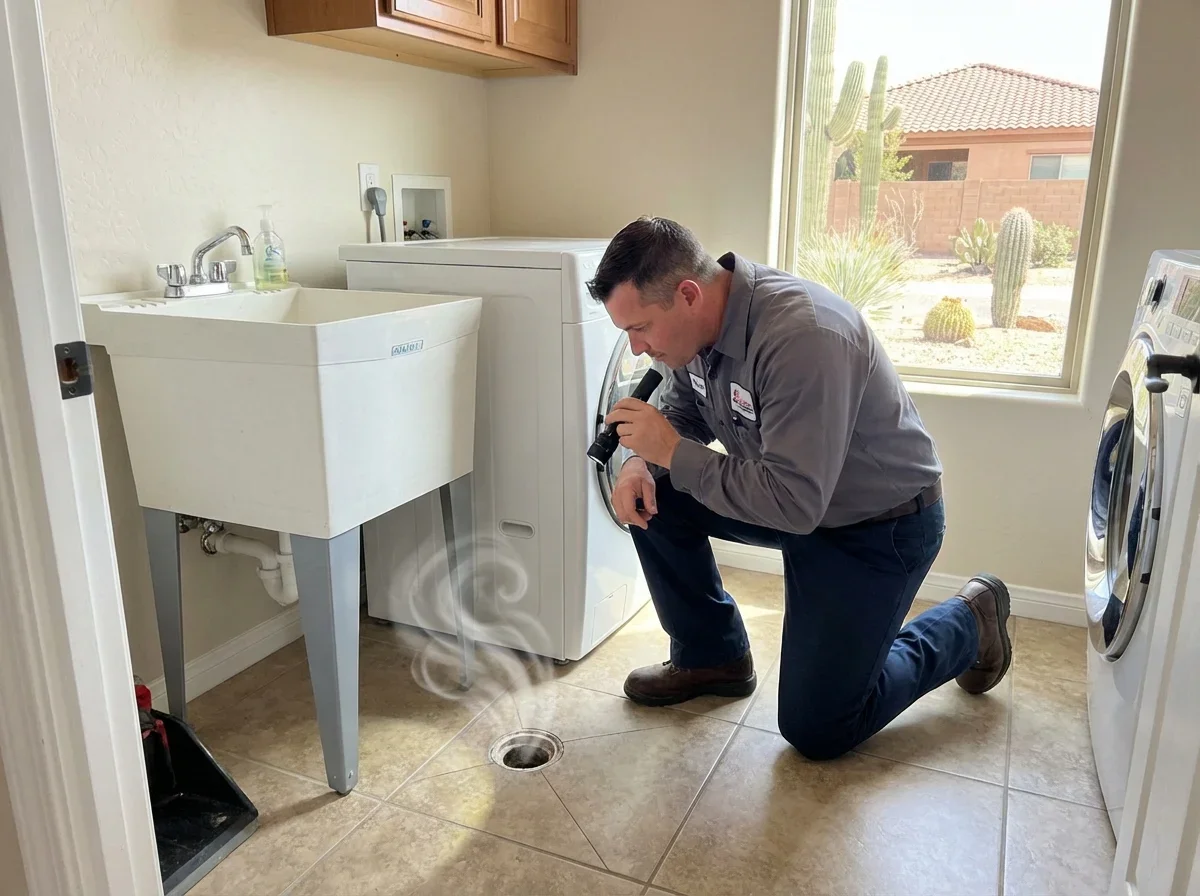
In slab-on-grade homes (standard throughout Phoenix), the lowest drains are typically floor drains in laundry rooms or showers. If you see standing water or sewage in these locations and you haven't used those fixtures recently, your main line is blocked. The backing up happens because wastewater from other parts of the house is being forced backward through the plumbing tree.
The health risks are immediate. Raw sewage contains E. coli, salmonella, hepatitis A, and other pathogens that spread through contact with contaminated surfaces. If sewage overflows in your home, you're dealing with a Category 3 water damage event — the most severe classification, requiring professional remediation.
Homeowners insurance may cover the damage restoration, but coverage for the actual sewer line repair varies wildly by policy. Most standard policies in Arizona exclude damage to underground pipes unless you've added a sewer line endorsement.
Phoenix's building code requires that all sewer line repairs or replacements include a plumbing permit, searchable at phoenix.gov/pdd.[1] Unpermitted work discovered during a home sale can delay closing and force you to tear out and redo the repair under inspection.
If a contractor offers to skip the permit to save time or money, walk away.
What Causes Sewer Line Failure in Phoenix Homes
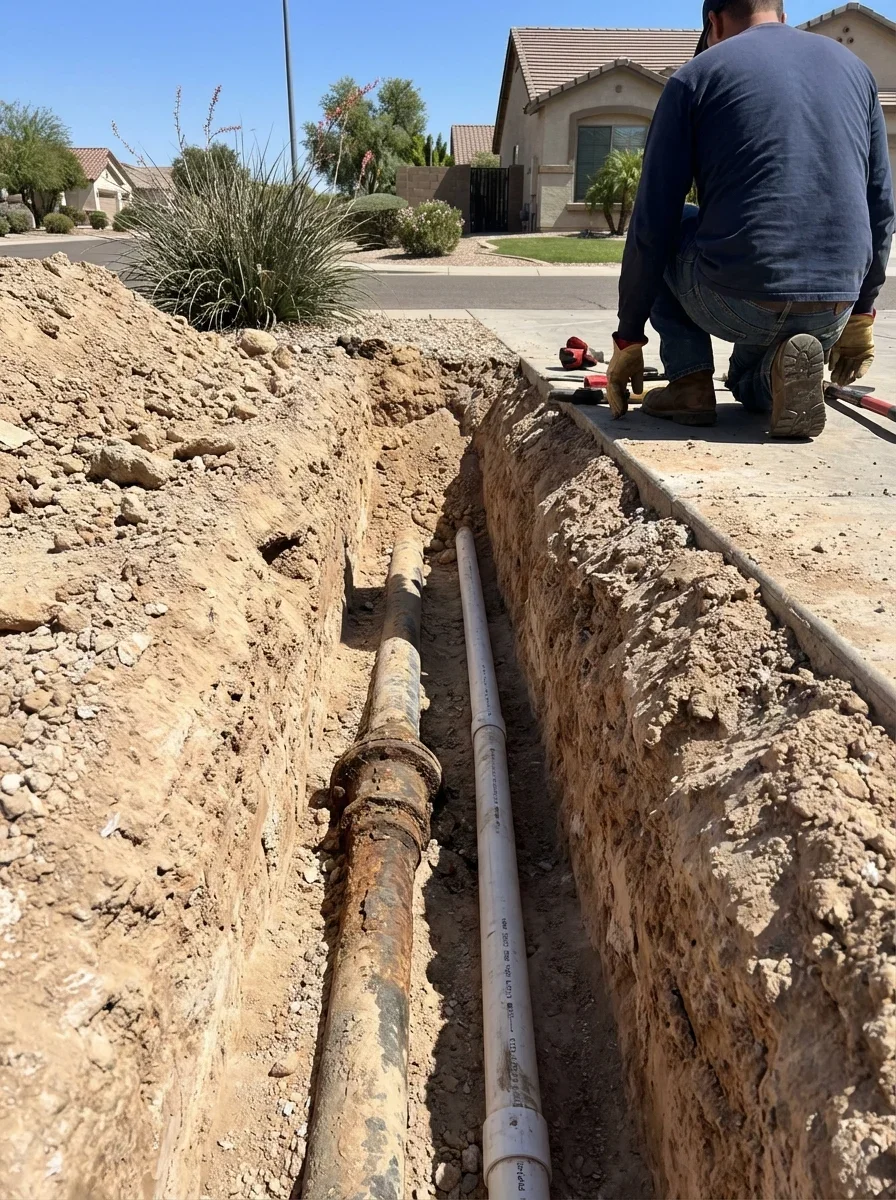
Phoenix's soil and climate create a perfect storm for sewer line deterioration. The caliche hardpan layer — a calcium carbonate-cemented soil deposit found 1–6 feet below the surface across the metro — shifts and settles as it alternates between bone-dry summers and saturated monsoon seasons. That movement puts shear stress on rigid pipes, causing joint separation in cast iron and early PVC systems that weren't designed with flexible couplings.
Hard water at 300+ ppm calcium carbonate accelerates corrosion inside cast iron and galvanized steel drain lines. Over 30–40 years, the pipe walls thin from the inside out, developing pinhole leaks and eventually collapsing entirely.
Neighborhoods built in the 1960s through early 1980s — including central Phoenix, Scottsdale, and Tempe — are seeing widespread cast iron sewer failures as those lines hit their 40–60 year service life.
Root intrusion is the other major culprit. Palo verde, mesquite, and Chinese elm trees are moisture-seeking species that will send feeder roots into any crack or joint separation they detect. Once inside the pipe, roots expand rapidly, creating a net that catches toilet paper and waste until the line is completely blocked.
Homeowners often discover this during a sewer camera inspection that shows thick root masses 15–20 feet from the house. Right where the irrigation zone keeps the soil moist.
Pro Tip: Homes built in the 1960s–1980s with mature palo verde or mesquite trees within 25 feet of the sewer line should schedule preventive camera inspections every 3–5 years. Root intrusion doesn't happen overnight — catching it early can mean a $800 hydro-jetting service instead of a $12,000 pipe replacement.
Foul Odors Coming from Drains or Yard
Sewer gas smells like rotten eggs mixed with ammonia. If you're catching that odor inside your home — especially near floor drains, toilets, or cleanouts — you've got either a dry trap or a venting problem.
But if the smell is coming from your yard, you've got an active sewer line leak.
Healthy sewer lines are sealed systems. Waste flows to the city main, and gases vent through roof stacks. When a pipe cracks or a joint separates, those gases escape underground and work their way to the surface. In Phoenix's caliche soil, which has low porosity, the gas doesn't disperse the way it would in sandy or loamy soils. It concentrates near the break point, creating a detectable odor plume.
The smell is strongest in the early morning or late evening when the air is still and cooler. During the heat of the day, thermal currents can disperse the gas enough that you won't notice it.
Homeowners often describe realizing something was wrong when they stepped outside with their morning coffee and got hit with a wave of sewage smell that wasn't there the night before.
If you're smelling sewer gas inside the house and you've checked that all your sink and floor drain traps have water in them (running water for 30 seconds refills a dry trap), the problem is likely a cracked vent stack or a failed wax ring on a toilet. Those are relatively minor fixes. But if the odor is persistent and localized to one area of your yard, you're looking at a sewer line leak that needs immediate attention.
Will My Homeowners Insurance Cover a Broken Sewer Line?
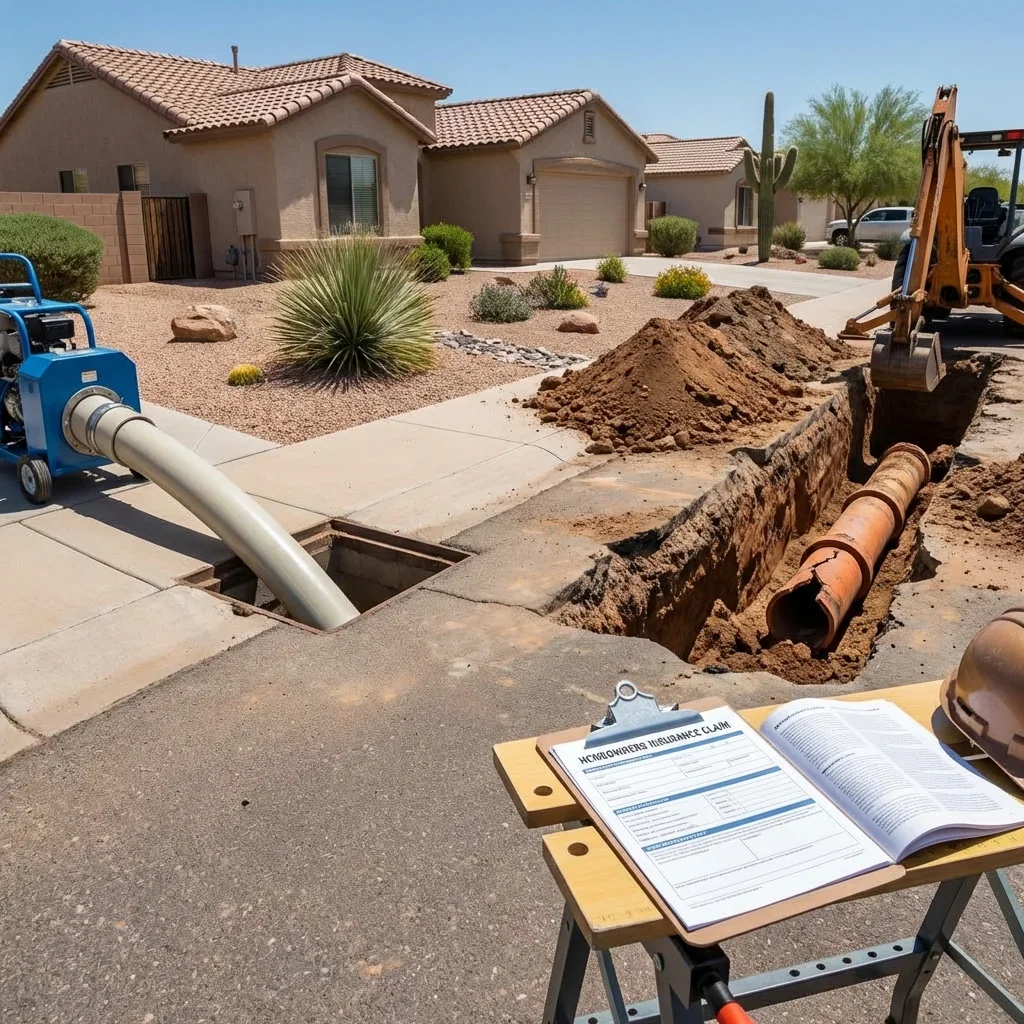
Standard homeowners insurance in Arizona typically excludes damage to underground pipes unless the failure was caused by a covered peril like a tree falling on the line or a vehicle collision. Gradual deterioration from age, corrosion, or root intrusion — the most common causes of sewer line failure in Phoenix — usually isn't covered.
However, if a sewer line failure causes secondary damage to your home (sewage backup flooding your house, foundation damage from soil erosion), that damage may be covered under your dwelling or personal property provisions.
The key is proving the damage was sudden and accidental, not the result of deferred maintenance.
Some insurers in Arizona offer optional sewer line endorsements or equipment breakdown coverage that extends protection to underground utility lines. These endorsements typically add $50–$150 per year to your premium and may cover up to $10,000–$25,000 in repair costs, minus your deductible. Third-party sewer line warranty plans are also available, with monthly premiums ranging from $8–$15 and coverage limits from $5,000–$10,000.
Before you file a claim, check your policy's sub-limit for water damage. Some Arizona policies cap water damage claims at $5,000 or $10,000, which may not cover both the sewer line repair and the interior restoration.
If your sewer line fails and you're facing a $20,000 repair bill, a $5,000 insurance payout may feel like a cruel joke.
Wet Spots or Standing Water in Your Yard
Soggy grass or pooling water in your yard when you haven't run irrigation is a red flag for an underground leak. In Phoenix, where irrigation schedules are carefully managed to avoid water waste, any unexplained moisture stands out immediately. If the wet spot is near your sewer line route (typically running from the house toward the front or side property line where the city main is located), you're likely looking at a sewer leak.
Sewage-contaminated water creates a different kind of wet spot than irrigation or supply line leaks. The grass in the affected area will often be darker green and more lush than surrounding turf because the nitrogen and phosphorus in sewage act as fertilizer.
You might also notice a slight depression or softness in the soil as the leak erodes the ground underneath.
The location of the wet spot can tell you where the break is. If it's close to the house (within 10–15 feet of the foundation), the damage is likely in the cleanout area or the initial run of pipe exiting the building. If it's farther out toward the street or alley, you're dealing with a failure in the mid-to-outer section of your lateral.
Phoenix's caliche soil makes this especially problematic because excavation costs spike dramatically once you're digging through hardpan.
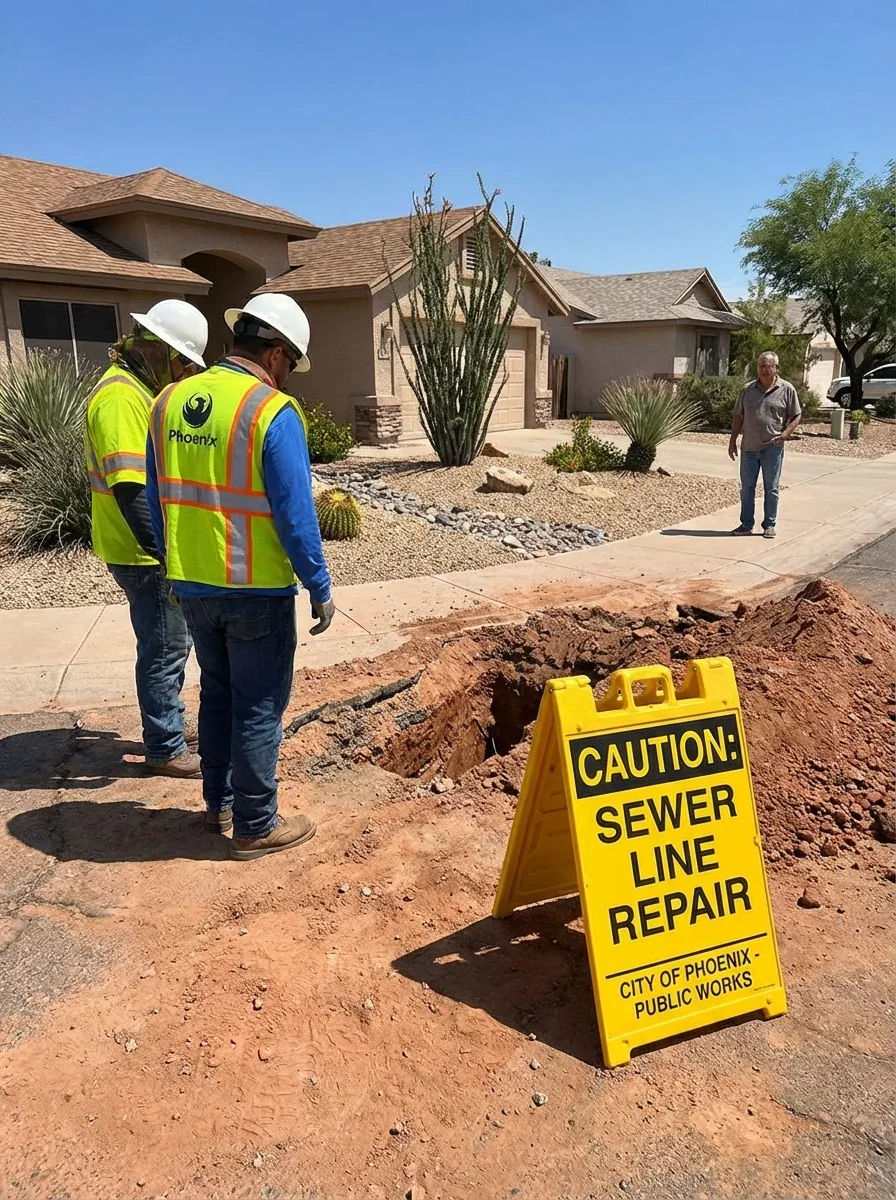
Traditional open-trench sewer repair in Phoenix costs $180–$250 per linear foot when you're cutting through caliche, compared to $80–$120 per foot in soft-soil markets.[4] For a typical 60-foot lateral replacement, you're looking at $10,800–$15,000 for open-trench work versus $8,000–$12,000 for trenchless pipe bursting. The trenchless option also spares your landscaping and hardscaping from destruction.
Compare your repair options to see which approach makes sense for your property.
Pest Intrusions Through Cracks or Openings
Scorpions, roaches, and rodents don't need much space to get inside your house. A cracked sewer line gives them a direct pathway from underground right into your plumbing system.
If you're seeing an uptick in pest activity near floor drains, toilets, or bathroom fixtures — especially if you've recently had pest control treatments that should be keeping them out — check your sewer line.
Rats and mice can squeeze through openings as small as a quarter inch. A separated pipe joint or root-damaged section of sewer line is an open invitation. They'll travel up through the plumbing and emerge from toilets, shower drains, or cleanouts. Phoenix homeowners dealing with this describe the horror of flushing a toilet at 2 a.m. and watching a rat scramble out of the bowl.
Scorpions are even more insidious. Arizona bark scorpions can flatten their bodies to fit through cracks as narrow as 1/16 inch. A sewer line with joint separation or stress cracks becomes a scorpion highway. They'll follow the moisture gradient (scorpions are attracted to water sources) and end up inside your home's plumbing voids, where they can access living spaces through pipe penetrations in walls and floors.
If pest control companies keep treating your house but you're still seeing critters, especially in bathrooms and laundry areas, ask your plumber to run a sewer camera inspection.
You might be dealing with an infestation source they can't solve with bait stations and sprays.
Foundation Cracks or Sinkholes Near the Sewer Line
Phoenix's slab-on-grade construction means your foundation sits directly on the soil, with plumbing lines running underneath or through the concrete. When a sewer line leaks for an extended period, it washes away soil and creates voids under your slab.
As the support disappears, the concrete settles and cracks.
You'll see this as hairline cracks in floors or walls that widen over time, doors and windows that suddenly stick or won't latch, or visible settling where one section of the floor is noticeably lower than adjacent areas. In severe cases, sinkholes develop in the yard directly above the leak point. These aren't the dramatic, car-swallowing sinkholes you see on the news. They're shallow depressions 1–3 feet across and 6–18 inches deep, but they signal serious soil erosion underneath.
Caliche soil is particularly susceptible to this because once the calcium carbonate cement dissolves from prolonged moisture exposure, the soil loses its structural integrity. It turns from a rock-hard layer into a slurry that washes away with the leaking sewage.
Homeowners in Tempe and Mesa have reported foundation repair bills exceeding $20,000 after sewer leaks undermined their slabs for months without detection.
If you see foundation damage appearing alongside other sewer line symptoms (slow drains, odors, wet spots), don't wait for a structural engineer to confirm the obvious.
Get a sewer camera inspection immediately. Catching the leak early can save you tens of thousands in foundation repair costs.
What to Expect During a Sewer Camera Inspection
A licensed Phoenix plumber will start by locating your sewer cleanout — a capped access point usually found in the front or side yard, or sometimes inside the garage or a bathroom. They'll remove the cap and feed a flexible cable with a high-resolution camera and LED lights into the pipe. The camera transmits real-time video to a monitor, letting the plumber (and you) see exactly what's happening inside the line.
As the camera travels through the pipe, the plumber will narrate what they're seeing: root intrusion at 18 feet, scale buildup reducing the pipe to 60% capacity, a belly sag at 32 feet collecting debris, or a complete collapse at 45 feet.
Modern camera systems include a locator transmitter that allows the plumber to mark the exact spot on the surface above where damage is occurring. This precision is critical if you end up needing excavation.
It means they'll dig in the right spot on the first try.
The inspection typically covers the entire length of your lateral from the cleanout to the city connection point, unless the pipe is too damaged for the camera to pass through. Total time is 30–45 minutes. You'll receive a digital recording of the inspection, which you should keep for your records. If you're selling the house within the next few years, that recording is valuable disclosure documentation.
For Phoenix homes built before 1990, camera inspections often reveal Orangeburg pipe (tar-impregnated fiber conduit used from the 1940s through 1970s) or clay tile joints that have separated over time.
Both materials are obsolete and should be replaced, not repaired. If the camera shows any of these materials in your sewer lateral, budget for full replacement rather than patching.
High Water Bills Without Increased Usage
A sewer line leak usually won't spike your water bill the way a supply line leak does because sewer lines carry waste away from your house. They're not pressurized and they're not drawing water from your meter. But if you're seeing a gradual increase in water usage that doesn't match your actual consumption, check for slab leaks in your supply lines first, then investigate the sewer lateral.
Here's why this gets confusing: many Phoenix homes have both supply line leaks and sewer line problems simultaneously. A slab leak in your hot water line might explain the water bill increase, while a separate sewer line failure explains the slow drains and yard odors.
They're not related mechanically, but they're both products of the same aging infrastructure. Homes built in the 1980s are now 40+ years old, and all the original plumbing is hitting end-of-service-life at once.
If your water bill has jumped 20–30% without a corresponding increase in use (no new landscaping, no houseguests, no seasonal changes that would explain it), call a plumber for a leak detection service. They'll use electronic listening equipment and thermal imaging to pinpoint supply line leaks under your slab, then follow up with a sewer camera to check the drain system if other symptoms are present.
Frequent Clogs Requiring Professional Snaking
If you're calling a plumber every 3–6 months to snake your drains, you're treating the symptom instead of diagnosing the cause.
Chronic clogs signal an underlying sewer line problem — usually root intrusion, pipe corrosion creating rough interior surfaces that catch debris, or belly sags that prevent proper drainage.
A drain snake clears the immediate blockage, but it doesn't fix the structural issue. Roots grow back within weeks. Belly sags continue to collect waste. Corroded pipe interiors keep snagging toilet paper and grease. Homeowners describe this as a $150–$250 quarterly tax on a failing sewer line, where each snaking buys them another few months before the next clog.
The smarter approach is hydro jetting followed by a camera inspection. Hydro jetting uses high-pressure water (3,000–4,000 psi) to scour the pipe interior clean, removing scale, grease, and root masses. Once the line is clear, the camera shows you what's left: the actual pipe condition underneath the buildup.
If you see heavy corrosion, cracks, or root penetration points, you're looking at repair or replacement. Not another round of snaking.
Phoenix plumbers who specialize in sewer work will tell you upfront whether snaking is a viable solution or just a temporary band-aid. If they're recommending camera and jetting on the first visit, they're trying to save you money long-term by solving the root cause instead of milking you for repeat service calls.
Trees or Landscaping Growing Unusually Fast in One Spot
That one patch of yard where the grass is always greener, the tree seems to grow twice as fast as others, or the shrubs stay lush without extra water?
It's probably fertilized by a sewer line leak.
Sewage is rich in nitrogen, phosphorus, and potassium — the same nutrients in commercial fertilizers — and plants will thrive when they have access to it.
This is especially noticeable in Phoenix during May and June, when irrigation schedules are reduced and most landscaping starts to stress from heat. If one area of your yard stays vibrant and green while everything else fades, you've got an underground water or sewage source feeding it. The smell test usually confirms which one you're dealing with.
Palo verde and mesquite trees are notorious for seeking out sewer line moisture. Their root systems can extend 30–50 feet from the trunk, and they'll send feeder roots into any crack or joint separation they detect. Once inside the pipe, those roots grow into thick mats that block flow and accelerate pipe failure.
Homeowners who've dealt with this report camera inspections showing root masses the diameter of a basketball completely filling the pipe.
If you have mature trees near your sewer line route — especially palo verde, mesquite, or eucalyptus — and you're seeing any of the other warning signs on this list, roots are likely involved. The fix isn't just cutting the roots out with a hydro jetter or mechanical cutter. You need to replace the damaged section of pipe with root-resistant materials and consider root barriers or tree removal if the species is too aggressive.
Strange Noises from the Plumbing System
Banging, clanking, or whistling sounds from your drains aren't normal. These noises usually indicate air pressure problems in your sewer system, which can be caused by partial blockages, vent stack issues, or pipe damage that's allowing air to enter the line where it shouldn't.
The most common sound is a loud glug-glug-glug when you drain a sink or flush a toilet.
That's air being pulled through the trap as the drain struggles to maintain proper flow. It means there's negative pressure in the line — either because a clog is creating a vacuum effect or because a vent stack is blocked and can't equalize pressure.
Banging or hammering sounds when you flush a toilet or turn off a faucet (water hammer) are technically supply line issues, not sewer line problems. But if you're hearing both types of noises and experiencing other symptoms, you're dealing with plumbing system-wide failure.
Everything installed in the 1980s is aging out at once.
If the noises are coming from under your slab or from walls where drain lines run, that's a stronger indicator of sewer line trouble. Phoenix's slab-on-grade construction means all your drain lines are either buried in the concrete or running through interior walls before exiting to the exterior lateral. Noises from those locations mean something inside the pipe is loose, broken, or allowing air to move where it shouldn't.
What to Do When You Spot Warning Signs
Don't wait for a complete failure. The difference between a $3,000 repair and a $25,000 disaster is often measured in weeks.
As soon as you notice multiple symptoms — especially slow drains, odors, and wet spots appearing together — schedule a sewer camera inspection.
Choose an Arizona ROC-licensed plumber with an active R-37, C-37, or CR-37 license (verify at roc.az.gov/contractor-search). Make sure they pull a City of Phoenix plumbing permit for any work over $1,000, and ask for the permit number for your records.[1] Unpermitted work can come back to bite you during a home sale or insurance claim.
If the camera inspection confirms damage, get at least three written estimates that specify the repair method (traditional excavation vs. trenchless), materials (Schedule 40 PVC is current code standard), and timeline. Phoenix's caliche soil makes traditional trenching expensive — factor in $180–$250 per linear foot if you're going that route.[4]
Trenchless methods (pipe bursting or CIPP lining) cost $100–$200 per foot but save your landscaping and complete the job in 1–2 days instead of a week.
Ask for references from jobs in your neighborhood. Soil conditions and city code requirements vary across the Phoenix metro, and a plumber who's worked in your area will know the specific permitting and inspection requirements for your jurisdiction. They'll also have relationships with inspectors, which can speed up the approval process.
Document everything. Take photos of wet spots, foundation cracks, or visible damage. Keep copies of your camera inspection video, estimates, permits, and invoices. If your insurance covers any portion of the repair, this documentation is essential for your claim.
And if you sell the home in the future, being able to show a permitted, licensed repair with full documentation will protect you from disclosure liability.
Frequently Asked Questions
- City of Phoenix Water Services Department. "Design Standards Manual for Water and Wastewater Systems 2021." https://www.phoenix.gov/content/dam/phoenix/waterservicessite/documents/2021_dsm-final_101421.pdf. Accessed April 07, 2026.
- City of Phoenix. "Water/Sewer Policies." https://www.phoenix.gov/administration/departments/waterservices/development-infrastructure/watersewer-policies.html. Accessed April 07, 2026.
- Arizona Department of Environmental Quality. "Ariz. Admin. Code § R18-9-E301 - 4.01 General Permit: Sewage Collection Systems." https://www.law.cornell.edu/regulations/arizona/Ariz-Admin-Code-SS-R18-9-E301. Accessed April 07, 2026.
- Arizona City Sanitary District. "Minimum Design Standards." https://acsd-az.gov/wp-content/uploads/2021/12/COMPLETE-Minimum-Design-Standards.pdf. Accessed April 07, 2026.