How Phoenix's Water Became This Hard
The Valley's water comes primarily from the Colorado River, Salt River, and Verde River systems — all flowing through mineral-rich desert geology for hundreds of miles before reaching Phoenix taps. As water percolates through limestone, gypsum, and caliche layers, it dissolves calcium and magnesium ions. By the time it reaches the city's treatment facilities, those dissolved minerals are locked in.
Phoenix Water Services treats for safety and taste, but doesn't soften the supply. That's a conscious infrastructure decision: adding sodium or using reverse osmosis at the municipal scale would cost hundreds of millions and create environmental disposal challenges.
So the burden of managing hardness falls to individual property owners.
The 300+ PPM Threshold
Water hardness above 180 ppm qualifies as "hard" by industry standards. Phoenix regularly exceeds 300 ppm. That concentration means you're depositing roughly a pound of mineral scale for every 1,000 gallons of water that passes through your system. The average Phoenix household uses 7,000-9,000 gallons monthly during summer when irrigation and cooling demands peak.
The minerals themselves aren't health hazards. Calcium and magnesium occur naturally and pose no drinking water risk.
The damage they cause is purely mechanical: they coat, constrict, corrode, and eventually rupture the infrastructure designed to deliver them.
What Hard Water Actually Does to Copper Pipes
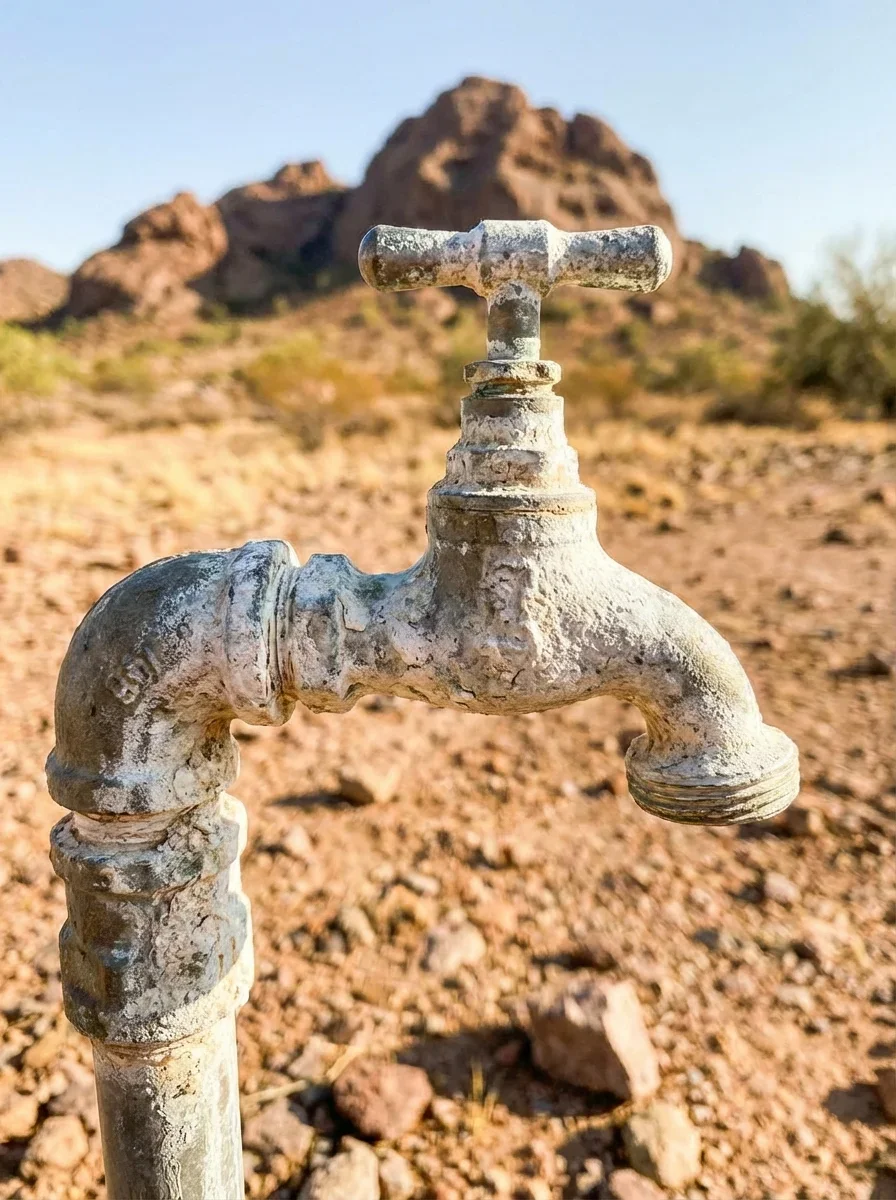
Pre-2000 Phoenix homes almost universally used Type L or Type M copper for supply lines. Copper made sense in desert construction — it handles heat, resists UV when exposed, and doesn't degrade in caliche soil. But copper and hard water create a chemical relationship that accelerates failure.
Hard water deposits a protective scale layer initially, which can actually slow corrosion. The problem starts when that scale becomes uneven. Water chemistry fluctuations, temperature changes, and flow turbulence create thin spots in the scale coating. Exposed copper beneath those thin spots becomes anodic relative to scale-protected areas nearby, creating localized galvanic cells.
Pitting corrosion follows — tiny pinpoint failures that perforate pipe walls from the inside out.
The Slab Leak Connection
Phoenix's slab-on-grade construction means copper supply lines run beneath your foundation, encased in concrete and caliche. You can't inspect them. You can't easily replace sections.
When a pinhole leak develops under the slab, pressurized water escapes into surrounding soil 24/7 until you notice symptoms: unexplained water bills, warm spots on flooring, or the sound of running water when all fixtures are off.
Detecting and repairing slab leaks requires specialized leak detection equipment — often electronic listening devices or thermal imaging — followed by either jackhammering through the slab or rerouting new lines overhead through attics and walls. Neither option is cheap, and both are direct consequences of hard water chemistry attacking buried copper over 15-25 years.
Water Heater Efficiency Loss You Can Measure
Tank-style water heaters act as mineral precipitation chambers. When cold hard water heats, calcium carbonate solubility drops — meaning minerals fall out of suspension and settle as sediment at the tank bottom.
Over five years without maintenance, a Phoenix water heater accumulates 2-4 inches of rock-hard sediment that insulates the burner from the water above it.
That insulation layer forces your heater to run longer cycles to achieve the same temperature setpoint. Studies show hard water reduces tank heater efficiency by 20-30% over five years. You're burning more gas or electricity to heat sediment rather than water. The sediment layer eventually becomes thick enough to cause the tank bottom to overheat and fail — a replacement scenario that runs $1,200-$2,500 depending on tank size and fuel type.
Anode Rod Depletion
Water heaters include a sacrificial anode rod — typically magnesium or aluminum — designed to corrode preferentially and protect the steel tank. Hard water accelerates anode consumption. In soft water regions, an anode might last 8-10 years.
In Phoenix, you're looking at 3-5 years before it's depleted.
Once the anode is gone, corrosion attacks the tank itself. Most homeowners never check or replace anode rods because accessing them requires draining the tank and dealing with sediment-clogged valves. When the tank finally leaks, they replace the entire unit rather than realizing a $30 anode rod could have added years of life.
| Hardness Level | PPM Range | Phoenix Status | Annual Mineral Deposit |
|---|---|---|---|
| Soft | 0-60 ppm | Not typical | Minimal scaling |
| Moderate | 61-120 ppm | Rare | Light buildup |
| Hard | 121-180 ppm | Below average | Noticeable deposits |
| Very Hard | 181-300 ppm | Common | Heavy scaling |
| Extremely Hard | 300+ ppm | Phoenix average | ~12 lbs per household |
Appliance Failures That Cost More Than Repairs
Dishwashers, washing machines, evaporative coolers, and ice makers all move water through narrow passages, heating elements, and spray nozzles. Hard water minerals clog these components progressively.
Dishwasher heating elements develop scale coatings that reduce heat transfer and eventually burn out. Washing machine inlet valves accumulate mineral deposits that restrict flow until the machine displays error codes or refuses to fill. Refrigerator ice makers produce cloudy cubes, then stop producing altogether when mineral buildup clogs the fill tube or jams the mechanism.
Repair technicians will replace the failed component — the heating element, the valve, the ice maker assembly — but if you haven't addressed the water hardness, you're just resetting the clock on the next failure.
A $400 dishwasher repair buys you maybe three more years before scale causes another breakdown in a different component.
The Evaporative Cooler Exception
Phoenix's remaining evaporative coolers (swamp coolers) cycle enormous water volumes through absorbent pads. Hard water saturates those pads with minerals within a single cooling season. By summer's end, pads are stiff with calcium deposits and airflow plummets.
Most cooler owners budget for annual pad replacement as a maintenance cost, but they're really funding hard water damage on a subscription basis.
Fixture and Faucet Degradation You Can See
White crusty buildup around faucet aerators, showerheads, and hose bibs is pure calcium carbonate. It's unsightly, but the visible deposits are the least of your concerns.
The real damage happens inside cartridges and valves where mineral accumulation increases friction, prevents seals from closing completely, and eventually locks mechanisms in place.
A single-handle kitchen faucet might develop a persistent drip because scale prevents the ceramic disc cartridge from seating properly. A shower valve becomes difficult to turn, then starts leaking behind the wall where you can't see it until water stains appear on drywall. Replacing these fixtures costs $150-$600 depending on complexity, and the replacement faces identical mineral assault from day one.
Aerator Clogging and Pressure Loss
Faucet aerators — the small screens screwed into spout tips — trap sediment and mineral flakes. As they clog, water pressure at that fixture drops.
Many homeowners assume they have a system-wide low pressure problem and call for pipe inspection, when unscrewing and cleaning five aerators would restore normal flow.
The fact that aerator clogging happens silently and incrementally means you adapt to gradually worsening pressure without realizing it's fixable. By the time you notice, you've been washing dishes and showering at 60% capacity for months.
The Scale Buildup Inside Pipes You Can't See
Even PEX supply lines — the flexible plastic tubing that's replaced copper in post-2000 construction — aren't immune to hard water. PEX itself doesn't corrode, but minerals still precipitate and coat interior surfaces.
Over 10-15 years, that coating narrows the effective diameter of the pipe.
A ½-inch PEX line might retain only ⅜-inch of clear passage after enough scale buildup. Flow volume drops proportionally. You'll notice reduced pressure at fixtures furthest from the water heater or at the ends of long pipe runs. Clearing scale from inside pipes isn't practical — you'd need to replace the affected sections entirely, or address hardness at the source so new deposits stop forming.
Hot Water Lines Scale Faster
Because mineral solubility decreases with temperature, hot water supply lines accumulate scale faster than cold lines. That's why you might notice stronger flow from the cold tap than the hot at the same fixture.
It's not a water heater problem — it's a mineral deposition problem in the 50+ feet of hot water piping between the heater and that faucet.
What Hard Water Does to Drain Lines and Fixtures
While supply lines face pressurized flow and heat that accelerate scaling, drain lines deal with soap scum and mineral combinations that create stubborn blockages. Phoenix's hard water reacts with soap to form insoluble calcium and magnesium salts — the soap scum you scrub off shower glass also coats the inside of drain pipes.
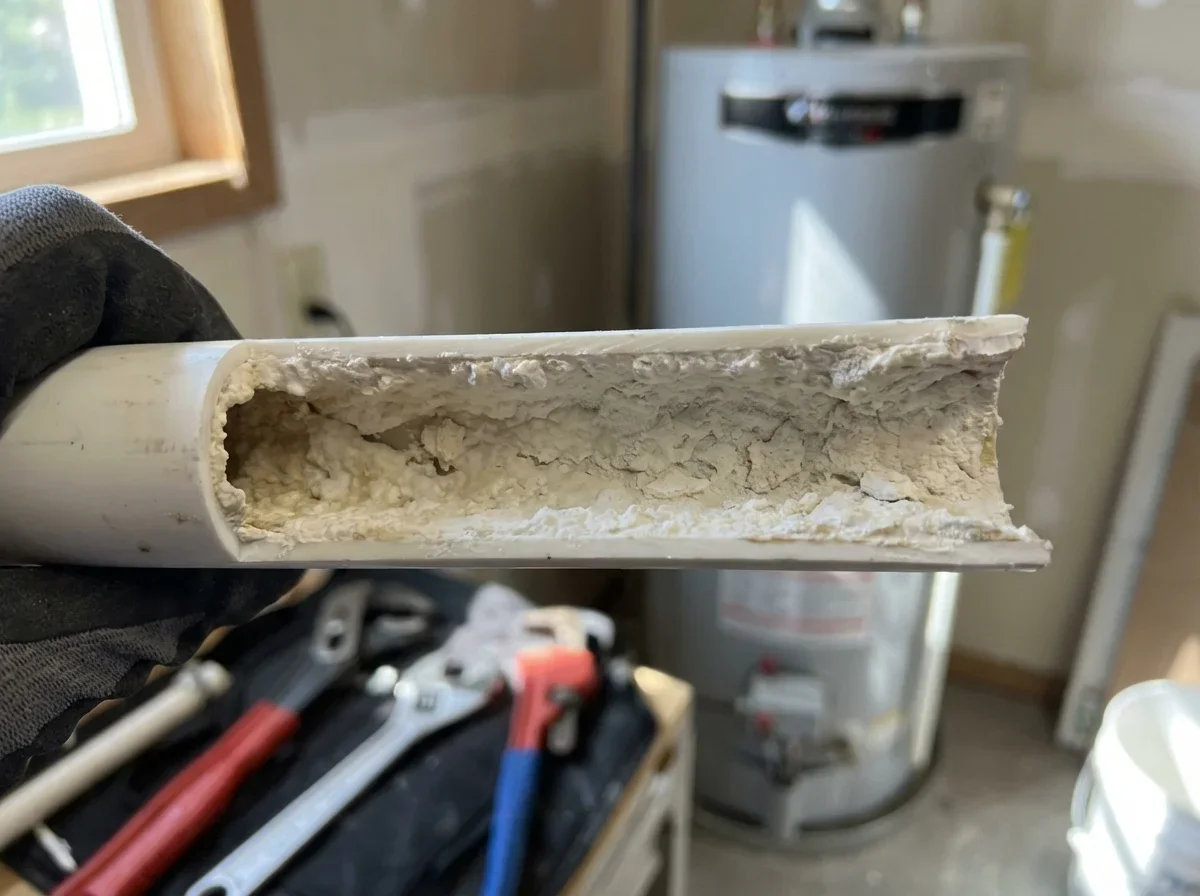
Over time, that coating narrows drain diameter and catches hair, grease, and debris that would normally flush through. What starts as mildly slow drainage in a bathroom sink becomes a recurring clog requiring professional drain cleaning every 12-18 months.
Kitchen drains handling grease develop buildup even faster.
Toilets aren't exempt. The siphon jet holes under the rim and the trapway passage accumulate mineral deposits that weaken flush performance. You might flush twice to clear the bowl, assuming it's a water level issue, when mineral restriction in the internal passages is the real culprit.
Warning: Hard water damage is cumulative and invisible. By the time you notice symptoms — declining pressure, frequent repairs, unexplained water bills — you may already have thousands of dollars in hidden infrastructure damage beneath your slab or inside your walls.
Insurance Coverage Realities for Hard Water Damage
Arizona's Department of Insurance confirms that water damage from sudden or accidental events may be covered under homeowners policies, but coverage details vary significantly by specific policy language[4].
The challenge with hard water damage is proving the "sudden" component.
A pinhole leak in a copper pipe that floods your home overnight qualifies as sudden. The insurer will likely cover structural drying, flooring replacement, and related repairs. But they won't cover the years of gradual scale buildup that caused the pipe to fail, or the cost of repiping to prevent future failures.
Similarly, if your water heater tank ruptures and dumps 50 gallons across your garage, the water damage is covered. Replacing the failed heater itself may or may not be, depending on policy terms. And the insurer won't pay to install a water softener to prevent the next tank from suffering the same fate.
The Maintenance Argument
Insurers can deny claims if they determine damage resulted from lack of maintenance. If you've ignored obvious signs of hard water problems — visible scale, declining pressure, frequent clogs — and a resulting failure causes damage, the insurer might argue you failed to maintain the property reasonably.
It's a gray area that often depends on adjuster interpretation and how well you've documented maintenance history.
Professional Solutions That Actually Stop the Damage
Whole-house water softeners remove calcium and magnesium through ion exchange — swapping hardness minerals for sodium or potassium ions. Properly sized and maintained systems can reduce incoming 300+ ppm hardness to under 50 ppm, eliminating new scale formation entirely.
Installation costs run $1,500-$3,500 depending on system capacity and whether the installation requires main line rerouting. ROC-licensed contractors following Arizona's design standards will position the softener on the cold water main after the pressure regulator but before any branch lines[2].
Most installations include a bypass loop for outdoor irrigation — softened water wastes money on landscaping and can harm desert-adapted plants sensitive to sodium.
Salt-Based vs. Salt-Free Systems
Salt-based ion exchange softeners are the proven technology. They require periodic salt refills (roughly $10-20/month) and generate brine discharge during regeneration cycles. Some Phoenix homeowners worry about sodium in drinking water, but the added sodium from softening 300 ppm water is minimal — about 150 mg per liter, less than a slice of bread.
Salt-free conditioners don't remove minerals; they claim to alter crystal structure to prevent adhesion. These systems avoid salt costs and brine discharge, but effectiveness is debated.
Many homeowners report they reduce visible scale but don't prevent internal pipe buildup the way true softening does. For severe Phoenix hardness, ion exchange remains the only approach with decades of proven performance.
Point-of-Use Solutions for Targeted Protection
If whole-house softening isn't in your budget or doesn't align with your priorities, point-of-use options protect specific high-value appliances and fixtures.
Installing a dedicated softener or descaling system on your water heater inlet prevents sediment accumulation and extends tank life. These units run $400-900 installed and pay for themselves by avoiding premature heater replacement.
Under-sink reverse osmosis systems eliminate hardness minerals at a single tap — typically the kitchen drinking water faucet. You get mineral-free water for cooking and drinking without treating the whole house. RO systems cost $300-800 installed but waste 3-4 gallons of water for every gallon of filtered output, which matters in desert water conservation contexts.
Showerhead Filters and Inline Cartridges
Showerhead filters claiming to remove hardness usually contain polyphosphate cartridges that sequester minerals temporarily, reducing some scale formation. They don't soften water in the true sense, and cartridges need replacement every 3-6 months.
Effectiveness is modest compared to true softening, but for renters or homeowners unwilling to invest in whole-house systems, they provide minor improvement at $30-60 per fixture.
Descaling and Flushing Services for Existing Damage
Once scale has accumulated, removing it requires mechanical or chemical intervention. Hydro jetting uses high-pressure water streams to scour drain line interiors, breaking loose years of soap scum and mineral deposits.
It's effective for clearing blockages and restoring drain flow, but doesn't address supply line scaling or water heater sediment.
Water heater flushing — draining the tank and forcing fresh water through until it runs clear — removes loose sediment before it hardens into a solid mass. Annual flushing extends tank life and maintains efficiency, but becomes difficult once sediment compacts. Many Phoenix homeowners discover during their first attempted flush that sediment has clogged the drain valve, requiring professional service to clear.
Pipe Descaling Chemicals
Commercial descaling products use weak acids (citric, phosphoric) to dissolve calcium deposits. They're effective for faucet aerators, showerheads, and appliance components you can soak.
Running descaling chemicals through your entire plumbing system risks damaging seals, gaskets, and valve seats — most manufacturers don't recommend it for whole-house applications.
For heavily scaled pipes, repiping with PEX becomes the practical solution. You're not repairing the damage; you're replacing the damaged infrastructure and installing a softener to protect the new system.
Hard Water Damage Timeline — What to Expect:
- Years 0-5: Cosmetic issues, mineral spots, minor scale buildup on fixtures
- Years 5-10: Measurable efficiency loss, first appliance repairs, declining water pressure
- Years 10-15: Frequent appliance failures, visible scale inside pipes, water heater struggles
- Years 15-25: Pinhole leaks develop, slab leak risk peaks, repiping becomes necessary
- Cost without treatment: $8,000-12,000+ over 15 years vs. $2,500 one-time softener investment
What Happens If You Do Nothing
Hard water damage progresses on a timeline measured in years, not months. For the first five years in a typical Phoenix home, you might notice only cosmetic issues — mineral spots on glass, white buildup around faucets, soap that doesn't lather well.
Between years 5-15, efficiency losses become measurable. Your water heater runs longer. Appliances need repairs. Water pressure declines gradually at fixtures furthest from the main line.
These symptoms feel like normal aging, so many homeowners budget for repairs rather than addressing the root cause.
After 15-25 years with untreated hard water, you're in failure territory. Copper pipes develop pinholes. Water heaters leak. Appliances die and aren't worth repairing. The cumulative cost of emergency repairs, water damage restoration, and premature replacements can easily exceed $15,000-25,000 — far more than whole-house softening would have cost at year five.
The Repiping Decision Point
Homes built in the 1980s and 1990s with original copper plumbing are entering the failure window right now. When you face your second or third slab leak repair, or when a plumber scopes your lines and shows you the internal corrosion, repiping becomes cheaper than continued patching.
Expect $8,000-15,000 for a full repipe in a typical Phoenix single-family home, with costs rising if you have multi-story construction or complex layouts.
The smart move is repiping with PEX and installing a water softener simultaneously. You get new supply lines rated for 50+ years and eliminate the chemistry that destroyed the old system. Do one without the other and you're either replacing damaged pipes that will continue corroding, or softening water flowing through pipes already compromised beyond recovery.
How to Verify a Plumber's ROC License Before Hiring
All contractors performing plumbing work over $1,000 in Arizona must hold an active Registrar of Contractors license. You can verify license status, check complaint history, and confirm insurance at roc.az.gov — this takes two minutes and protects you from unlicensed operators.
ROC licenses come in specific classifications. Residential plumbing requires a K-36 (Plumbing) license with residential (R) classification. Verify the license matches the work you're hiring for.
The database shows license issue date, bond amount, workers' compensation status, and whether any disciplinary actions are pending.
Arizona doesn't require contractors to carry workers' compensation insurance, which is unusual nationally. That means if an uninsured worker is injured on your property, you could face liability. Always verify insurance coverage independently — don't just trust a contractor's verbal assurance.
Design Standards Compliance
Regional potable water system installations must comply with Arizona Department of Environmental Quality rules and Title 18 of the Arizona Administrative Code[3]. ROC-licensed contractors know these requirements. Unlicensed handymen often don't, which can create permit and inspection failures that delay projects or require expensive rework.
Phoenix's Design Standards Manual establishes minimum criteria for pipe materials, system specifications, and installation methods that account for local water conditions[2].
Softener installations, water heater replacements, and repiping work should follow these standards to ensure long-term performance and code compliance.
Testing Your Water Hardness at Home
Hardness test kits cost $10-25 at hardware stores and provide reasonably accurate measurements. You're looking for total hardness expressed in grains per gallon (gpg) or parts per million calcium carbonate (ppm).
Phoenix water typically tests 17-20 gpg or 300-350 ppm.
Test at multiple taps — kitchen sink, bathroom faucet, outdoor hose bib — to confirm consistency. If you already have a water softener installed, test both the unsoftened bypass and a softened tap to verify the system is working. Softened water should measure under 3 gpg (50 ppm).
When to Request Professional Water Analysis
If you're considering a whole-house system, some softener companies offer free water testing as part of their sales process. These tests are accurate but come with a pitch.
Independent water testing labs provide detailed mineral analysis for $40-80, breaking down not just calcium and magnesium but also iron, manganese, pH, and total dissolved solids. That comprehensive profile helps you choose the right treatment approach if your water has multiple issues beyond hardness.
Maintaining a Water Softener for Long-Term Performance
Salt-based softeners require three maintenance tasks: refilling the brine tank with salt every 4-8 weeks, cleaning the brine tank annually to remove sediment and salt bridges, and checking system settings to ensure regeneration cycles match your water usage.
Most Phoenix homeowners use 40-pound bags of solar salt or pellet salt, available at grocery and home improvement stores. Avoid rock salt — it contains more impurities that leave residue in the brine tank.
Budget $120-200 annually for salt depending on household size and water consumption.
When to Call for Softener Service
If you notice hardness symptoms returning — scale buildup, spotting on dishes, appliance issues — despite maintaining salt levels, your softener may need professional service. Common issues include failed resin bed (requires replacement every 10-15 years), stuck control valves, or incorrect regeneration settings.
ROC-licensed plumbers familiar with water treatment equipment can diagnose and repair softener problems, though some homeowners find it more cost-effective to replace aging units with newer, more efficient models after 15-20 years of service.
Long-Term Financial Comparison: Treating vs. Not Treating
A $2,500 whole-house water softener costs roughly $0.57 per day over 12 years (typical system lifespan). Add $15/month in salt and you're at roughly $1.07/day for comprehensive hard water protection.
Without treatment, you're facing water heater replacement every 8-10 years instead of 12-15 ($1,500 average), appliance repairs and premature replacements (dishwasher, washing machine, ice maker — collectively $2,000-3,000 over a decade), higher energy bills from scaled water heaters (roughly $100-150 annually in wasted energy), and increased likelihood of slab leak repairs ($2,500-6,000 per incident).
Run those numbers over 15 years in a Phoenix home and untreated hard water easily costs $8,000-12,000 more than installing and maintaining a softener.
That doesn't include the inconvenience of emergency repairs, the hassle of dealing with failing appliances, or the water damage risk from undetected leaks.
Resale Value Considerations
Installing a quality water softener adds tangible value when selling your Phoenix home. Buyers understand hard water problems here and appreciate homes with treatment systems already in place. Some real estate agents report that homes with whole-house softeners sell faster and for slightly higher prices, particularly in neighborhoods where hard water damage is widely known.
Conversely, visible hard water damage — heavy scale on fixtures, poor water pressure, known slab leak history — creates buyer concerns and negotiation leverage.
Addressing these issues before listing prevents price reductions and inspection contingencies that delay or kill sales.
Prevention Checklist for New Phoenix Homeowners
When you buy a Phoenix home, especially one built before 2000, hard water assessment should be part of your first-year maintenance plan:
- Test water hardness at multiple taps using a home test kit
- Check all faucet aerators and showerheads for mineral buildup
- Inspect exposed pipe fittings under sinks for signs of corrosion or scale
- Review water heater age and service history (tank should be flushed annually)
- Look for white mineral deposits around outdoor hose bibs and irrigation valves
- Monitor water pressure at fixtures — note any declining performance
- Check recent water bills for usage creep that might indicate slow leaks
If you find evidence of hard water problems or learn the home has original 1980s-1990s copper plumbing, budget for either whole-house softening or leak detection services to establish a baseline.
Catching a developing slab leak early through professional inspection costs $200-400 and can prevent $5,000+ in emergency repairs later.
- City of Phoenix Water Services Department. "2024 Water Quality Report - City of Phoenix." https://phoenix.gov/waterqualityreport. Accessed April 07, 2026.
- City of Phoenix Water Services Department. "Design Standards Manual for Water and Wastewater Systems 2021." https://www.phoenix.gov/content/dam/phoenix/waterservicessite/documents/2021_dsm-final_101421.pdf. Accessed April 07, 2026.
- Maricopa Water Reclamation District. "Design and Construction Standards for Potable Water Systems." https://www.maricopadwid.org/files/22225ad6a/GWR+Design+and+Construction+Standards+01+25.pdf. Accessed April 07, 2026.
- Arizona Department of Insurance, Financial Institutions and Medical Marijuana Establishments (DIFI). "Water Damage | DIFI - Arizona Department of Insurance." https://difi.az.gov/water-damage. Accessed April 07, 2026.