Storage Tank Water Heaters: The Phoenix Standard
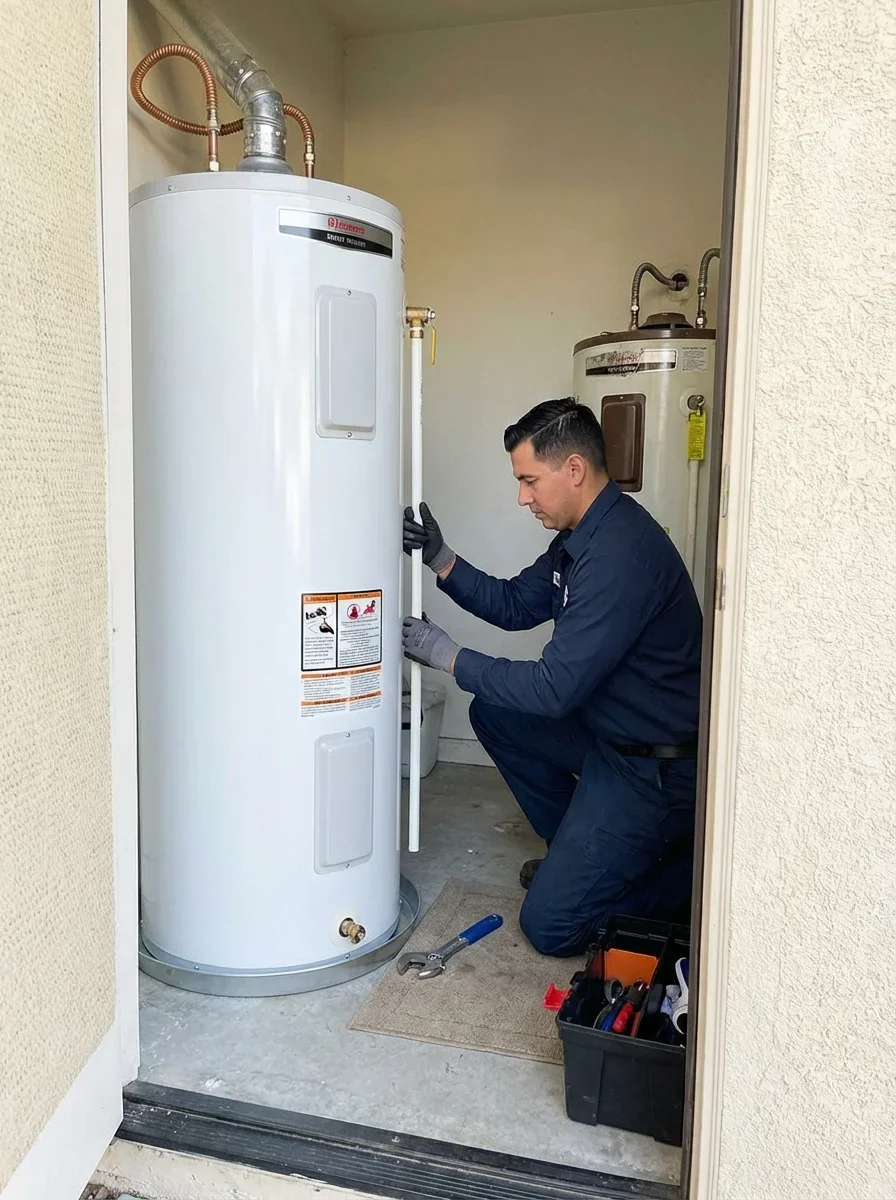
Storage tank water heaters dominate Phoenix installations because they work reliably in extreme heat and handle sudden demand spikes when multiple family members shower before work. The tank stores 30-80 gallons of heated water, maintaining temperature through a gas burner or electric heating element. When you turn on a hot water tap, heated water flows out the top of the tank while cold water enters the bottom to be heated.
Gas models cost $800-$1,400 installed for a 40-50 gallon unit, while electric versions run $600-$1,100. Gas heats faster and costs less to operate in Phoenix where natural gas averages $1.10 per therm versus electricity at $0.13 per kWh.
A family of four using 64 gallons of hot water daily pays about $22/month for gas versus $38/month for electric, assuming 60% energy factor on both units.
Sizing for Phoenix Households
Maricopa County requires all hot water systems to meet ANSI standards and carry third-party certification from agencies like UL or CSA.[3] But those standards don't tell you how Phoenix usage patterns affect sizing. A 40-gallon tank handles two people comfortably. Three to four people need 50 gallons. Five or more require 60-80 gallons, especially if teenagers take long showers or you run a dishwasher and washing machine simultaneously.
The recovery rate matters as much as capacity.
Gas units recover at 40-50 gallons per hour, while electric models manage only 12-18 gallons per hour. If your morning routine involves back-to-back showers, a gas heater with a 50-gallon tank outperforms an electric 60-gallon unit because it replaces hot water faster.
Quick Phoenix Water Heater Sizing Guide:
- 2 people — 40-gallon tank (gas or electric)
- 3-4 people — 50-gallon tank minimum
- 5+ people — 60-80 gallons, prioritize gas for faster recovery
- Gas recovery rate — 40-50 gallons/hour
- Electric recovery rate — 12-18 gallons/hour
- Rule of thumb — Multiple simultaneous users need gas or larger capacity
Garage Installations and Phoenix Heat
Most Phoenix homes install water heaters in the garage, where summer temperatures hit 130-145°F. This location costs you money every month. A water heater maintaining 120°F water in a 140°F space barely works at all. The standby heat loss reverses, and the ambient heat can actually warm the tank. But in winter, when garage temps drop to 45°F on cold mornings, the unit cycles constantly to maintain temperature.
Wrapping the tank with an insulation blanket saves 4-9% on water heating costs in Phoenix garages. Use fiberglass insulation with an R-value of at least 10, leaving the thermostat, relief valve, and burner access uncovered.
Electric units benefit most from tank wraps. Gas models already have better factory insulation but still gain efficiency.
Tankless Water Heaters: Endless Hot Water With Caveats
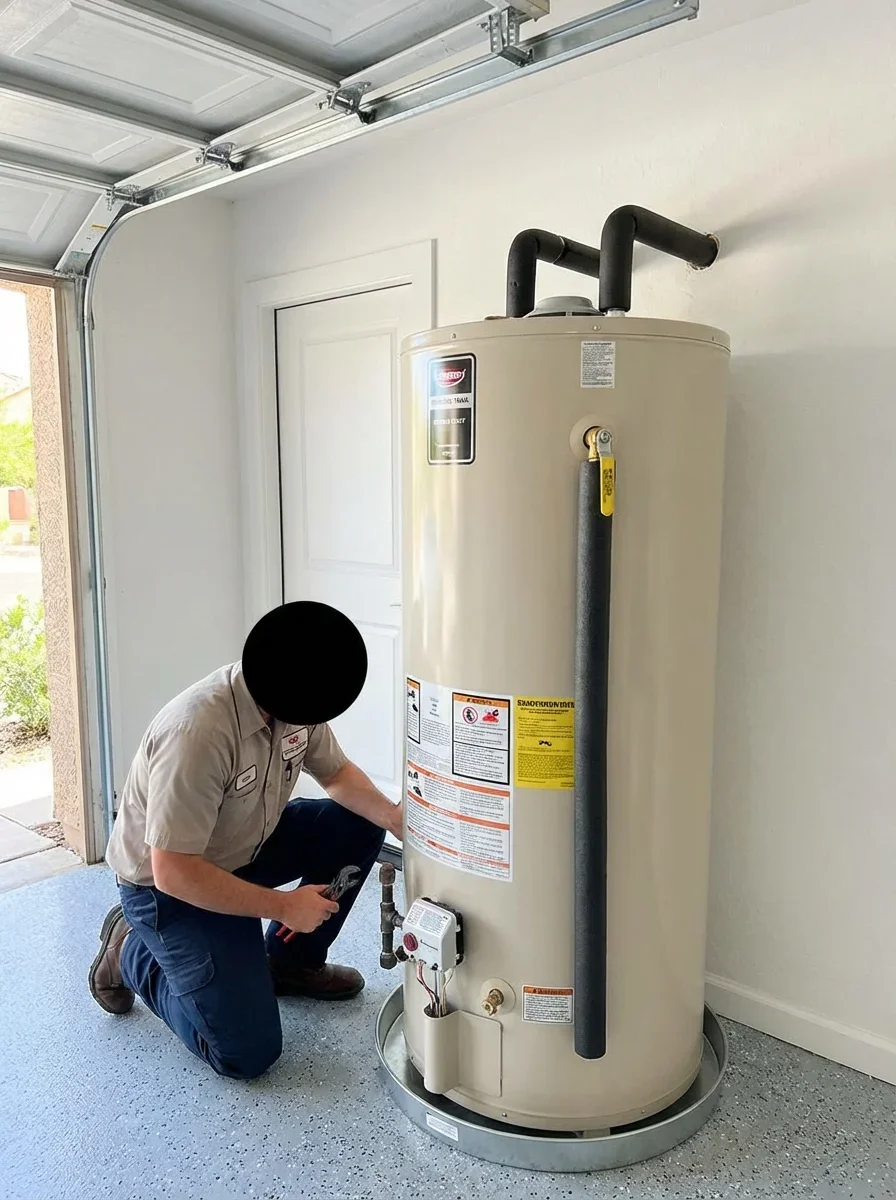
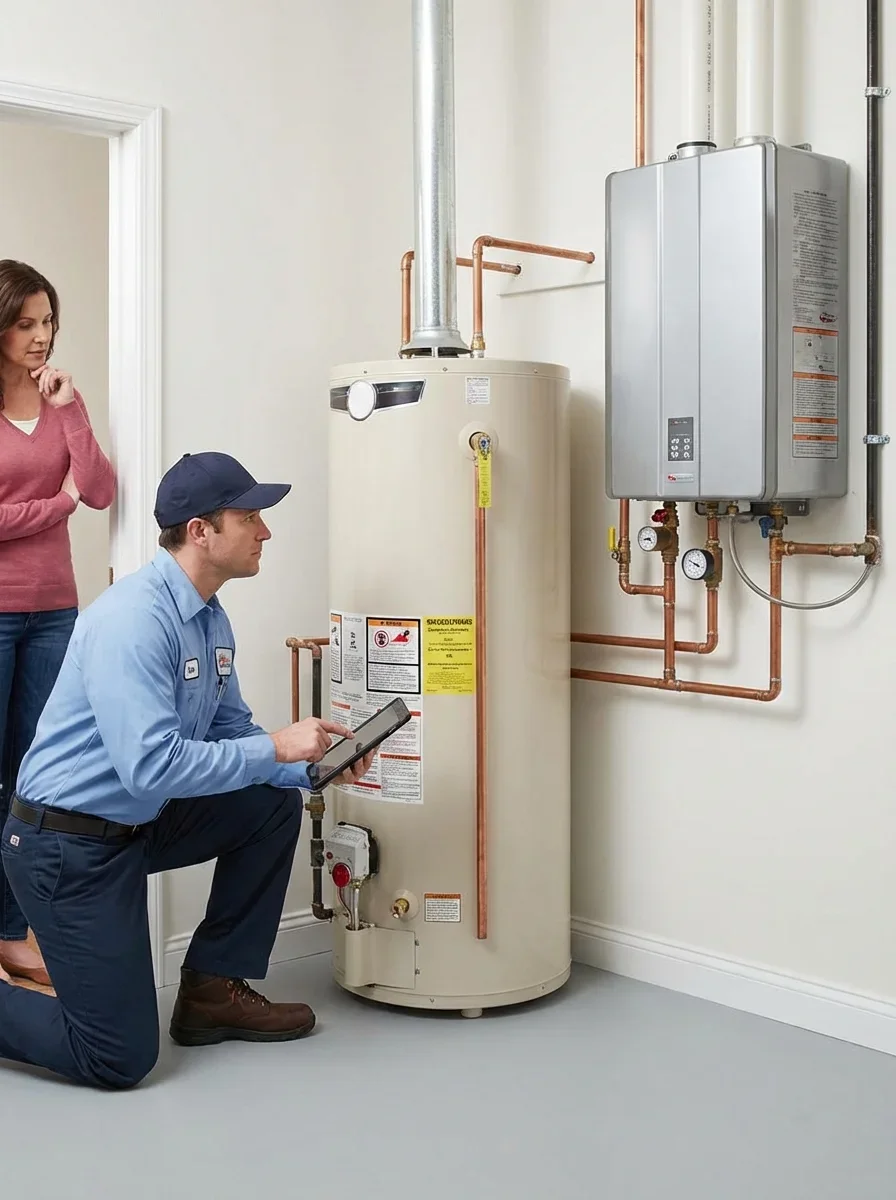
Tankless units heat water on demand as it flows through the device, eliminating the standby energy loss that costs Phoenix homeowners $50-$80 annually on tank models. You never run out of hot water. The unit produces it continuously as long as the tap runs. Gas tankless heaters cost $2,200-$4,500 installed for whole-house models, while electric versions run $1,000-$2,800.
The efficiency advantage disappears quickly in Phoenix's hard water.
Calcium carbonate buildup forms inside the heat exchanger within 12-18 months without treatment. Scale reduces efficiency by 20-30% and shortens the unit's lifespan from 20 years to 8-10 years. You need annual descaling service ($120-$180) or a whole-house water softener to protect your investment.
Flow Rate Reality in Desert Homes
Tankless units specify flow rate in gallons per minute at a given temperature rise. Phoenix groundwater enters at 75-80°F year-round, requiring a 40-45°F temperature rise to reach 120°F output. A typical shower uses 2.5 GPM. Run a shower and the dishwasher (1.5 GPM) simultaneously, and you need a unit rated for at least 4 GPM at 45°F rise. That's a mid-range gas model producing 160,000-180,000 BTU.
Electric tankless units struggle with simultaneous demand. Even a powerful 27-kW unit delivers only 3.5 GPM at Phoenix's required temperature rise. If you have teenagers showering while someone runs laundry, you need multiple smaller units installed at point-of-use locations or a gas whole-house unit.
Gas Line Upgrades and Venting
Tankless gas heaters demand ¾-inch gas lines for units over 150,000 BTU. Most Phoenix homes have ½-inch lines to the garage. The gas line upgrade adds $400-$900 to installation costs.
These units also require different venting than tank heaters. They use sealed combustion with PVC intake and exhaust pipes running through an exterior wall, not the existing metal flue shared with your furnace.
Arizona regulations require all water tube or coil-type heaters with forced circulation to have independent safety controls that shut down the burner if flow becomes inadequate, plus a remote shutdown switch located outside the room.[4] This applies to tankless installations and typically adds a wall switch near the garage entry.
| Feature | Storage Tank | Tankless | Heat Pump |
|---|---|---|---|
| Upfront Cost | $600-$1,400 | $1,000-$4,500 | $1,800-$3,200 |
| Monthly Operating Cost | $22-$38 | $18-$23 + maintenance | $12-$18 |
| Lifespan | 8-15 years | 20 years (with maintenance) | 10-15 years |
| Phoenix Hard Water Impact | Sediment buildup | Severe scaling without treatment | Moderate sediment |
| Installation Complexity | Simple | Gas line + venting upgrades | Space + electrical requirements |
| Best For | Standard households, reliable performance | High demand, unlimited hot water | Energy savings, conditioned spaces |
Heat Pump (Hybrid) Water Heaters: Efficiency With Space Requirements
Heat pump water heaters move heat from surrounding air into the water rather than generating heat directly. They're a storage tank with a small heat pump mounted on top. These units achieve 2.5-3.5 energy factor ratings, meaning they produce 2.5-3.5 units of heat for every unit of electricity consumed.
Your operating cost drops to $12-$18 monthly for the same hot water that costs $38 from a standard electric tank.
The upfront cost runs $1,800-$3,200 installed. Payback takes 4-6 years in Phoenix at current electric rates, faster if you qualify for utility rebates. SRP and APS occasionally offer $300-$500 rebates on ENERGY STAR certified heat pump models. Check current programs before buying.
Climate Compatibility and Performance
Phoenix's hot climate creates a paradox for heat pump water heaters. They work most efficiently when ambient air temperature stays between 40-90°F. In a 140°F summer garage, the heat pump struggles because there's less temperature differential to exploit. It's trying to move heat from 140°F air into 120°F water. The unit switches to backup electric resistance heating, erasing your efficiency gains during the hottest months when you use the most hot water.
Winter performance is excellent.
When garage temps drop to 45-60°F, the heat pump runs efficiently and cools and dehumidifies the garage slightly as a side effect. This makes heat pump heaters ideal for conditioned spaces like laundry rooms or interior closets, but less attractive for garage installations in Phoenix's temperature extremes.
Space and Noise Considerations
Heat pump heaters need 1,000 cubic feet of air space, roughly a 10×10 room with 10-foot ceilings. The heat pump pulls heat from this space, so installing one in a small closet makes the room noticeably cooler. In a Phoenix garage, this cooling effect provides minor relief in summer but creates no real benefit since the space isn't conditioned anyway.
The compressor and fan produce 45-55 decibels during operation, roughly as loud as a refrigerator.
In a detached garage, you won't notice. In a garage that shares a wall with a bedroom or living space, the noise becomes an issue. Several Phoenix homeowners report the sound travels through shared walls enough to be annoying during late-night or early-morning operation cycles.
Solar Water Heaters: Free Energy With Installation Complexity
Solar water heaters use roof-mounted collectors to heat water directly, reducing or eliminating conventional fuel costs. Phoenix receives 300+ sunny days annually with intense solar radiation, ideal conditions for solar thermal collection. A properly sized system cuts water heating costs by 60-90% compared to conventional electric heaters.
Active systems use pumps to circulate water or heat-transfer fluid through rooftop collectors and into a storage tank. Passive systems rely on natural convection, heated water rises from the collector into the tank without pumps.
Active systems cost $4,500-$8,000 installed. Passive systems run $3,000-$5,000.
Maricopa County approves solar water heaters on a case-by-case basis, requiring systems to match Solar Rating & Certification Corporation (SRCC) performance standards.[3] Verify that any proposed system carries SRCC certification before moving forward with installation.
System Types for Desert Conditions
Direct circulation systems pump household water through roof collectors and back to the tank. They work well in Phoenix's freeze-free climate but fail in the few nights each winter when temperatures dip to 28-32°F.
A single hard freeze can rupture collector tubes, causing thousands in damage.
Indirect systems circulate a propylene glycol heat-transfer fluid through collectors, then exchange heat to household water through a heat exchanger in the tank. These systems tolerate freezing temperatures and last longer in Phoenix's hard water because the glycol loop stays closed. Calcium deposits only affect the tank side, not the expensive rooftop collectors.
Roof Integration and Monsoon Durability
Solar collectors mount on south-facing roof sections with 20-45 degree pitch. Phoenix's flat and low-slope roofs require special mounting racks that tilt collectors to optimal angles. Each collector panel weighs 75-120 pounds when filled with fluid. Your roof structure must support this load plus the mounting hardware. Homes built before 1980 sometimes need reinforcement.
Monsoon winds gust to 50-70 mph during July-September storms.
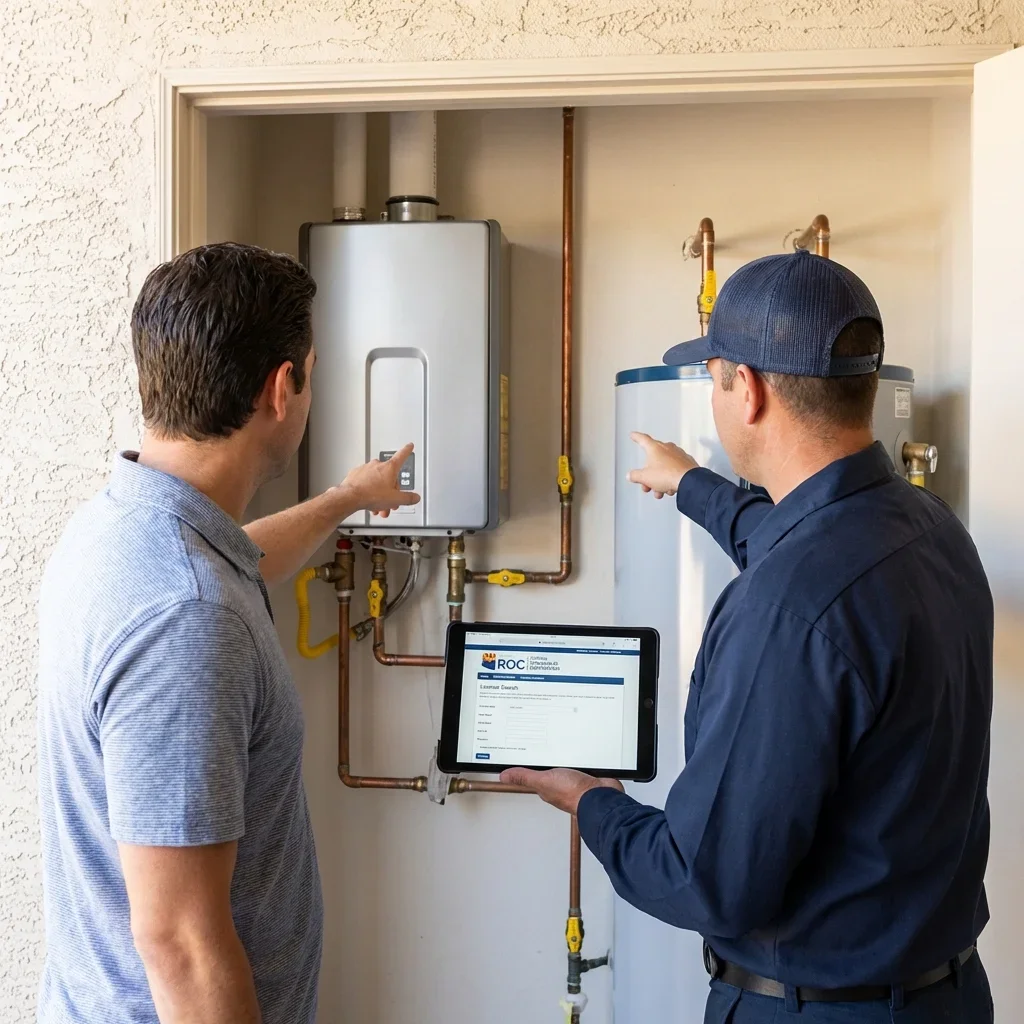
Collectors need secure mounting that meets current IRC wind load requirements with Arizona amendments. Poor installations have blown loose during monsoons, damaging roofs and the collectors themselves. Use only ROC-licensed contractors with verifiable solar water heater experience. Verify licenses at roc.az.gov.
Point-of-Use Electric Heaters: Targeted Solutions
Small electric tankless units installed directly at sinks or showers provide hot water for single fixtures without the wait for water to travel from a central heater. These units cost $150-$450 each plus $200-$400 for installation if electrical upgrades are needed. They draw 3-8 kW, requiring dedicated 30-40 amp circuits.
Point-of-use heaters solve specific Phoenix problems.
If your master bathroom sits 80 feet from the garage water heater, you waste 2-3 gallons waiting for hot water to reach the shower each morning. That's 700-1,000 gallons yearly running down the drain, meaningful in a desert city where water conservation matters. A point-of-use heater delivers instant hot water at the fixture.
They also support water heater replacement scenarios where you're downsizing the main unit. If three kids moved out and you're replacing a 75-gallon tank, install a 40-gallon central unit plus a 3-kW point-of-use heater at the kitchen sink. You save on operating costs while maintaining performance where you need it.
Condensing Water Heaters: Efficiency for High-Demand Homes
Condensing water heaters capture exhaust heat that standard gas heaters vent outside. They route exhaust gases through a secondary heat exchanger, extracting additional BTUs before venting. This process raises efficiency from 60-65% (standard gas tank) to 90-96% (condensing tank).
These units cost $1,800-$3,500 installed for 50-75 gallon models.
The efficiency gain saves $80-$140 annually on gas costs for a Phoenix family of four. Payback takes 8-12 years, longer than ideal, but worthwhile if you're staying in the house long-term or have high hot water demand that amplifies the savings.
Condensate Drainage Requirements
Condensing heaters produce acidic condensate, roughly 1-2 gallons daily for a typical household. This condensate needs proper drainage to a floor drain, condensate pump, or exterior discharge point. Phoenix's slab construction means you can't simply drain to a basement floor. Many garage installations require a condensate pump ($180-$280 installed) to move the liquid to an appropriate discharge location.
The acidic condensate can damage concrete floors if spilled repeatedly.
Some jurisdictions require neutralization kits that raise pH before discharge. Verify local requirements with your contractor during planning. Condensate handling adds complexity that standard tank heaters don't involve.
Water Heater Safety and Code Compliance in Arizona
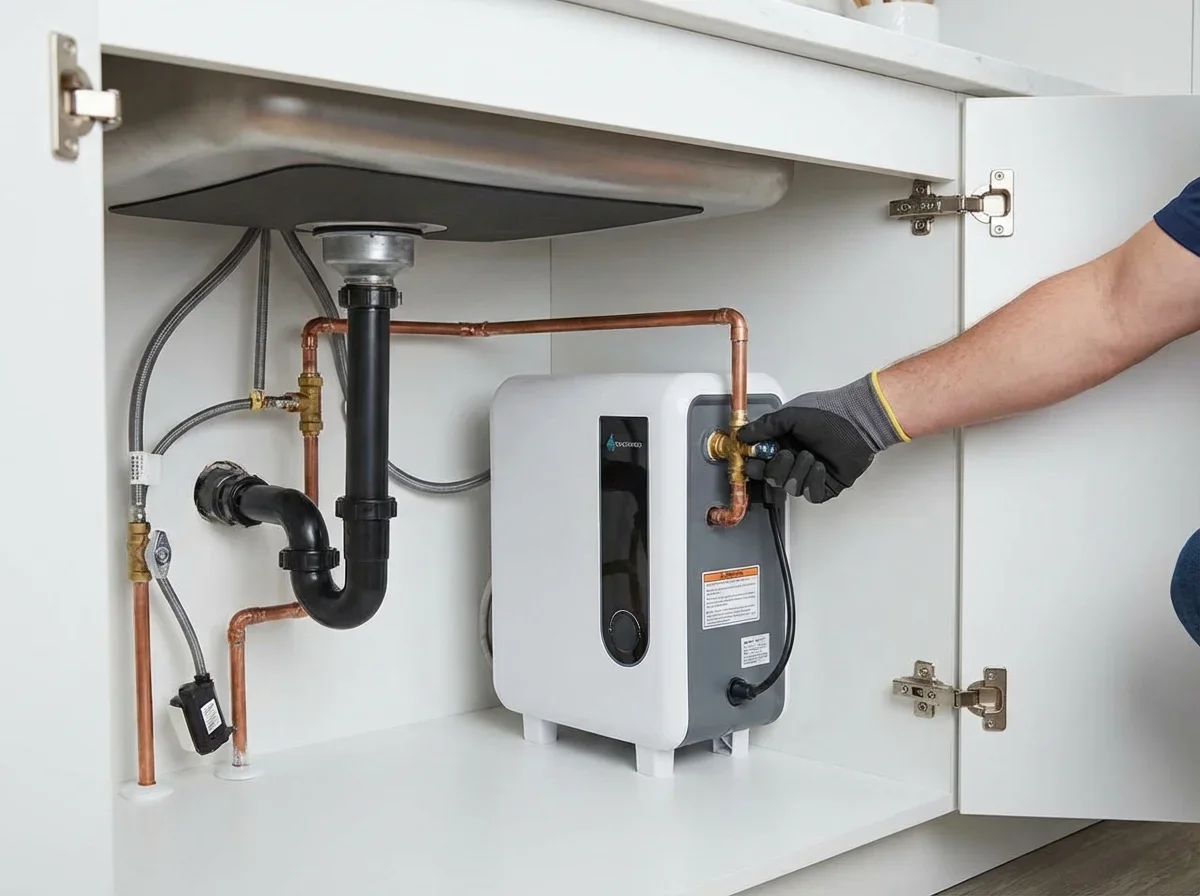
All water heaters in Arizona must have UL or AGA approved temperature/pressure relief valves on the hot water side at the tank top.[5] The sensing element must sit in the top six inches of the tank where the hottest water collects. The discharge line runs downward in galvanized steel, copper, or flexible copper tubing, terminating 6-12 inches above the floor in a visible location.
Arizona regulations exempt residential water heaters from most commercial boiler rules as long as heat input stays below 200,000 BTU/hour and water temperature doesn't exceed 210°F.[1] This covers all standard residential units but excludes some large-capacity or commercial-grade installations that homeowners occasionally consider for high-demand situations.
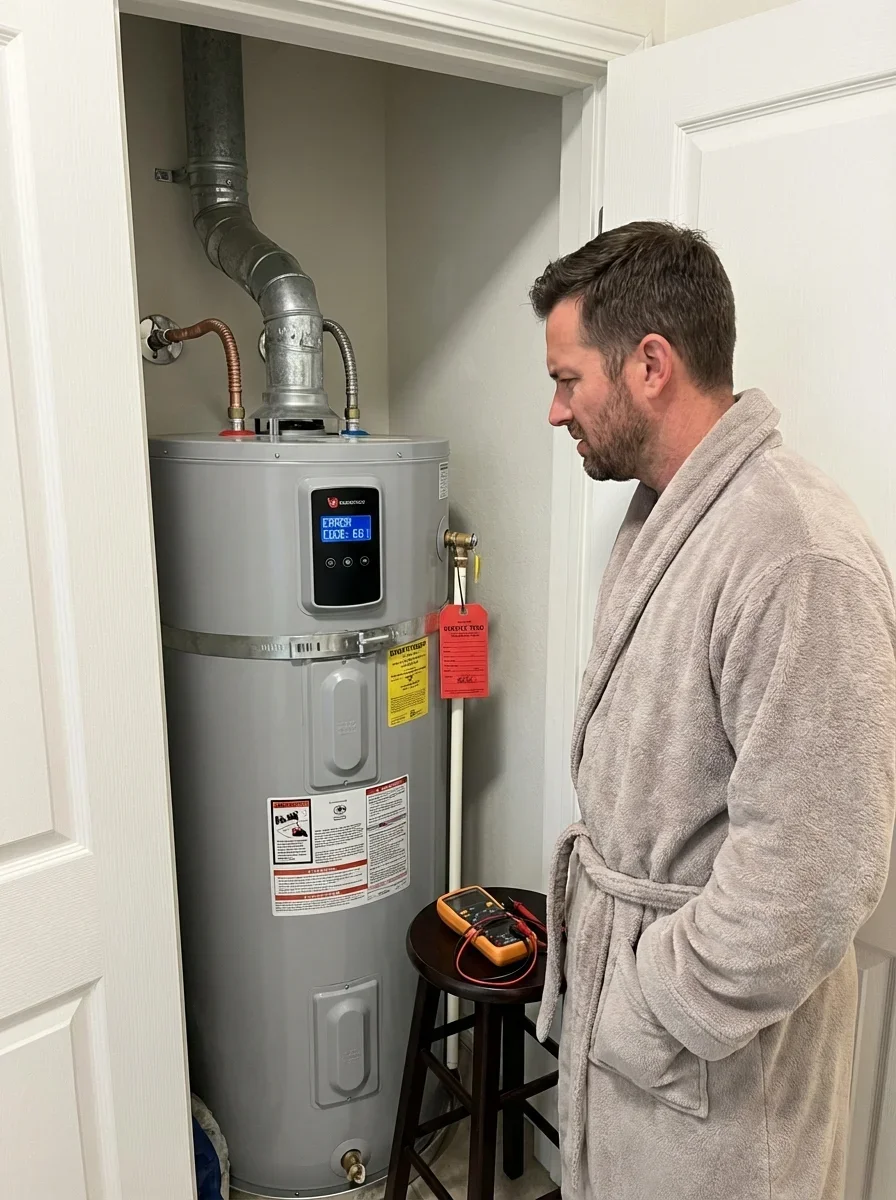
Safety Alert: Phoenix sits in a low seismic zone, but Arizona building code still requires water heater strapping. Two metal straps must wrap around the tank at points one-third and two-thirds up from the base, anchored to wall studs or masonry. Inspectors will red-tag installations that lack proper strapping—no exceptions.
Seismic Strapping and Stability
Tank heaters also need 6-inch clearance from combustible materials and adequate combustion air if gas-fired. Garage installations typically meet these requirements easily, but closet installations sometimes need additional ventilation. Calculate one square inch of ventilation per 1,000 BTU input, with openings within 12 inches of the ceiling and floor.
Hard Water Impact and Maintenance Requirements
Phoenix's 300+ ppm calcium carbonate water accelerates sediment buildup in all water heater types. Tank models accumulate a crusty layer of calcium at the bottom, acting as insulation between the burner and the water. This layer reduces efficiency 10-15% in the first three years and makes the bottom of the tank overheat, weakening the steel and shortening lifespan.
Flushing the tank annually removes sediment before it hardens.
Attach a garden hose to the drain valve, run it outside, and drain 2-3 gallons. You'll see cloudy, particle-filled water. Keep draining until it runs clear. This simple maintenance extends tank life from 8-10 years to 12-15 years in Phoenix water conditions.
Tankless units need professional descaling annually. A plumber circulates white vinegar or citric acid solution through the heat exchanger for 30-45 minutes, dissolving calcium deposits. Skip this service and the unit clogs, triggering error codes and reducing flow.
The $120-$180 service cost is mandatory maintenance, not optional. Factor it into your operating budget when comparing water heater types.
Electrical and Gas Infrastructure Requirements
Electric water heaters draw 3,500-5,500 watts for standard tank models. Heat pump units add another 500 watts for the compressor. Most homes have adequate 30-amp circuits already in place.
Tankless electric heaters are different.
Whole-house units demand 80-150 amps at 240V, requiring panel upgrades in homes with 100-amp or 125-amp main service. If your electrical panel shows empty breaker slots and was installed after 1990, you likely have capacity for most electric heater upgrades. Older panels with all slots filled and a main breaker of 100 amps or less need panel upgrades costing $1,800-$3,500 before installing high-demand electric tankless units.
Gas line sizing matters for tankless and high-capacity tank units. A ½-inch line delivers enough gas for standard 40,000 BTU tank heaters but chokes a 180,000 BTU tankless model. The gas line from your meter to the heater needs upgrading to ¾-inch diameter, running 20-60 feet depending on your home's layout.
This work requires an ROC-licensed contractor. Verify licenses at roc.az.gov before hiring.
Energy Costs and Long-Term Operational Savings
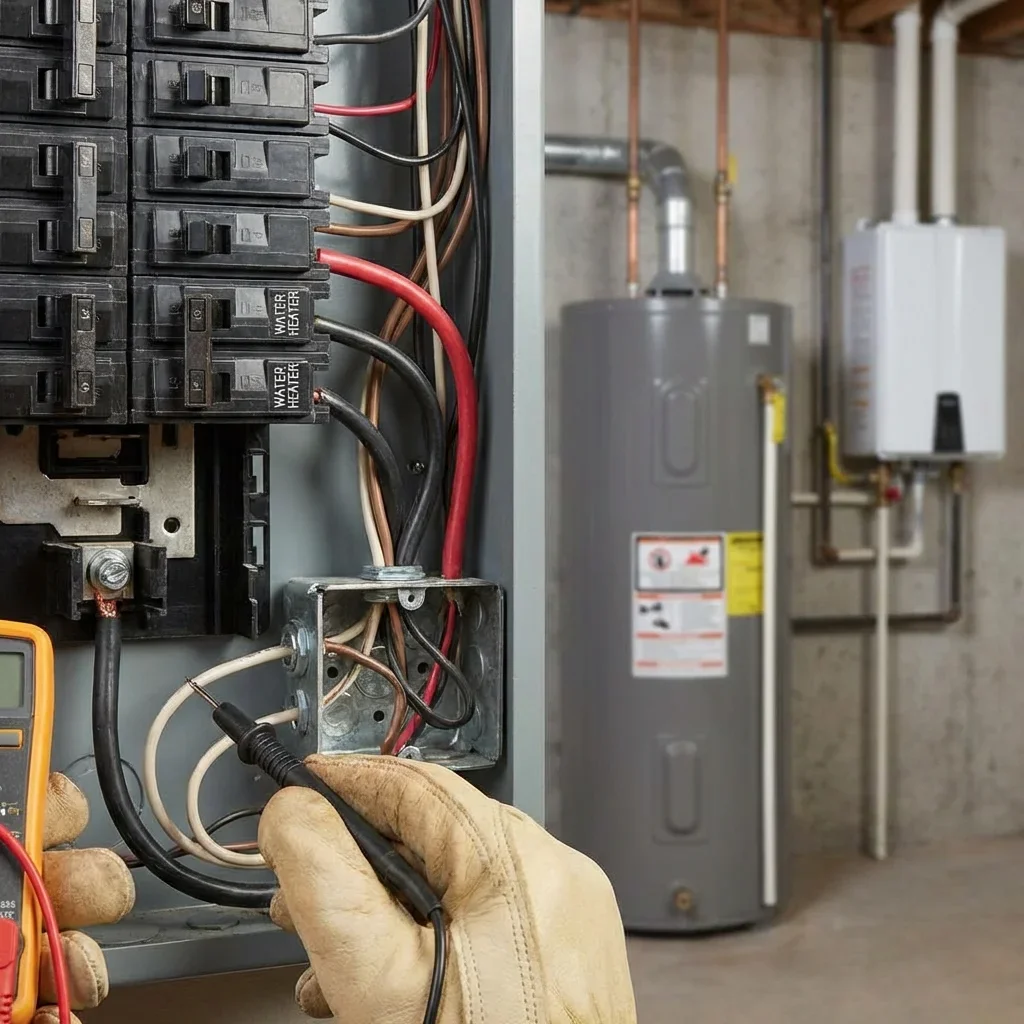
A conventional 50-gallon electric tank heater costs $35-$42 monthly to operate in Phoenix at $0.13/kWh. The same capacity gas heater runs $20-$25 monthly at $1.10/therm. Over a 12-year lifespan, the electric unit costs $5,040-$6,048 to operate while gas costs $2,880-$3,600, a $2,160-$2,448 difference.
Tankless gas heaters cost $18-$23 monthly to operate for equivalent usage but require annual descaling at $120-$180.
Over 20 years, operating costs total $4,320-$5,520 plus $2,400-$3,600 in maintenance, roughly $6,720-$9,120 total compared to $4,800-$6,000 for two consecutive standard gas tanks over the same period.
Heat pump electric models cost $12-$18 monthly when running efficiently. Over a 12-year lifespan, you spend $1,728-$2,592 on electricity, less than half the cost of a standard electric tank. But the $1,200-$1,800 price premium over standard electric tanks takes 4-6 years to recover through savings.
Choosing Based on Phoenix Home Characteristics
Pre-1980 block homes with copper supply lines should prioritize water heater choices that minimize aggressive water chemistry. Hotter water accelerates copper corrosion in Phoenix's hard water. Keep tank thermostats at 120°F maximum and install a water softener to remove calcium before it reaches both the heater and your supply lines.
Homes built 1980-2000 typically have adequate gas lines for tankless upgrades but may need electrical panel work for electric tankless or heat pump units.
These homes often have aging tank heaters in garages. Replacing with the same fuel type (gas-to-gas, electric-to-electric) keeps installation costs lowest.
Post-2000 construction usually includes PEX supply lines and may have conditioned space options for heat pump installations. These homes were built during the housing boom with minimal gas line sizing, so expect gas line upgrades for tankless installations. But the PEX plumbing tolerates higher water temperatures better than copper, giving you more flexibility in heater selection.
Permit Requirements and ROC Contractor Selection
Water heater replacement in Phoenix requires a plumbing permit when the installation involves gas line modifications, electrical upgrades, or changes to venting systems. Simple like-for-like replacements of electric tank heaters sometimes proceed without permits, but inspections verify proper T&P valve installation, seismic strapping, and clearance requirements.
Working with unlicensed contractors saves $200-$400 on installation costs but voids warranties and creates liability if the installation fails.
Arizona's Registrar of Contractors requires licenses for any work exceeding $1,000.[2] Verify your contractor holds an active ROC license in good standing at roc.az.gov before signing contracts or accepting quotes.
Licensed contractors carry insurance and bonding, though Arizona doesn't require workers compensation coverage, a controversial gap that leaves homeowners liable if unlicensed workers injure themselves on your property. Ask contractors directly about their insurance coverage and verify it independently before work begins. The ROC bond ranges from $4,000-$15,000 depending on license classification, which may not cover large claims from faulty installations.
Frequently Asked Questions
- Industrial Commission of Arizona, Division of Occupational Safety and Health. "ARIZONA BOILER RULES Applying to boilers, water heaters and pressure vessels." https://www.azica.gov/sites/default/files/ADOSH_Rules_Boilers_2009_rev2.pdf. Accessed April 07, 2026.
- Arizona Administrative Code, Title 20, Chapter 5. "Article 4 - ARIZONA BOILERS AND LINED HOT WATER HEATERS." https://www.law.cornell.edu/regulations/arizona/title-20/chapter-05/article-4. Accessed April 07, 2026.
- Maricopa County, Arizona. "Guideline to Sizing Water Heaters, Water Temperature, and Potable Water Supply Requirements." https://www.maricopa.gov/DocumentCenter/View/5888/Hot-Water-Supply-Requirements-PDF. Accessed April 07, 2026.
- Arizona Administrative Code. "Ariz. Admin. Code § R20-5-430 - Forced Circulation Lined Hot Water Heaters." https://www.law.cornell.edu/regulations/arizona/Ariz-Admin-Code-SS-R20-5-430. Accessed April 07, 2026.
- City of Phoenix, Arizona. "Water Heater Information." https://www.phoenix.gov/administration/departments/housing/section-8-housing/section-8-inspections/water-heater-information.html. Accessed April 07, 2026.