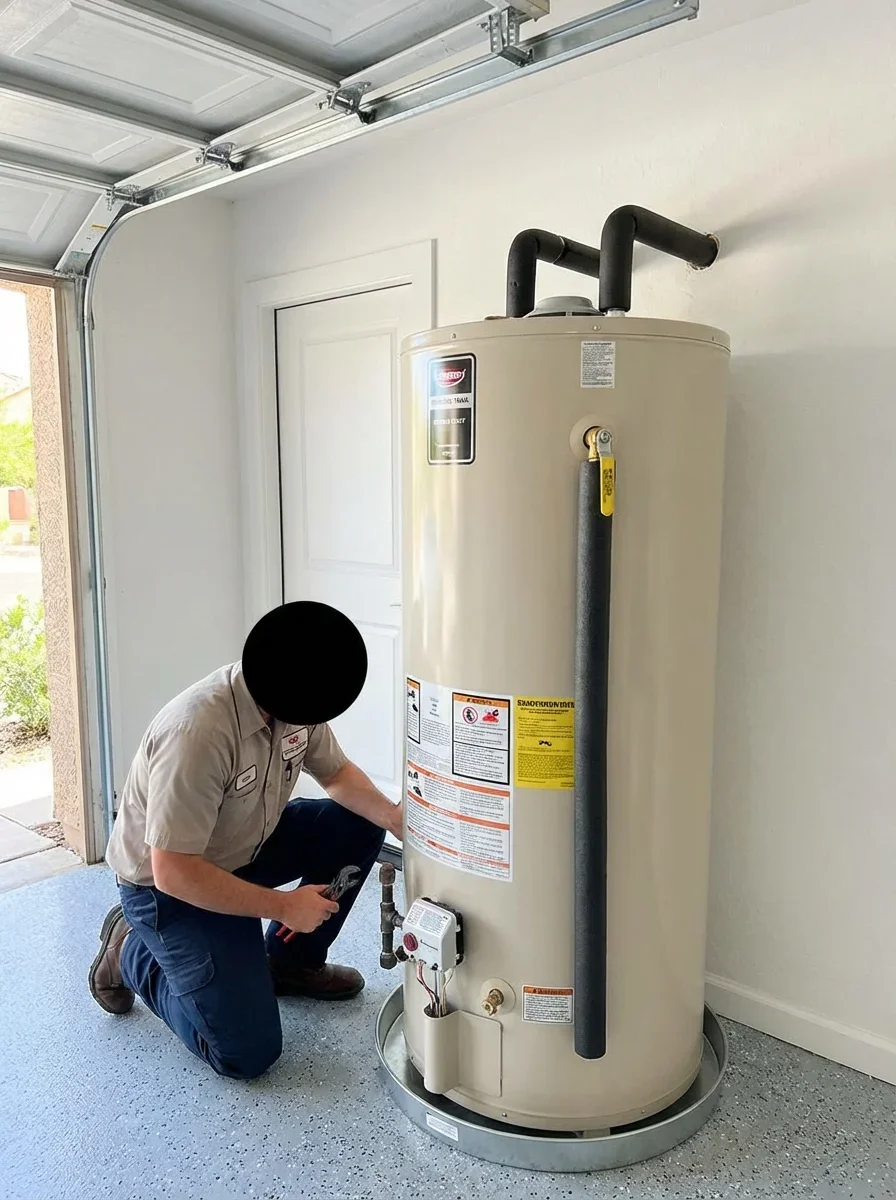
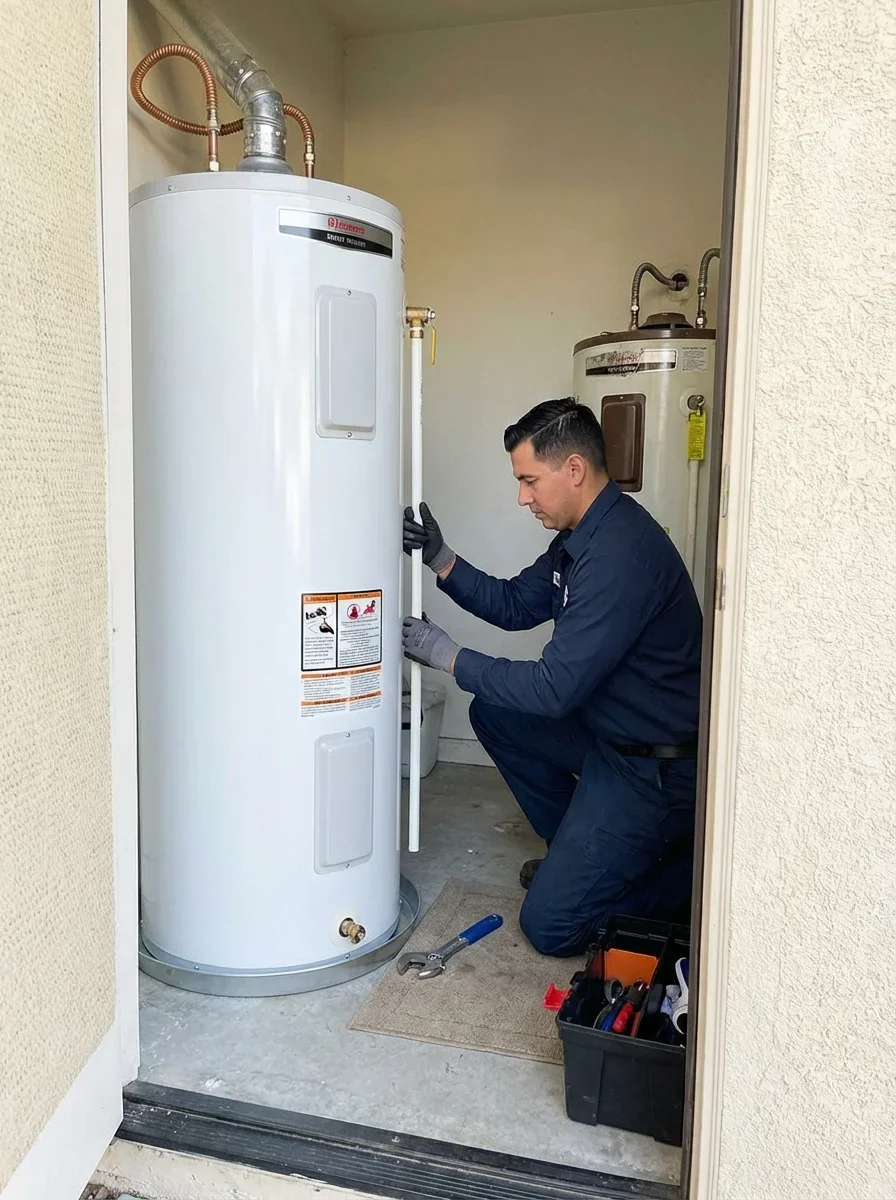
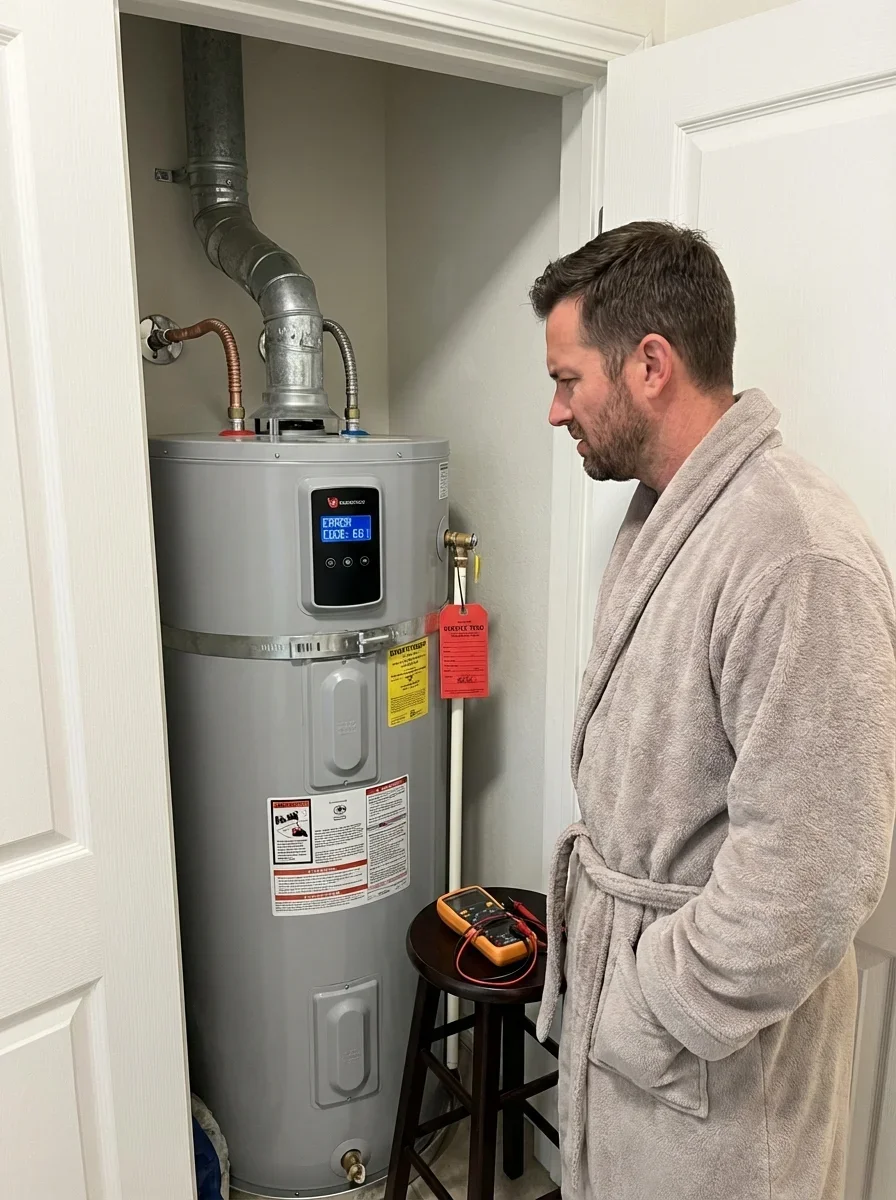
Expected Lifespan by Water Heater Type
Tank water heaters have a service life of 10-15 years nationally, but Arizona conditions typically knock 1-2 years off that range.[1] The DOE's 10-year baseline assumes moderate water hardness and consistent maintenance — neither of which applies to most Phoenix homes.
Between hard water mineral deposits and thermal cycling from 110°F summer ambient temps, expect 8-12 years from a conventional tank.
Tankless water heaters last more than 20 years under the same national standards, and Arizona's dry climate actually helps here.[1] You won't deal with the condensation corrosion issues that plague tankless units in humid states. The catch: hard water scale still clogs heat exchangers, so annual descaling isn't optional if you want that 20-year lifespan. Skip maintenance, and you'll replace your tankless unit at year 12-15.
Heat pump water heaters fall somewhere in between — 10-15 years for the compressor and tank assembly. These units struggle in Phoenix garages where summer temps hit 130°F, forcing the heat pump to work harder than designed. If yours is in a climate-controlled space, you'll hit the upper end of that range.
| Water Heater Type | National Lifespan | Phoenix Lifespan | Maintenance Required |
|---|---|---|---|
| Tank (Gas/Electric) | 10-15 years | 8-12 years | Annual flushing, anode rod checks |
| Tankless | 20+ years | 18-22 years | Annual descaling, filter cleaning |
| Heat Pump | 10-15 years | 10-15 years | Standard maintenance, climate control preferred |
How Arizona's Hard Water Cuts Water Heater Lifespan
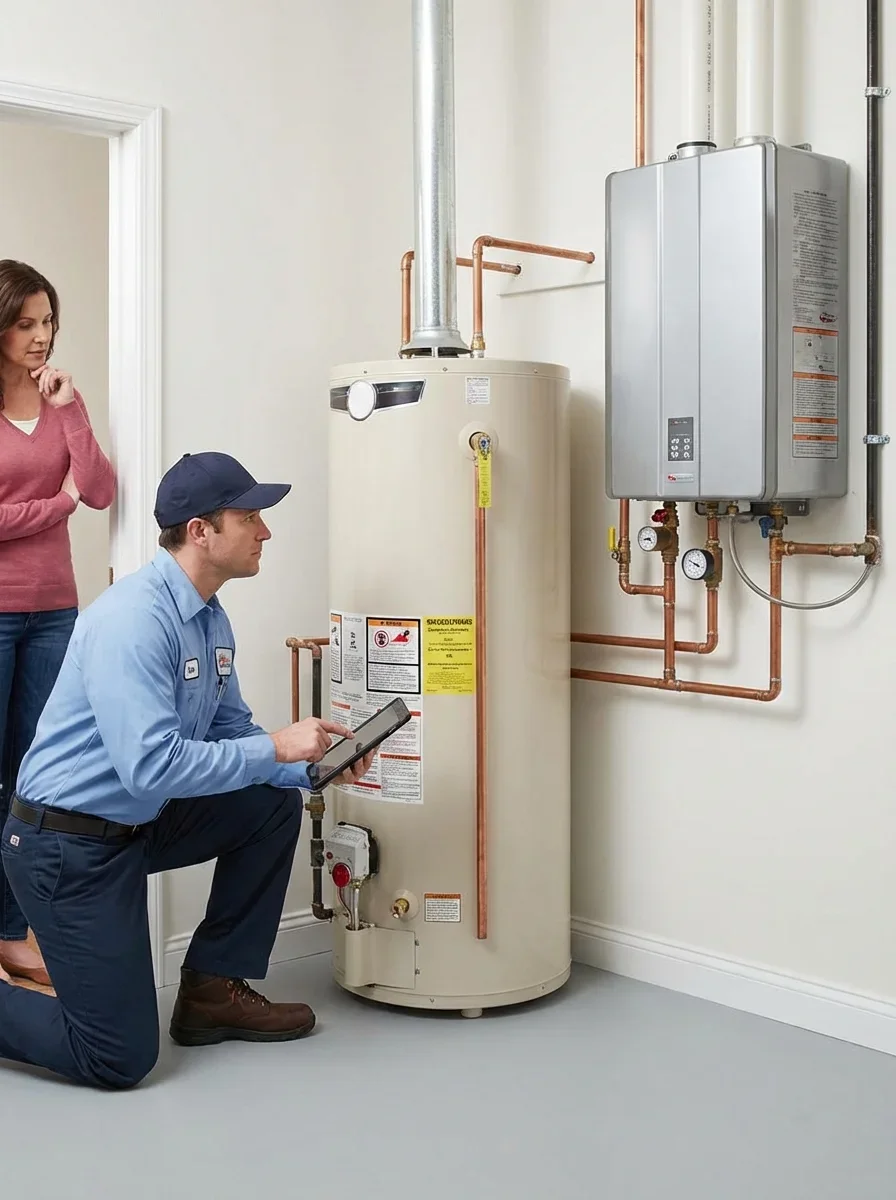
Phoenix-area water averages 12-16 grains of hardness (205-275 ppm), with some neighborhoods pushing 18 grains (300+ ppm).[4] That mineral load — primarily calcium and magnesium carbonates — precipitates out when water heats, forming scale on tank walls, anode rods, and heating elements.
A quarter-inch of scale reduces heat transfer efficiency by 20%, forcing your burner or element to run longer for the same hot water output.
The efficiency loss compounds over time. By year five, an unmaintained tank in hard water zones operates at 70% of its original capacity, cycling more frequently and stressing components that were never designed for that workload. The calcium carbonate deposits also create pockets where the tank's glass lining cracks, exposing bare steel to corrosive water.
Once that happens, rust-through is inevitable.
Tankless units face different scale problems. Hard water clogs the narrow passages in heat exchangers, creating hot spots that warp the exchanger plates. Most manufacturers void warranties if you skip annual descaling in hard water zones, and they'll know, because the scale pattern is unmistakable. Budget $150-200 annually for professional descaling, or learn to do it yourself with food-grade vinegar and a recirculating pump.
Water Softeners and Their Impact
Installing a water softener adds 2-4 years to tank heater lifespan by eliminating the mineral load that causes scale.[5] You'll see immediate efficiency gains. The heating element or burner won't fight through calcium deposits to warm the water. Anode rods last longer, too, since they're protecting against corrosion rather than getting buried in scale.
The ROI math works if you're replacing an older tank anyway. Whole-home softeners run $1,200-2,500 installed, while water heater replacement in Phoenix costs $1,800-3,500 depending on type. Extending your current tank's life by three years defers that replacement cost, and you'll save 10-15% on water heating energy during that time.
Tankless owners see even bigger gains. A softened water supply means you can skip annual descaling (though you should still flush the system yearly), and heat exchanger warranties stay valid. For a $2,000 investment in water treatment, you're protecting a $3,500-5,000 tankless installation.
The Role of Anode Rods in Tank Longevity
Tank water heaters rely on a sacrificial anode rod — typically magnesium or aluminum — that corrodes instead of your tank.[3] Phoenix's hard water consumes anode rods faster than soft water does, often depleting them in 3-5 years rather than the 8-10 years manufacturers cite.
Once the rod is gone, the tank's steel shell becomes the sacrificial element.
Most homeowners never check their anode rod, which explains why so many tanks fail right around year eight. The rod is accessible through the tank's top, usually under a plastic cap that looks like it's just part of the heater. Replacement rods cost $20-40 and take 20 minutes to swap if you catch it before the threads corrode into the tank. Wait too long, and the threaded port rusts solid, making rod replacement impossible without specialized tools.
Powered anode rods (also called "electronic" or "impressed current" anodes) use a low-voltage current to protect the tank instead of sacrificing material. They never wear out, eliminate the sulfur smell some magnesium rods produce, and cost $150-200 installed.
For a tank in hard water, a powered anode can add 5-7 years of life.
You'll find them marketed as aftermarket upgrades, and they're compatible with most major tank brands made after 2000.
Warning Signs Your Water Heater Is Failing
Rusty or discolored water from hot taps signals advanced tank corrosion. If the rust clears after running water for a minute, the problem might be your pipes. If it persists or you only see rust from hot water, the tank's interior lining has failed and you're on borrowed time.
Steel tanks rust from the inside out, so by the time you see rust-colored water, the tank wall is already compromised.
Rumbling or popping sounds during heating cycles mean sediment buildup on the tank bottom. The noise is steam bubbles forcing their way through the mineral layer, essentially the sound of scale baking onto the tank and insulating the heating element from the water. This both wastes energy and creates hot spots that accelerate tank fatigue. If you hear it, flushing the tank might help, but sediment that's compacted for years won't always drain out.
Water pooling around the base isn't always a leak. Sometimes it's condensation from cold water pipes or the pressure relief valve weeping slightly during thermal expansion. But if you find standing water on multiple occasions, or if the leak corresponds with the heater running, the tank has developed a crack or rust-through hole.
There's no repair for tank leaks. You're looking at immediate replacement.
Critical Failure Warning Signs:
- Rusty water from hot taps only (not cold)
- Rumbling or popping noises during heating cycles
- Persistent water pooling around the base
- T&P valve constantly dripping or spraying
- Age 10+ years with any secondary symptoms
- Visible rust on tank exterior or connections
Temperature and Pressure Relief Valve Issues
The T&P valve opens when tank pressure or temperature exceeds safe limits — typically 150 psi or 210°F. If yours drips constantly, the valve might be failing, or it's doing its job because your tank is overheating.
Both scenarios need immediate attention.
A stuck-closed T&P valve turns your water heater into a bomb. They're required by code precisely because tanks can explode when pressure has no release path.
Test the T&P valve annually by lifting the lever and letting water discharge through the overflow pipe. If nothing comes out, or if the valve doesn't reseat properly afterward, replace it. If it keeps dripping after testing, you either have a faulty valve ($20 part, 30 minutes to swap) or an actual pressure/temperature problem that needs diagnosis. Don't just cap it or plug the discharge line — that defeats the entire safety system.
Water heaters in Phoenix garages sometimes show T&P valve issues during summer because the ambient temperature raises the tank's baseline temp by 15-20°F. A 120°F water setting plus 130°F garage heat can push the tank closer to the valve's 210°F trigger, especially if the thermostat is slightly out of calibration.
When Repair Makes Sense vs. Replacement
Heating element failure on an electric tank costs $200-350 to fix — cheap enough to justify if your tank is under seven years old and shows no other problems. Gas burner assemblies run $300-500 for parts and labor.
Both are straightforward repairs if the tank itself is sound.
Check the manufacture date on the rating plate (it's usually encoded in the serial number) before approving the repair.
Thermostat issues ($150-250 repair) and T&P valve replacements ($100-200) are almost always worth fixing regardless of age. These are wear items that fail independently of tank condition. But if your contractor finds significant sediment buildup or recommends multiple repairs during the same visit, you're throwing money at a dying tank.
The age-based rule: repairs make sense on tanks under 8 years old for single-component failures. Between 8-10 years, you're in the gray zone where repair costs should be weighed against replacement costs. After 10 years, replacement usually wins unless it's a $150 thermostat fix and you're planning to move within a year.
The Cost-Per-Year Calculation
A $2,200 tank water heater that lasts 10 years costs $220/year. If that same heater needs a $400 repair at year nine, you're paying $400 for one additional year.
Now you're at $260/year total.
The math tilts heavily toward replacement when you factor in the old tank's reduced efficiency (costing you $10-15/month extra on gas or electric) and the risk of catastrophic failure.
Tankless repairs cost more — $400-800 for heat exchanger descaling or flow sensor replacement — but you're protecting a unit with 12-15 years of remaining life. The cost-per-year math still favors repair until around year 15, assuming you've maintained it properly. If you've never descaled a 10-year-old tankless unit, though, the exchanger might be too far gone to save.
How Maintenance Extends Water Heater Life
Annual tank flushing removes sediment before it compacts into a concrete-like layer on the bottom. The process takes 20 minutes: shut off power/gas, connect a garden hose to the drain valve, open the valve, and drain 2-3 gallons into a bucket.
You're not trying to empty the tank — just stir up and remove the sediment layer.
Do this every 12 months, and you'll add 2-3 years to the tank's life.[2]
Temperature setting matters more than most homeowners realize. Every 10°F above 120°F accelerates tank corrosion and scale formation. The DOE recommends 120°F for safety and efficiency, but many tanks ship at 140°F. Lower temps also reduce standby heat loss — the energy wasted keeping 40-50 gallons hot when you're not using it. You'll save $20-30 annually on energy and extend tank life by reducing thermal stress.
Pressure regulation protects tanks from the hammering effect of high street pressure. Phoenix water pressure ranges from 50-80 psi, but some areas hit 100+ psi during low-demand hours. Anything over 80 psi stresses tank seams and connections. A whole-home pressure regulator ($200-400 installed) maintains 60-65 psi, which helps water heaters, washing machines, and all your plumbing fixtures last longer.
PRO TIP: Check your water heater's manufacture date before you buy the house. The date is encoded in the serial number — the first four digits usually represent the month and year (e.g., "0518" = May 2018). An 8-year-old tank at closing means you're likely buying someone else's deferred maintenance problem.
Expansion Tank Installation
Arizona's 2018 IRC adoption requires thermal expansion tanks on all new water heater installations in closed plumbing systems. "Closed" means you have a backflow preventer or pressure-reducing valve that prevents heated water from expanding back into the street main.
The expanding water has nowhere to go except into the expansion tank's air bladder, which prevents pressure spikes that stress the tank and T&P valve.
Older homes without expansion tanks experience micro-leaks at connections and accelerated T&P valve wear. Adding an expansion tank to an existing system ($150-250 installed) eliminates that stress. You'll notice the T&P valve stops weeping, and you won't hear pipes rattling when hot water cycles.
It's cheap insurance for a critical appliance.
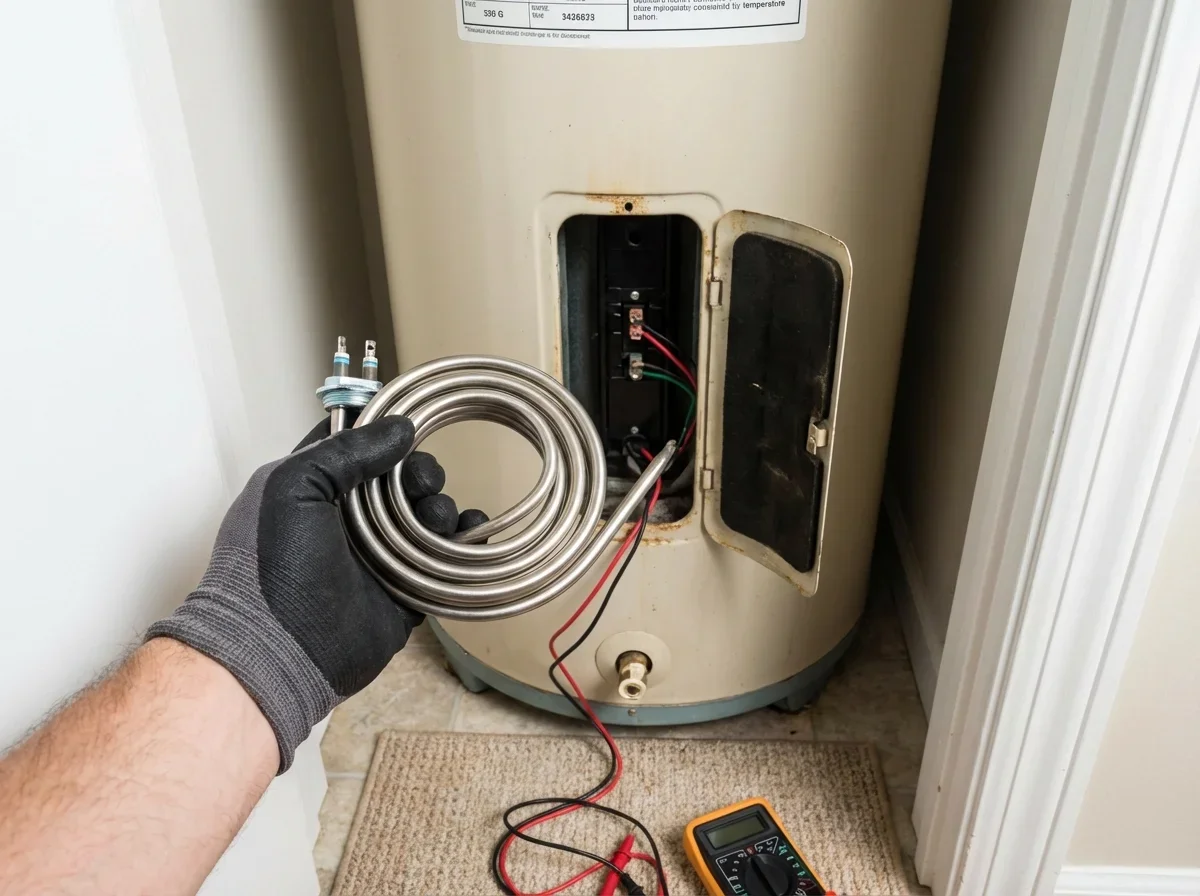
First-Year Failure Risk and Warranty Coverage
Manufacturing defects typically surface within the first two years. If your brand-new water heater fails in year one, it's almost always a factory defect — bad weld, faulty dip tube, defective gas valve.
Standard tank warranties cover parts for 6-12 years depending on the model tier, but labor is rarely included after the first year.
The warranty fine print matters when you're comparing replacement units. A "9-year warranty" might cover just the tank itself, while elements, thermostats, and gas valves have separate 1-year coverage. Premium models sometimes include one year of labor coverage, which saves you $200-400 if something fails in year one. Read the actual warranty document, not the sales brochure — they're rarely the same.
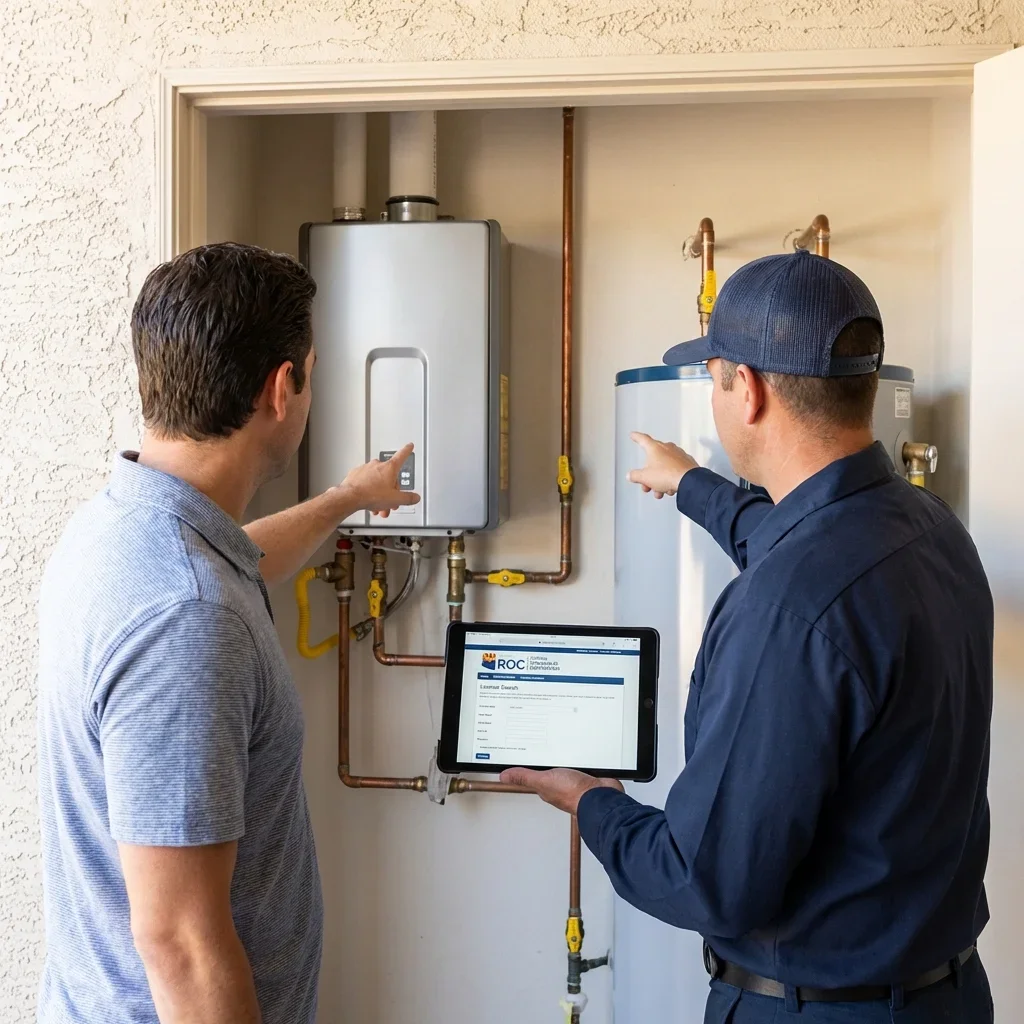
Installation quality affects warranty validity more than homeowners realize. Manufacturers void coverage if the unit wasn't installed per code — that includes proper venting clearances, correct gas line sizing, expansion tank installation (where required), and sediment trap orientation. Use a licensed ROC contractor (verify at roc.az.gov) and keep the permit documentation. You'll need it if you file a warranty claim.
Lifespan Differences: Gas vs. Electric vs. Tankless
Gas tank heaters in Phoenix average 8-10 years, slightly shorter than electric tanks (9-12 years). The burner assembly creates more heat stress, and the flue baffle corrodes from combustion byproducts.
Electric tanks have fewer failure points — just elements and thermostats — which explains the longer average life.
But electric tanks suffer worse from hard water scale on elements, so maintenance is non-negotiable for either fuel type.
Tankless gas units dominate the Phoenix market because natural gas is cheaper than electricity for water heating, and tankless units don't waste energy on standby losses. Properly maintained tankless heaters hit 18-22 years, but that "properly maintained" qualifier does heavy lifting. Annual descaling, intake filter cleaning, and occasional flame rod replacement are required, not suggested.
Heat pump water heaters haven't been in Phoenix homes long enough to establish real-world lifespan data, but the hybrid design (tank + heat pump) means you're maintaining two systems. The compressor typically lasts 10-12 years, and the tank follows standard tank longevity patterns. Replacement compressors cost nearly as much as a whole new unit, which makes heat pump water heaters a calculated gamble after year 12.
Geographic Factors: Slab-on-Grade Construction Impact
Phoenix's slab-on-grade construction puts water heaters in garages, closets, or exterior alcoves — rarely in basements (which don't exist here). Garage installations expose the unit to 110-130°F ambient summer temps, forcing the heater to work harder to maintain set temperature.
That heat stress shortens tank life by 1-2 years compared to climate-controlled interior locations.
The concrete slab also affects leak damage severity. A ruptured water heater in a garage might dump 40-50 gallons onto a floor drain before you notice, limiting damage to the garage. But units in interior closets adjacent to bedrooms or living spaces cause catastrophic damage — drywall, flooring, possibly ceiling damage to rooms below if it's a two-story home.
That risk calculation sometimes justifies replacing an 8-year-old tank that's not quite failed yet.
Energy Efficiency Decline as Heaters Age
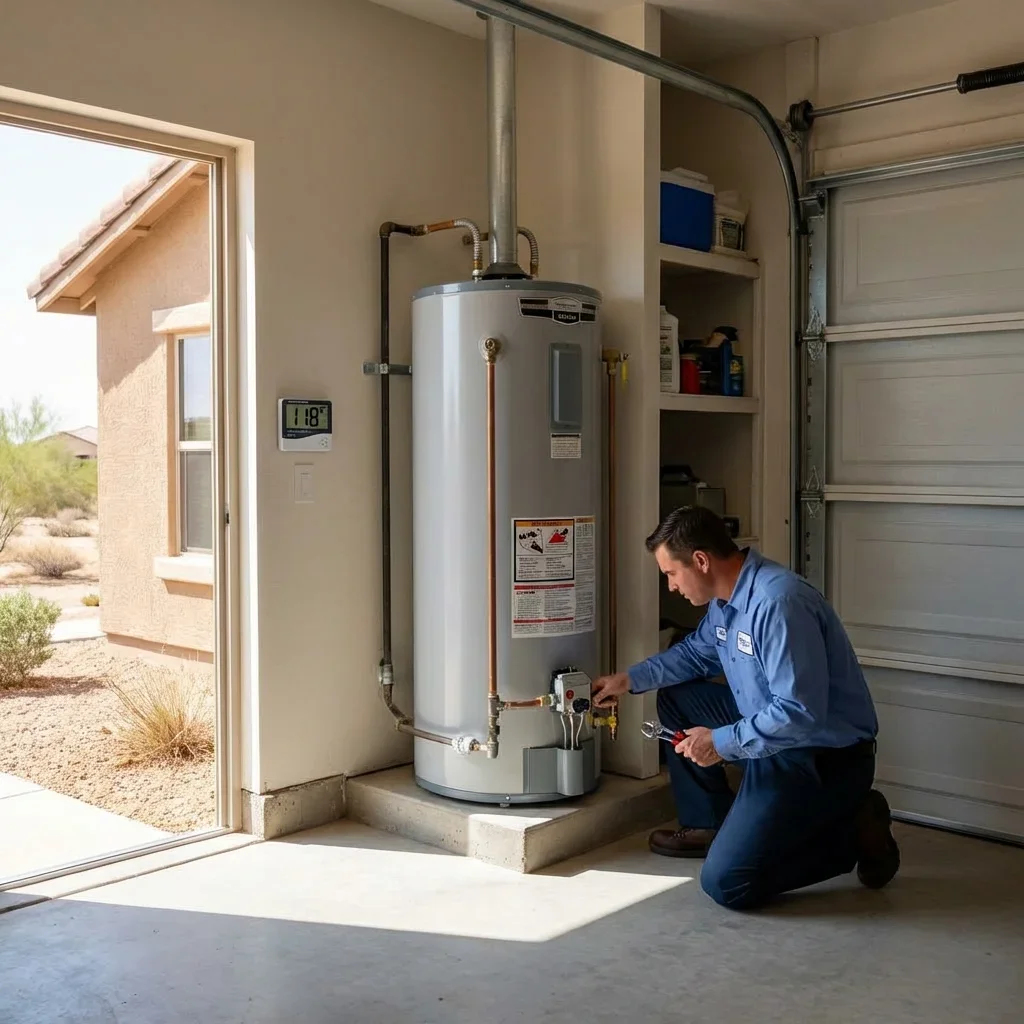
A new tank water heater operates at 60-65% energy factor (gas) or 95% (electric resistance). By year seven in hard water, scale buildup and sediment accumulation drop that to 50-55% for gas and 80-85% for electric.
You're paying 15-20% more to heat the same amount of water, which adds up to $80-120 annually on gas or $100-150 on electric.
Tankless efficiency holds steadier if you descale annually — they maintain 80-85% thermal efficiency through year 15. But a neglected tankless unit clogs with scale and drops to 60-70% efficiency by year 10, eliminating the efficiency advantage over tanks. The energy penalty makes replacement economically justified even if the unit still technically functions.
Insulation deterioration affects all tank types. The foam or fiberglass wrap between the tank and outer shell compresses over time, increasing standby heat loss. You can add an insulation blanket ($30-50) to older tanks, but if the tank itself is corroding, you're polishing rust. Better to replace with a modern high-efficiency unit that has 2-3 inches of foam insulation built in.
Commercial vs. Residential Grade Lifespans
Residential-grade tanks (6-year and 9-year warranty models) are built for 8-12 year service lives. Commercial-grade tanks with 12-year warranties use thicker steel, powered anode rods, and larger-diameter heat exchangers.
They cost 40-60% more upfront but routinely hit 15-18 years in residential applications.
The math works for homeowners planning to stay put — you'll skip one replacement cycle entirely.
The commercial-grade designation also appears in tankless units. Residential tankless models (Rinnai, Noritz, Navien) are built for single-family flow demands — 5-8 GPM output. Commercial units handle 10-15 GPM and use heavier-duty heat exchangers that resist scale better. Installing a commercial-grade tankless in a residential application is overkill from a capacity standpoint, but the enhanced durability means 20+ year service lives even in hard water.
Marathon electric tanks use a polyethylene tank instead of glass-lined steel. No tank corrosion means lifespans routinely exceed 20 years. They cost roughly double standard electric tanks upfront, but the lifetime cost-per-year beats everything except well-maintained tankless units. The limitation: they're bulkier than standard tanks and only available in electric, so they don't work for homes with gas infrastructure already in place.
When to Replace Before Failure
Age 8-10 represents the decision window for Phoenix homeowners. Your tank might have 2-4 years left, or it might fail next month.
The uncertainty itself has a cost.
Planned replacement lets you shop sales, compare contractors, and schedule around your calendar. Emergency replacement means you're paying expedite fees, accepting whatever model the plumber has on the truck, and dealing with water damage from the old tank's failure.
Preemptive replacement makes sense if you're already replumbing for a repiping project, replacing your water softener, or doing major bathroom renovations. The marginal cost of swapping the water heater while everything's already opened up is half what you'd pay for a standalone replacement. Combine the work and you'll save $400-600 in redundant labor.
Selling your home creates a different calculation. Buyers often request water heater replacement if it's over 10 years old, either as a condition of sale or a price reduction. Replacing it proactively at 9 years lets you control the model choice and contractor selection rather than negotiating a credit against asking price. A new water heater on the disclosure also eliminates one inspection concern entirely.
Professional Inspection and Diagnosis
ROC-licensed plumbers can assess remaining life during an annual maintenance visit. They'll check the anode rod, measure sediment depth, test the T&P valve, inspect for rust or leaks, and evaluate burner/element condition.
The inspection runs $100-150 as a standalone service, or it's often included free with routine maintenance packages.
Find licensed contractors through Arizona's ROC database at roc.az.gov.
Expect honest answers about whether repair makes sense. Reputable contractors won't push replacement on a 5-year-old tank with a bad thermostat — they'll fix it and move on. But they also won't sugarcoat things when your 11-year-old tank is rusting through. The best diagnostic indicator: ask how long they'd keep running the heater if it were in their own home. That answer cuts through sales pitch nonsense.
Some plumbing companies offer free replacement estimates that include full diagnostic inspection. You're not obligated to buy from them, and the inspection gives you the data you need to make an informed decision. Just verify the inspector holds an active ROC license — unlicensed inspections carry no accountability if they miss something or recommend unnecessary work.
Frequently Asked Questions
- U.S. Department of Energy. "Water Heating." https://www.energy.gov/energysaver/water-heating. Accessed April 07, 2026.
- U.S. Department of Energy. "Water Heater Maintenance Fact Sheet." https://www.energy.gov/energysaver/water-heater-maintenance-fact-sheet. Accessed April 07, 2026.
- U.S. Department of Energy. "How It Works: Water Heater." https://www.energy.gov/energysaver/how-it-works-water-heater. Accessed April 07, 2026.
- University of Arizona Cooperative Extension. "Water Softening." https://extension.arizona.edu/pubs/az1492. Accessed April 07, 2026.
- University of Arizona Cooperative Extension. "Ion Exchange Water Softening in Arizona." https://cals.arizona.edu/cooperative-extension/waterquality/documents/IONEXCHANGE.pdf. Accessed April 07, 2026.