How Each System Works (And Why It Matters in Phoenix)
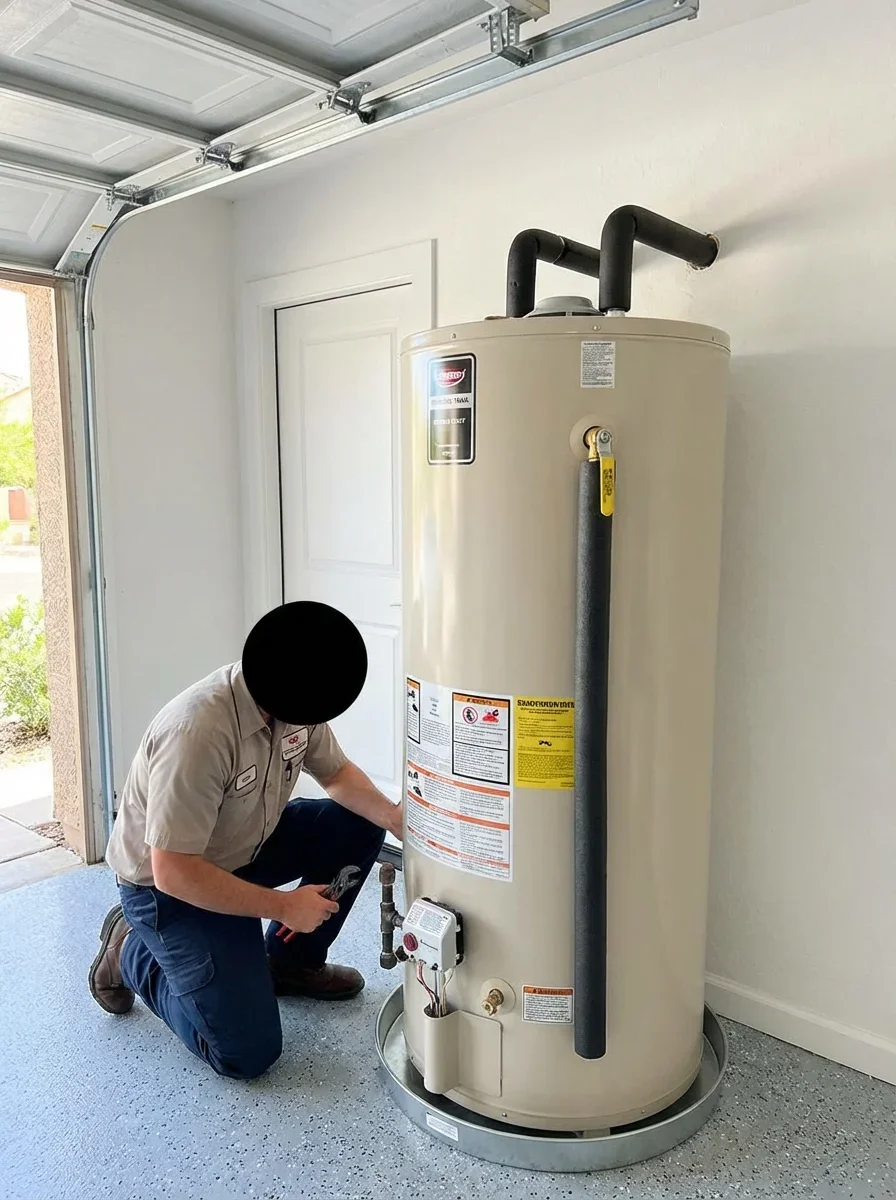
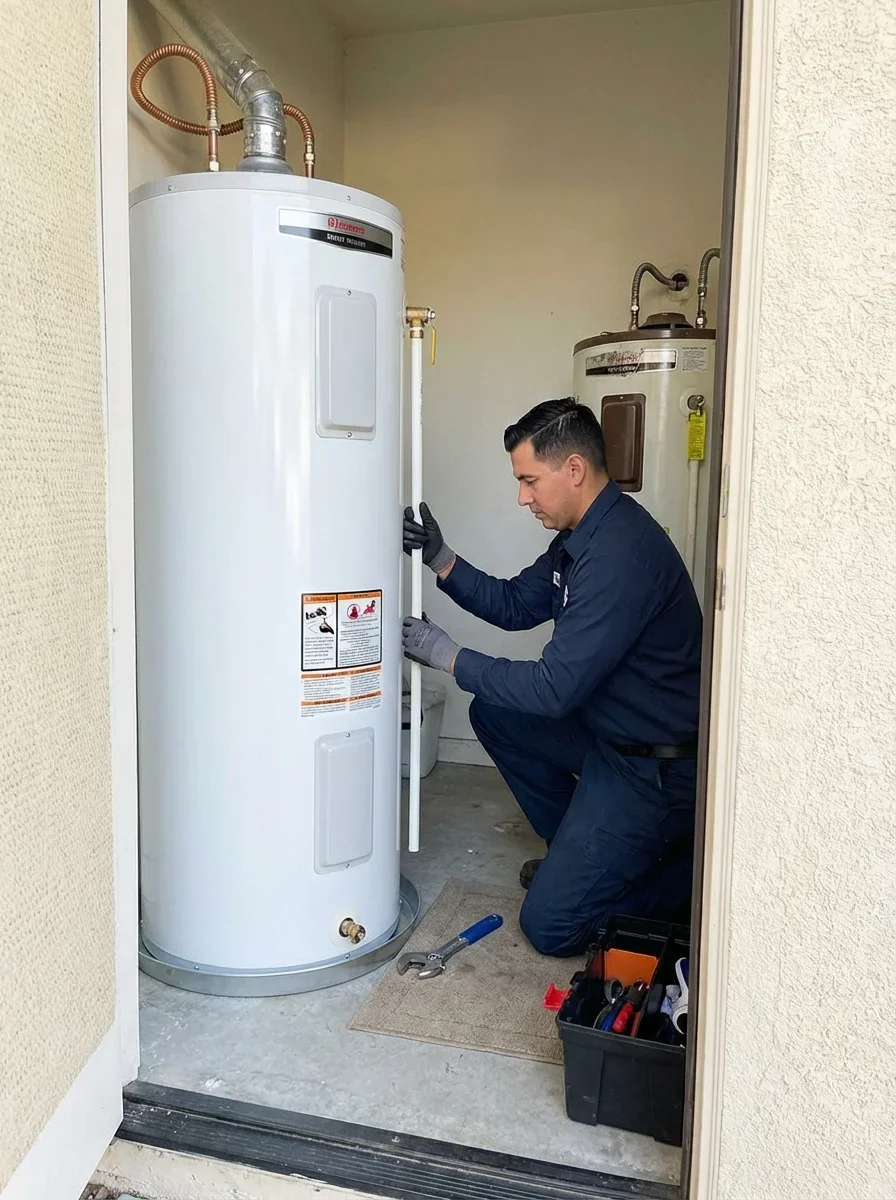
Traditional tank water heaters store 40-80 gallons of hot water in an insulated cylinder. Gas burners or electric elements maintain temperature around the clock, even when you're asleep or at work.
That constant reheating is called standby loss — you're paying to keep water hot that you're not using.[2]
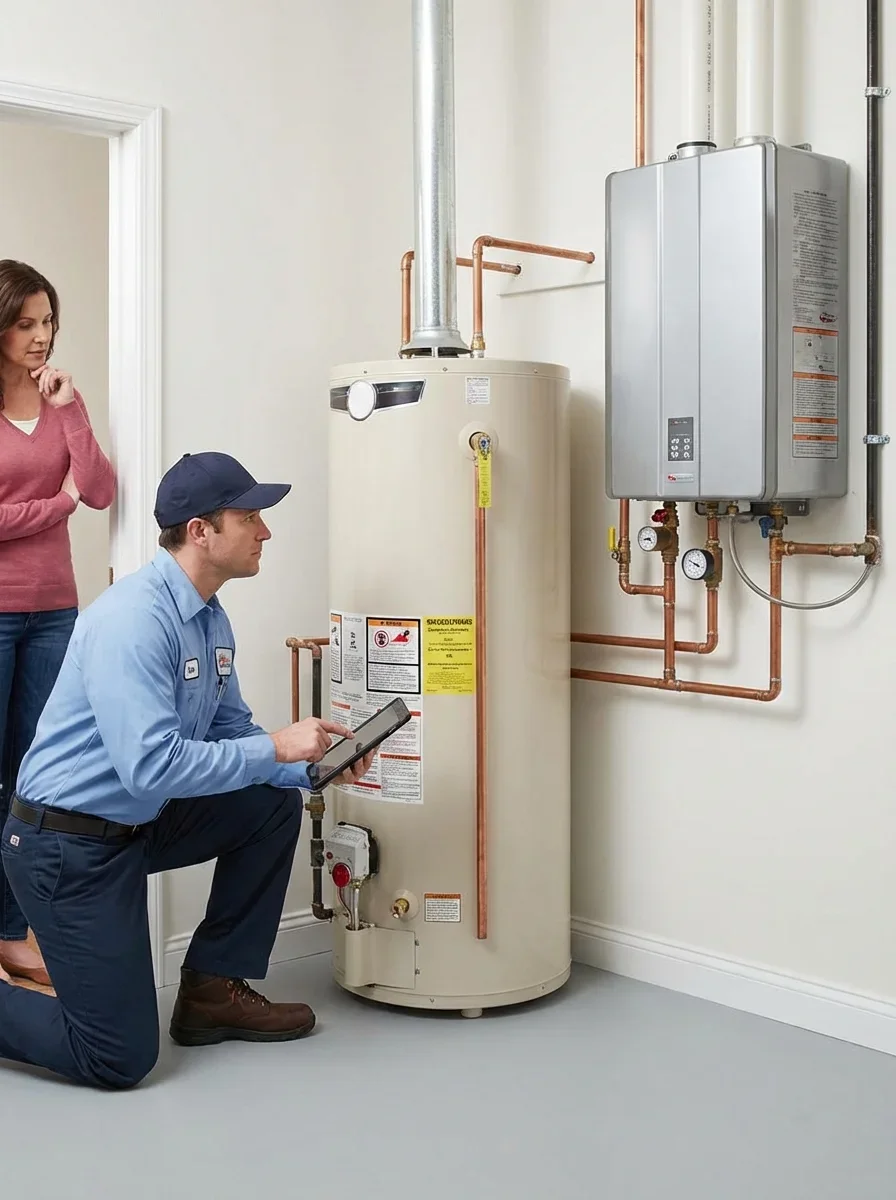
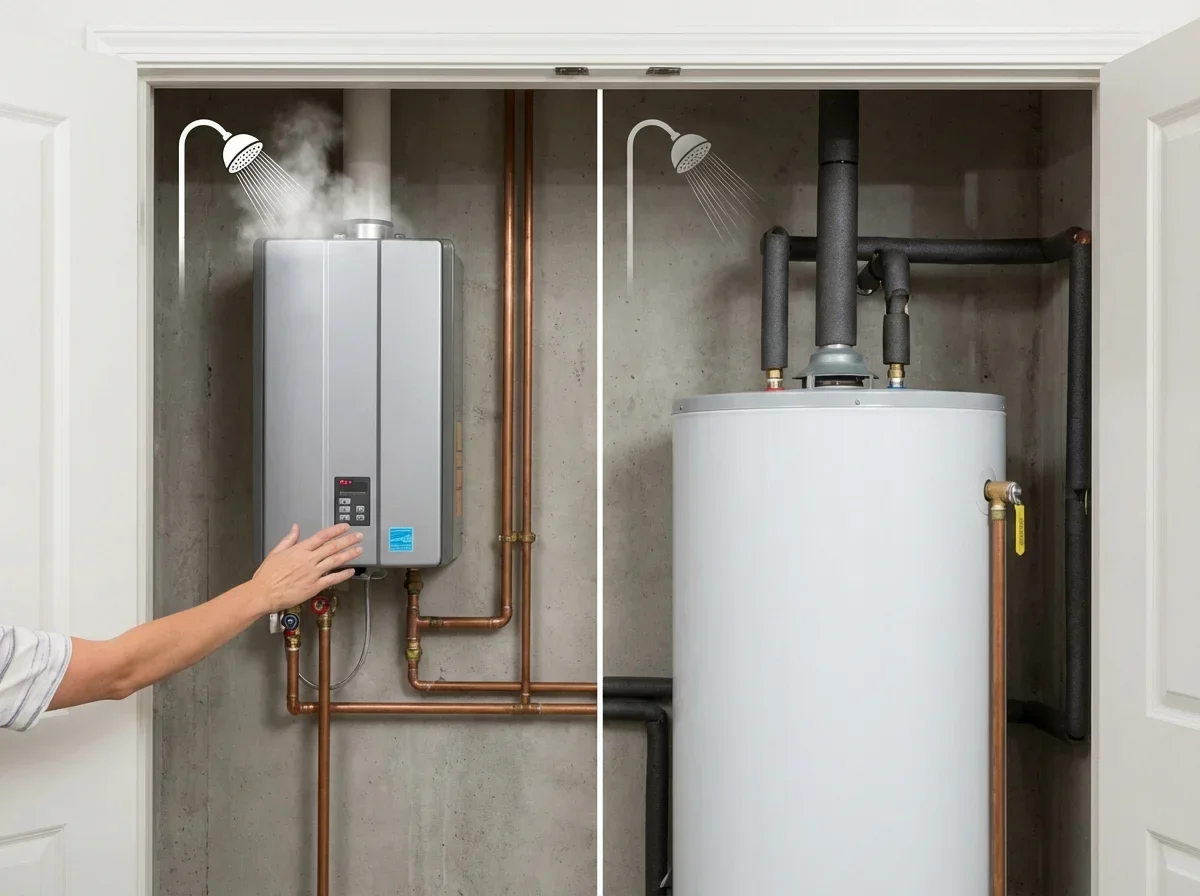
Tankless systems skip the storage entirely. Cold water runs through a heat exchanger only when you open a tap, heated by a powerful gas burner or electric element on demand. No tank means no standby loss, but it requires significant energy input in short bursts.[2]
Phoenix's incoming water temperature matters more than most homeowners realize. Summer groundwater here runs 75-80°F, but winter temps drop to 55-60°F. That 20-degree swing means your tankless unit works 30% harder in January than July to deliver the same 120°F shower. Tank heaters smooth out that variation since they maintain temperature constantly.
| Feature | Tank Water Heater | Tankless Water Heater |
|---|---|---|
| Standby Loss | Yes — constant reheating | None — heats on demand |
| Winter Performance | Consistent (maintains temp 24/7) | Works 30% harder with cold groundwater |
| Summer Efficiency | Lower (fights ambient heat) | Higher (warm input water) |
| Recovery Method | Reheats stored water over 45-60 min | Instant heating via burner/element |
Upfront Cost Reality: What You'll Actually Pay
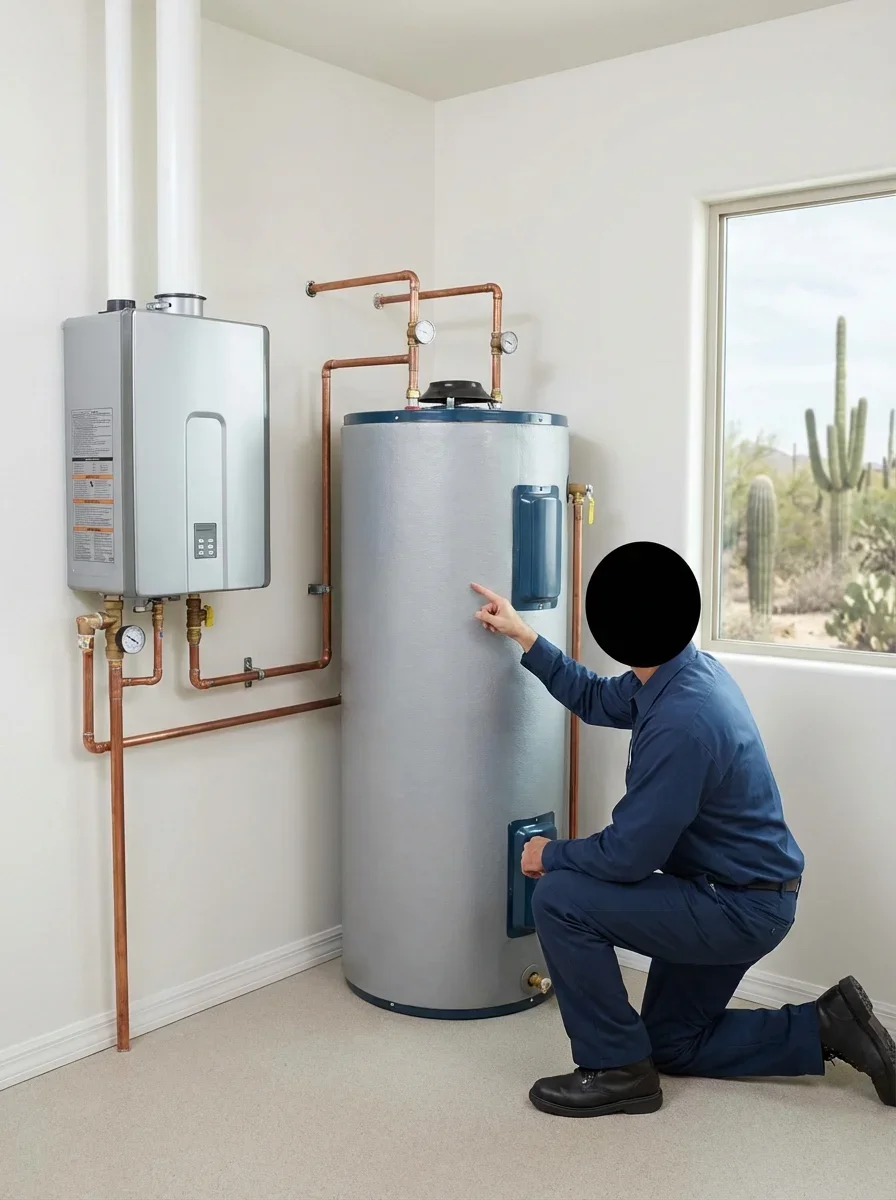
A 50-gallon tank water heater installed in Phoenix runs $1,200-$2,200 depending on whether you choose basic atmospheric venting or power-vented models. Gas units sit at the lower end, electric at the higher end. Replacement is straightforward when you're swapping like-for-like.
Tankless installation starts around $3,000 and easily reaches $5,500-$6,500 for whole-home gas units.
The price jump isn't just the equipment.
You're often upgrading gas lines (most homes have ½" lines that won't support tankless flow requirements), adding dedicated electrical circuits for the ignition system, running new venting (tankless units require Category III or PVC vent pipe, not the standard B-vent most homes have), and potentially relocating the unit since tankless models need outdoor installation or significant indoor ventilation in Phoenix's climate.
Installation Challenges in Slab Homes
Phoenix's slab-on-grade construction adds complications. There's no basement or crawlspace to run new gas lines — everything goes through walls or gets trenched outside through caliche.
One plumber quoted a homeowner $2,800 extra just to upgrade the gas line from the meter to the house because hitting caliche at 18 inches turned a four-hour job into two days of excavation.
ROC-licensed contractors can verify whether your existing infrastructure will support tankless before you commit. Verify credentials at roc.az.gov before signing contracts. Unlicensed work on gas systems voids your homeowner's insurance and creates serious safety liability.
Energy Efficiency: The Numbers Behind the Claims
Tankless water heaters are 24-34% more energy efficient than tank models for homes using 41 gallons or less of hot water daily.[1] Push above that threshold and the efficiency advantage drops to 8-14%.[3]
The question is where your household sits on that spectrum.
A typical Phoenix family of four uses 60-80 gallons of hot water daily between showers, laundry, and dishes. You're in the lower efficiency bracket. Running the math: if your current tank heater costs $35/month in gas, switching to tankless might save you $4-5 monthly. Over 15 years, that's $900-$1,100 in energy savings against a $3,000+ upfront premium.
Hard Water Destroys Efficiency Faster Here
Phoenix's extremely hard water (300+ ppm calcium carbonate) changes the efficiency equation. Scale buildup reduces water heater efficiency 20-30% over five years in both tank and tankless systems.
But tankless heat exchangers have tighter tolerances.
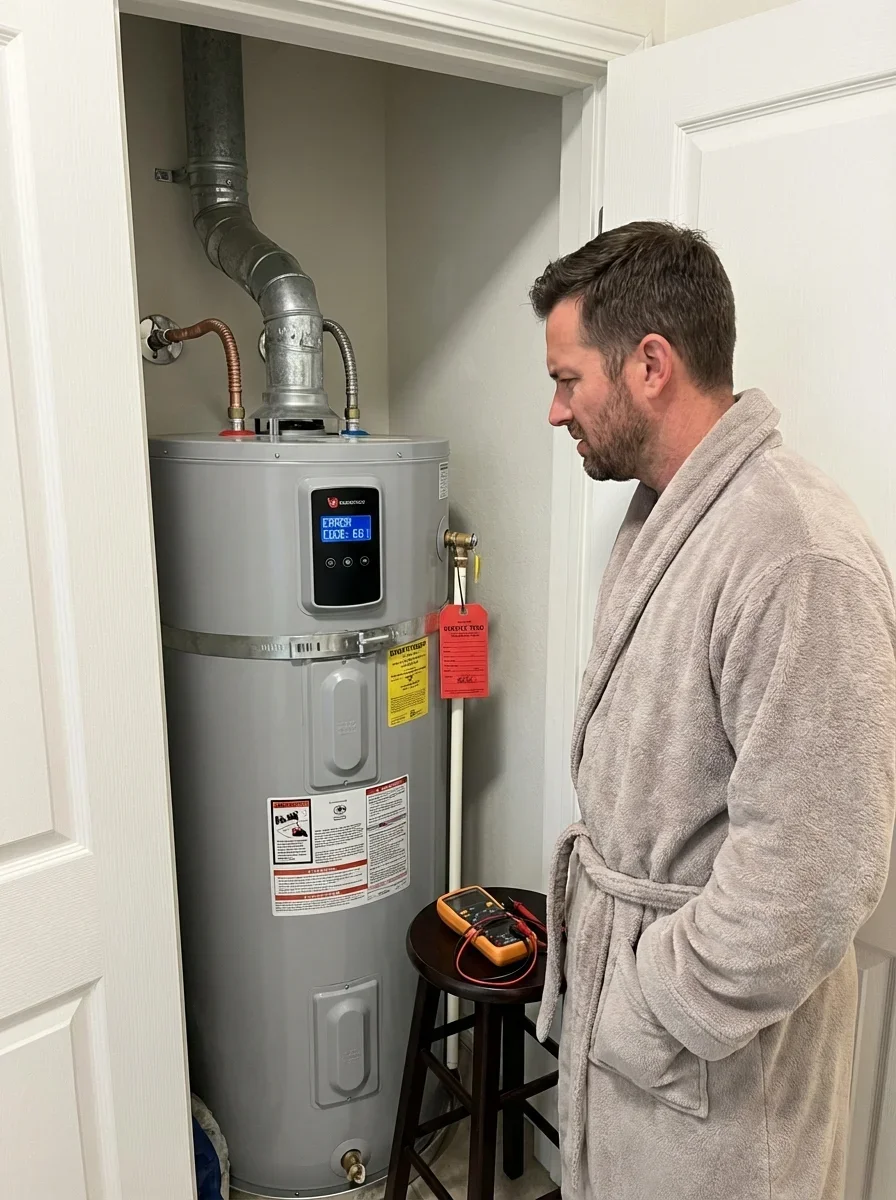
Mineral deposits choke flow faster and require annual descaling that costs $150-$200 per service. Tank heaters need flushing too, but homeowners skip it more often because the performance degradation is gradual. A scaled-up tankless unit will cycle on and off erratically or display error codes. A scaled tank just takes longer to reheat. Both are bad, but tankless systems force you to address the maintenance or face complete failure.
Installing a water softener before going tankless isn't optional in Phoenix. It's the difference between a 15-year lifespan and a 7-year one. Factor that $1,500-$2,500 cost into your decision.
Phoenix Hard Water Reality: At 300+ ppm calcium carbonate (double the national threshold for "very hard"), Phoenix water accelerates scale buildup in tankless heat exchangers. Skip annual descaling and you're looking at heat exchanger replacement ($600-$1,200) every 3-4 years instead of a 15-20 year unit lifespan.
Lifespan and Replacement Reality
Gas tank water heaters in Phoenix typically last 8-10 years. Electric tanks might reach 12 years. The combination of hard water and constant thermal cycling wears out sacrificial anode rods and tank linings faster than the national 12-15 year average you'll see quoted.
Tankless units should last 15-20 years with proper maintenance.
That longer lifespan is real, but it assumes annual descaling, regular filter cleaning, and flushing the heat exchanger every 12-18 months.
Skip maintenance and you'll replace components (flow sensors, ignition assemblies, heat exchangers) at $400-$800 per incident. One homeowner replaced their tankless unit's heat exchanger twice in six years before giving up and switching back to tank. They hadn't known about the descaling requirement until scale deposits cracked the exchanger.
Total cost: $6,400 for a system that never reached year seven.
Performance Differences You'll Notice Daily
Tankless systems deliver truly endless hot water as long as flow rate stays within capacity. A properly sized unit handles two showers running simultaneously without temperature fluctuation.
Tank heaters run out — you know exactly when the last person gets a cold shower.
Flow Rate Becomes the Limiting Factor
But "endless" doesn't mean unlimited flow. A typical whole-home tankless unit in Phoenix provides 6-8 gallons per minute (GPM) with our groundwater temperatures. One shower uses 2-2.5 GPM, a dishwasher 1.5 GPM, a washing machine 2 GPM.
Run a shower, dishwasher, and washing machine simultaneously and you're maxing out capacity.
The unit maintains temperature, but water pressure drops noticeably across all fixtures. Tank heaters deliver 10-12 GPM during the first-hour rating period (the amount of hot water available in one hour of peak use). You get strong pressure everywhere until the tank empties, then you wait 45-60 minutes for full recovery.
Phoenix summer demand shifts this equation. June through August, cold water input is already warm. Your tankless unit runs more efficiently and your tank heater reheats faster. Winter is when you'll notice tankless recovery times during back-to-back showers.
Operating Cost Breakdown Over 15 Years
Compare actual ownership costs for a typical Phoenix household using 65 gallons of hot water daily:
50-gallon tank water heater:
- Purchase and installation: $1,800
- Annual energy cost: $420 (gas) or $550 (electric)
- Maintenance: $0-$150 total (most homeowners skip flushing)
- Replacement at year 10: $1,800
- 15-year total: $9,900 (gas) or $12,000 (electric)
Tankless water heater:
- Purchase and installation: $5,200 (including gas line upgrade)
- Annual energy cost: $365 (gas)
- Annual descaling service: $175
- Minor repairs (sensors, igniters): $800 over 15 years
- 15-year total: $11,975
The tankless system costs $2,075 more over 15 years in this scenario.
Not the massive savings marketing materials promise. Your math changes if energy prices spike or if you use less than 50 gallons daily, but most Phoenix families won't see dramatic savings.
Quick Cost Comparison Summary:
- Tank upfront cost: $1,200-$2,200
- Tankless upfront cost: $3,000-$6,500
- Monthly energy savings (tankless): $4-$5 for typical families
- Annual maintenance (tankless): $150-$200 required
- 15-year total ownership difference: $2,000-$2,500 more for tankless
- Break-even point: Never for most Phoenix households using 60+ gallons daily
Space and Installation Footprint
Tank water heaters in Phoenix typically sit in garages since we don't have basements. A 50-gallon tank occupies about 7-8 square feet of floor space. Indoor closet installations are possible but require atmospheric venting through the roof or power-vented models that exhaust through an exterior wall.
Tankless units mount on exterior walls (preferred) or in garages with dedicated ventilation. The unit itself is roughly the size of a carry-on suitcase — about 2 square feet of wall space.
That's a legitimate space savings in newer homes where garage storage matters.
Outdoor installation in Phoenix requires shade or the electronics fail prematurely. Direct sun on a tankless unit's control board shortens its life by 30-40%. You'll see units mounted on north-facing walls or under eaves. Some homeowners build small shade structures, adding $200-$400 to installation costs.
Maintenance Requirements and Costs
Tank water heaters need annual flushing to remove sediment buildup. The job takes 30 minutes if you DIY or costs $100-$150 if you hire it out. Anode rod replacement every 3-5 years adds another $200-$300.
Most Phoenix homeowners skip both until the unit fails.
Tankless systems require annual descaling with vinegar or citric acid solution — not optional in hard water areas. The process takes 60-90 minutes and requires a submersible pump and hoses. DIY costs $30-$40 in supplies. Professional service runs $150-$200 and includes cleaning the inlet filter screen and checking ignition components.
Skipping descaling voids most manufacturer warranties. You'll see fine print requiring "annual maintenance by a qualified technician" or "regular descaling in areas with hard water above 150 ppm."
Phoenix is double that threshold.
Which System Makes Sense for Your Situation
Tankless systems genuinely work better for specific Phoenix households. Small homes or couples using less than 40 gallons daily hit the efficiency sweet spot where energy savings partially offset upfront costs. Homes with existing upgraded gas lines and outdoor mounting locations avoid the installation premium.
If you're already installing a whole-home water softener for other reasons, tankless becomes more viable.
Tank heaters make more sense for families with high simultaneous demand (teenage daughters, elderly parents, guests), homes requiring significant infrastructure upgrades to support tankless, and anyone who won't commit to annual maintenance schedules. The lower upfront cost and simpler replacement cycle matter when you're budgeting for other home improvements.
The Hybrid Option Few Consider
Hybrid heat pump water heaters combine a small tank (50-80 gallons) with heat pump technology that's 2-3x more efficient than standard electric resistance heating. They cost $1,800-$2,800 installed — between tank and tankless — and work exceptionally well in Phoenix's climate. The heat pump pulls warmth from garage air, which is abundant here even in winter.
They're slower to recover than tankless (90 minutes for full reheat vs. instant), but more efficient than standard tanks.
One homeowner saw their water heating costs drop from $52/month (electric tank) to $18/month after switching.
They're worth considering if you have garage space and 240V electrical service available.
Contractor Selection and ROC License Requirements
All water heater installations in Arizona require an active ROC plumbing license for work exceeding $1,000. Gas line modifications require additional endorsements beyond basic plumbing licenses.
Verify contractor credentials at roc.az.gov before signing contracts.
You're checking for license type, status, and any complaint history. ROC bonds cover only $4,000-$15,000 depending on license classification. That doesn't cover major gas line failures or improper installations that damage your home. Ask contractors for their general liability insurance certificates (not just the ROC bond) and verify workers compensation coverage if they have employees.
Arizona doesn't mandate workers comp, so injuries on your property could become your liability.
Get three quotes for tankless installations. The price spread is typically $2,000-$3,500 because infrastructure requirements vary by home. One contractor might quote $3,400 assuming your gas line is adequate while another includes a $1,800 gas line upgrade in their $5,200 quote.
Make sure all quotes specify what infrastructure work is included.
Permit Requirements for Water Heater Replacement
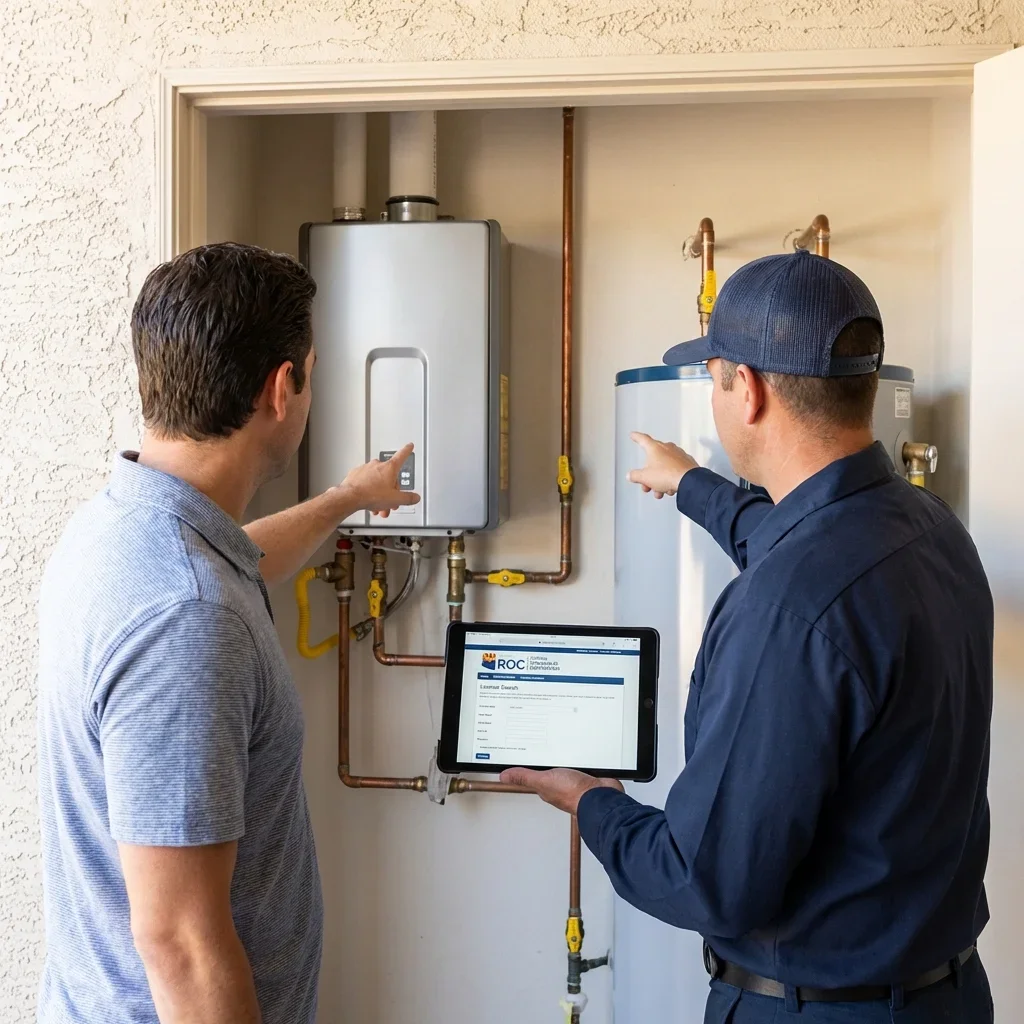
Tank-to-tank replacement of the same fuel type (gas-to-gas, electric-to-electric) typically doesn't require permits in Phoenix if the location and venting remain unchanged. Switching fuel types, relocating the unit, or upgrading from tank to tankless requires permits through your local building department.
Tankless installations almost always require permits because they involve gas line modifications, new electrical circuits, and venting changes. Permit costs run $150-$300 depending on scope.
Inspections verify proper gas line sizing, adequate combustion air, correct venting termination, and earthquake strapping requirements.
Unpermitted work surfaces during home sales when buyers request utility verifications. Sellers either bring the work into compliance (expensive) or face contract cancellations. Some insurance companies deny claims if they discover unpermitted fuel-burning appliance installations.
Local Climate Considerations That Actually Matter
Phoenix summer temperatures exceed 106°F for 30-40 days annually. Garage-mounted water heaters sit in 120°F+ ambient heat. That thermal load means tank heaters work less to maintain temperature (the garage acts as a pre-heater), but it also accelerates tank corrosion and anode rod depletion.
Tankless units struggle with extreme ambient heat because control boards and ignition systems have maximum operating temperatures around 140°F.
Outdoor units mounted in full sun or garage units without ventilation fail at higher rates.
Expect component replacements every 5-7 years instead of the 10-12 year intervals seen in temperate climates. Winter desert nights drop to 35-40°F. Outdoor tankless units need freeze protection kits (included in better models) that maintain minimum internal temperatures. Those protection circuits run 24/7 during cold snaps, consuming electricity even when you're not using hot water.
It's not standby loss in the traditional sense, but it's parasitic energy consumption that erodes efficiency claims.
When Replacement Timing Forces Your Decision
Most water heater decisions happen under pressure. Your existing unit flooded the garage or stopped heating entirely, and you need hot water restored within 24 hours.
Emergency replacement scenarios favor tank heaters because inventory is available immediately and installation takes 2-4 hours.
Tankless emergency installations rarely happen same-day unless your home already has the necessary infrastructure. Most scenarios require ordering equipment (3-5 days), scheduling gas line work, and coordinating inspections. You're using cold water or heating pots on the stove for a week.
If your current tank heater is 7-9 years old and showing signs (rusty water, popping noises, moisture around the base), now is the time to research tankless options. You can get three quotes, verify infrastructure requirements, and make an informed decision before you're forced into emergency mode.
Consider reading our detailed breakdown of water heater replacement costs in Phoenix to understand what drives pricing variations. We also cover common water heater problems specific to Phoenix and expected lifespans by unit type.
The Honest Bottom Line
Tankless water heaters aren't automatically better.
They're different systems optimized for different use cases. Phoenix's hard water and extreme temperatures amplify maintenance requirements and narrow the efficiency gains compared to milder climates. You'll spend more upfront and commit to annual service, gaining space savings and continuous hot water in return.
Tank heaters remain the practical choice for most Phoenix households when you factor in total ownership costs, infrastructure limitations in slab homes, and actual hot water usage patterns.
The $3,000-$4,000 price difference buys a lot of other home improvements that might deliver more value.
Make your decision based on your specific household's hot water demand, existing infrastructure, and honest assessment of whether you'll maintain the system properly. Both technologies work fine in Phoenix when sized correctly and maintained appropriately. The "best" choice is whichever system matches your budget, usage patterns, and willingness to commit to maintenance schedules.
Frequently Asked Questions
- U.S. Department of Energy. "Water Heating." https://www.energy.gov/energysaver/water-heating. Accessed April 07, 2026.
- U.S. Department of Energy. "Tankless or Demand-Type Water Heaters." https://www.energy.gov/energysaver/tankless-or-demand-type-water-heaters. Accessed April 07, 2026.
- U.S. Department of Energy. "Tankless Water Heaters." https://www.energy.gov/energysaver/tankless-water-heaters-0. Accessed April 07, 2026.