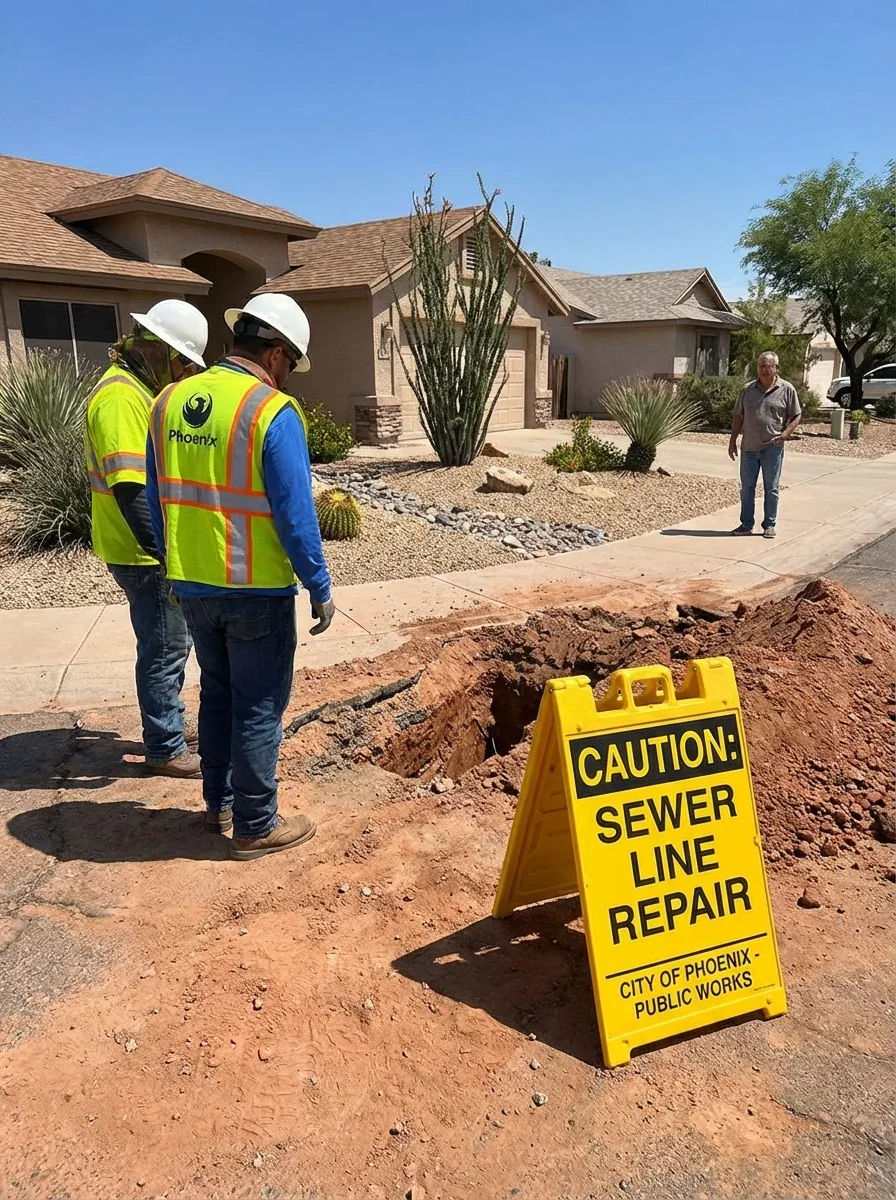
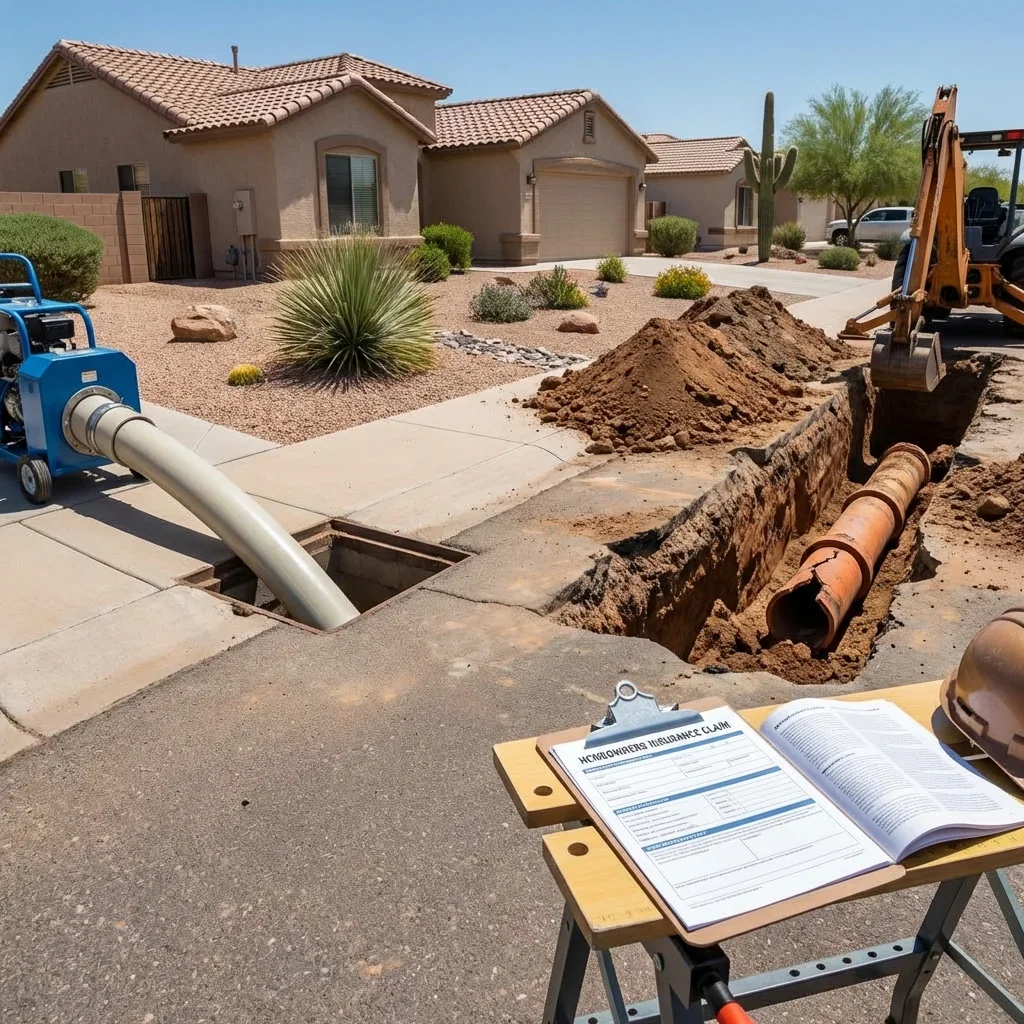
Why Phoenix Sewer Lines Fail Differently
Your sewer line doesn't just carry waste—it navigates conditions that accelerate deterioration faster than national averages predict. Phoenix's caliche layer, that cement-hard calcium carbonate formation sitting 1-6 feet below grade, shifts and settles differently than normal soil. When your foundation moves (and in Phoenix, they all move), rigid cast iron and clay pipes crack at the joints.
The city's relentless UV exposure and temperature swings matter more than you'd think for underground pipes. Summer soil temps can hit 95°F at shallow depths, while winter nights drop to 40°F. That 55-degree annual swing causes expansion and contraction cycles that fatigue pipe materials, especially in pre-1980 homes built with cast iron drain lines.
Add hard water carrying dissolved minerals through every flush, and you've got scale accumulation narrowing your pipe diameter by 15-20% over a decade.
Materials That Don't Age Well in Arizona
Camera inspections regularly uncover Orangeburg pipe (bituminous fiber) in homes built before 1970. This compressed wood pulp material was cheap and common in post-war construction, but it degrades into an oval-shaped tube that collapses under Phoenix's alkaline soil conditions.
If your home was built between 1945-1972 and you've never scoped your sewer line, there's a 40% chance you're running on borrowed time with Orangeburg somewhere in your system.
Cast iron pipes installed through the 1980s face a different problem: hydrogen sulfide corrosion. Bacteria in sewage produce H₂S gas, which condenses on pipe walls above the water line and converts to sulfuric acid. Phoenix's hot, dry climate accelerates this process because less rainwater dilutes your sewer line, creating more concentrated bacterial activity.
The top half of your cast iron pipe corrodes from the inside out while the bottom half looks fine. Until a camera reveals metal so thin you can see light through it.
| Pipe Material | Common Era | Primary Failure Mode | Expected Lifespan in Phoenix |
|---|---|---|---|
| Orangeburg (bituminous fiber) | 1945-1970 | Collapses into oval shape under alkaline soil | 30-40 years |
| Cast Iron | 1950-1980s | Hydrogen sulfide corrosion from inside | 40-50 years |
| Clay | Pre-1980 | Cracks at joints from foundation movement | 50-60 years |
| PVC | 2000-present | Joint separation from improper installation | 50-100 years |
What Arizona Code Requires (And What It Doesn't)
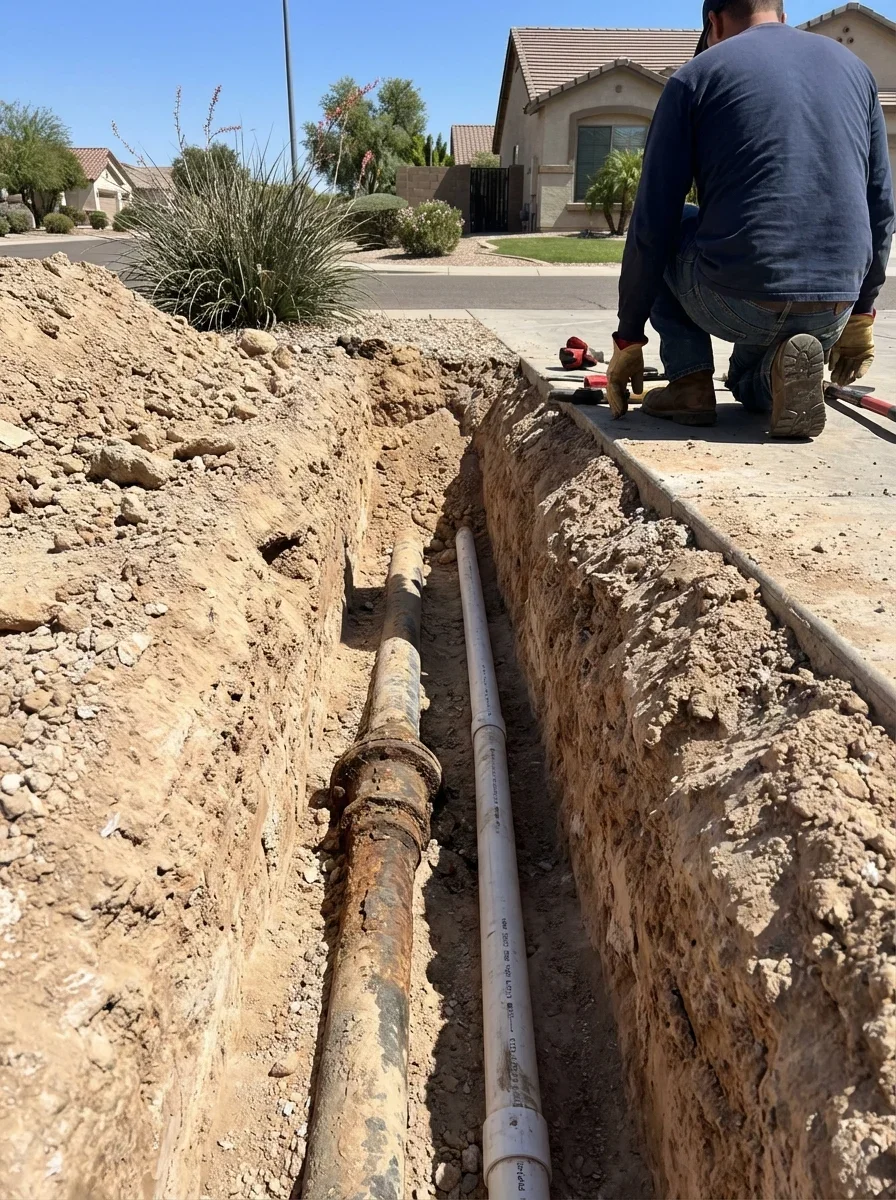
Arizona Administrative Code R18-9-E301 mandates sewer lines maintain a minimum slope calculated from Manning's Formula using a roughness coefficient of 0.013 and sewage velocity of 2 feet per second, with at least 3 feet of earth cover over each line[1]. That's engineering speak for "your pipe needs to drain by gravity without creating standing water where solids settle."
Here's what most homeowners miss: the City of Phoenix Design Standards Manual (2021) provides detailed specifications for municipal sewer mains, but your private lateral from the house to the city connection operates under different rules[2]. The Town of Florence code makes this explicit: property owners bear full responsibility for maintenance of the entire customer line from the building to the public sewer connection, including locating and repairing damaged sections on private property[5].
Phoenix operates under the same principle even though it's not always clearly communicated at closing.
That three-foot minimum cover depth requirement becomes critical during landscaping projects. Contractors installing irrigation systems or digging post holes regularly strike sewer lines running shallower than code in older neighborhoods where documentation disappeared decades ago. Arizona City Sanitary District standards define your maintenance responsibility as beginning three feet outside your foundation wall[4], which means the transition from inside to outside your home includes a significant section you can't see without excavation.
Warning Signs Phoenix Homeowners Report
Multiple drains slowing down simultaneously signals a main line problem, not individual fixture clogs. When your kitchen sink, guest bathroom, and laundry drain all start gurgling within the same week, water is backing up in your sewer line and pushing air bubbles backward through branch lines.
Phoenix homeowners in aging neighborhoods report this pattern 2-3 months before a complete blockage occurs.
Sewage odors near cleanouts, in your yard, or around the foundation perimeter indicate either a crack in your line or a failing wax ring seal where the pipe exits your foundation. Desert landscaping hides these smells better than grass lawns. You might not notice the problem until you're watering plants near the affected area and disturb gases trapped in dry soil.
Drainage Patterns That Reveal Hidden Damage
Water pooling in your yard during normal use (not after rain) points to a break in your sewer line. Phoenix's caliche layer prevents water from percolating down, so sewage escaping a cracked pipe creates a saturated zone that stays wet even in 105°F heat.
You'll often see unusually green grass or thriving plants in a suspicious circle. They're feeding on nutrient-rich sewage leaking into the soil.
Toilet water levels that rise and fall on their own indicate a partial blockage creating a siphon effect as other fixtures drain. This happens when tree roots penetrate a crack and create a flap valve: water can pass in one direction but gets restricted coming back. Homeowners in established Phoenix neighborhoods with mature trees (especially mesquite, palo verde, and oleander planted near sewer lines) see this pattern when roots follow moisture vapor escaping through aging pipe joints.
Red Flags That Demand Immediate Camera Inspection:
- Multiple drains slowing simultaneously (main line issue, not fixture clog)
- Sewage odors near cleanouts or foundation perimeter
- Water pooling in yard during normal use (not after rain)
- Unusually green grass patches in circular patterns
- Toilet water levels rising/falling on their own
- Gurgling sounds from drains when other fixtures are used
- Persistent slow drains despite repeated snaking
Preventive Maintenance That Actually Works
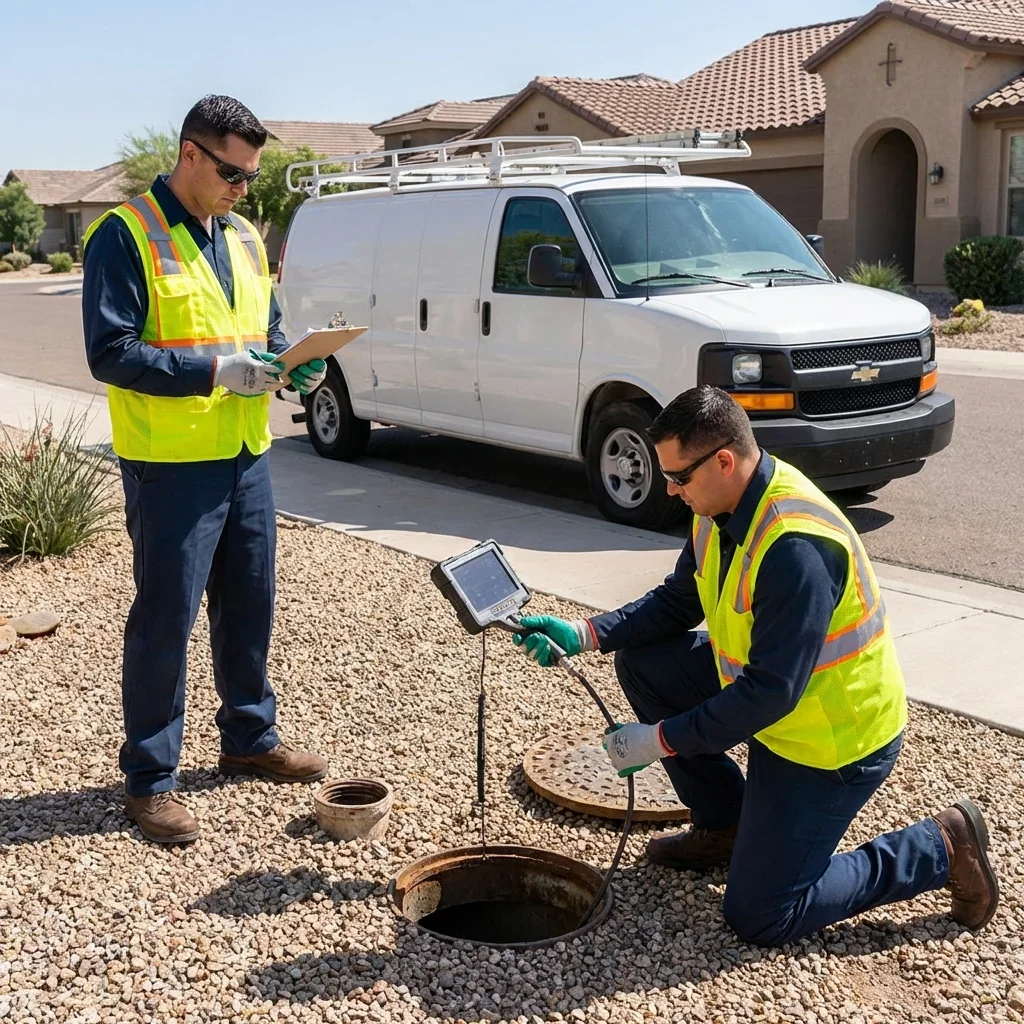
Annual professional inspections using camera technology cost $200-400 but identify problems while they're still affordable to fix. A sewer camera inspection reveals cracks, root intrusion, scale buildup, and pipe material condition in real-time video you can review with the technician.
For homes built before 1980, this isn't optional maintenance. It's insurance against five-figure emergency repairs.
Phoenix's hard water creates mineral scale that standard drain snaking can't address. Homeowners who rely on repeated snaking for slow drains report temporary relief lasting 3-6 months before symptoms return. The snake cuts a hole through the clog but leaves scale coating the pipe walls, narrowing the effective diameter.
Hydro jetting uses 3,000-4,000 PSI water pressure to scour pipes clean, removing grease, mineral deposits, and early-stage root intrusion. One Phoenix homeowner documented the difference: after years of quarterly snaking appointments at $175 each, a single $450 hydro jetting service eliminated slow drains for 18 months.
What Smart Homeowners Do Differently
Schedule major cleaning before problems emerge, not after backups occur. Hydro jetting works best as preventive maintenance on pipes that still have full structural integrity. Once a line has collapsed or separated at joints, high-pressure water can worsen the damage.
Homes built 1960-1990 should have their first camera inspection at age 30-35, then hydro jetting based on what the camera reveals.
Fountain Hills Sanitary District standards require all gravity sewer lines be cleaned by hydrovac prior to final inspection[3]. While that applies to new construction, the principle holds for existing homes: professional cleaning reveals problems that routine use masks. Scale buildup and early root penetration show up clearly after cleaning removes the organic layer coating damaged areas.
Document your sewer line location before you need it. Take photos during any excavation work that exposes the line, note depth and distance from permanent landmarks, and keep cleanout locations mapped in your home maintenance file.
Phoenix contractors charge $350-600 just to locate a sewer line using camera equipment, and caliche soil makes exploratory digging expensive ($180-250 per hour for hand excavation through hardpan).
How Phoenix's Construction Types Affect Maintenance
Slab-on-grade homes (the Phoenix standard) route all drain lines under the concrete foundation before exiting to the main sewer connection. Unlike homes with basements or crawl spaces, you can't access these pipes without jackhammering concrete.
A break in the section under your slab requires either slab leak repair techniques or trenchless repair methods that reline the pipe from inside.
Pre-1980 block construction used cast iron drain lines stubbed up through the slab, with ABS or PVC branches connecting fixtures. The transition points between dissimilar materials corrode faster than uniform piping. The electrochemical reaction between cast iron and plastic accelerates rust formation at joints. Camera inspections on 40+ year old Phoenix homes routinely find these transition joints failing while the main cast iron trunk line still functions.
Post-2000 frame and stucco construction switched to PVC for all drain lines, which solves the corrosion problem but introduces different maintenance needs. PVC joints rely on solvent welding that can fail if installed in Phoenix's summer heat when pipe surface temps exceed manufacturer specifications (140°F).
Improperly cured joints separate under normal use after 10-15 years, creating gaps where roots penetrate and sewage leaks.
The Root Intrusion Reality
Mesquite and palo verde trees send roots 50+ feet from the trunk, following moisture vapor that escapes through the microscopic gaps where sewer pipe sections join. Once a root hair finds a crack, it grows into a thick mat inside your pipe within 2-3 years.
Phoenix's year-round growing season means roots never go dormant. They're actively seeking water 12 months a year.
You can't stop tree roots from existing, but you can minimize access points. Sewer pipe joints should be watertight, which older clay and cast iron lines rarely achieve after 30+ years in shifting caliche soil. Applying copper sulfate or foaming root killers through your toilet provides temporary chemical barriers (90-180 days of effectiveness), but damaged pipes need mechanical clearing and eventual repair.
When Roots Require Replacement, Not Just Cleaning
Hydro jetting removes root intrusion up to a point. Once roots exceed 2 inches in diameter or create a dense mat covering 60%+ of your pipe's cross-section, cleaning becomes a recurring expense rather than a solution.
Phoenix homeowners report costs of $350-500 per hydro jetting service, required every 6-12 months when roots are severe. Compare that to trenchless pipe lining at $3,500-7,000 for a 50-foot section, which eliminates the root access point permanently.
Trenchless sewer repair installs an epoxy liner inside your existing pipe, creating a seamless interior surface that roots can't penetrate. The existing pipe becomes the structural outer shell while the liner handles all flow. This works in Phoenix because most sewer lines sit deep enough (3+ feet) that caliche excavation would cost $4,000-8,000 in labor before you even begin traditional pipe replacement.
Verify with your ROC-licensed contractor whether your specific damage pattern suits trenchless repair or requires full replacement.
Pro Tip: If you're scheduling hydro jetting more than twice a year for the same root problem, the math has shifted. You'll spend $700-1,000 annually on temporary fixes when a permanent trenchless solution costs $3,500-7,000 with a 50-year warranty. Calculate your break-even point—it's usually 4-5 years of repeated cleaning.
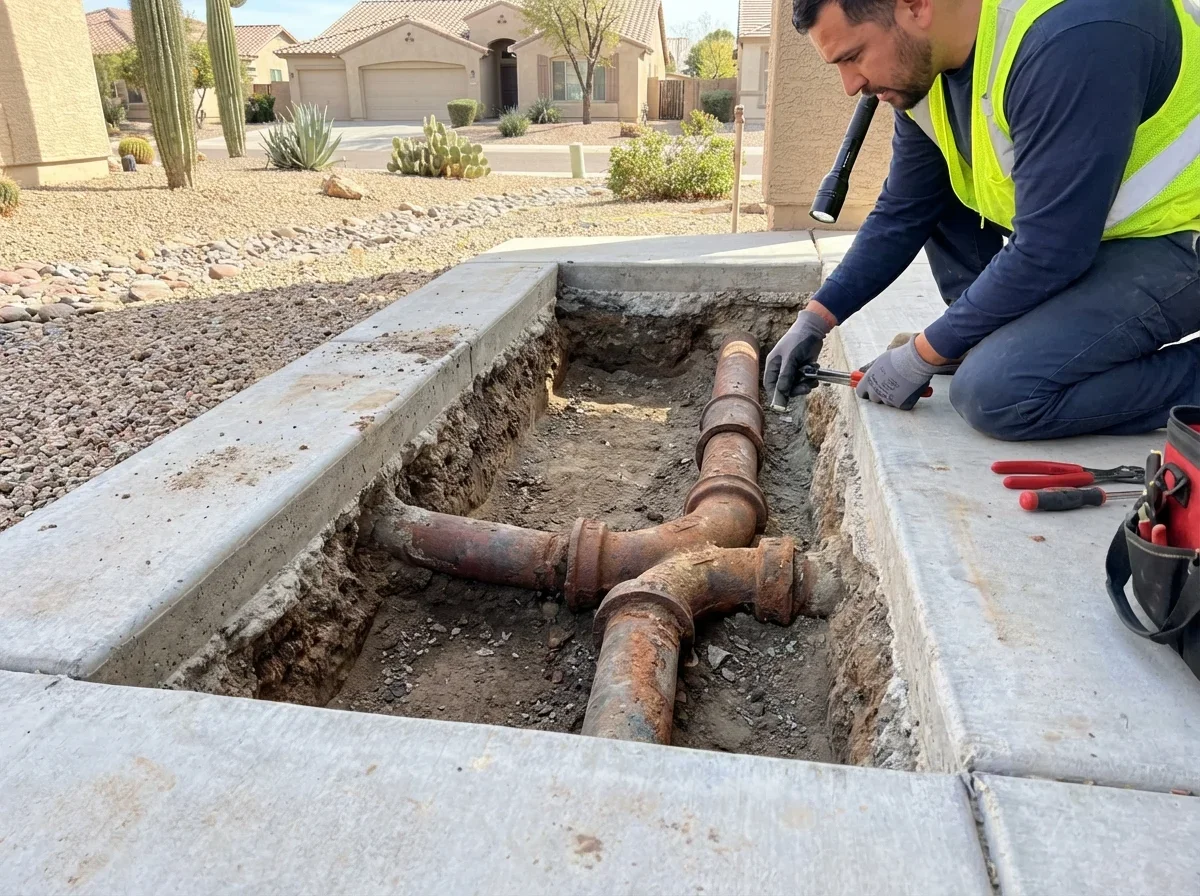
What Proper Maintenance Actually Costs
Camera inspection: $200-400 for a standard residential scope, $500-800 if extensive root cutting is needed to advance the camera.
Routine hydro jetting: $350-600 for main line cleaning on pipes in good condition. Add $150-300 if root intrusion requires pre-cutting before jetting.
Emergency cleanout (after hours/weekend): $450-900 minimum service call plus hourly rates of $175-250.
Preventive maintenance contracts: Some Phoenix plumbing companies offer annual plans at $300-500 that include one camera inspection, one hydro jetting service, and priority scheduling. For homes 35+ years old, this typically pays for itself compared to a la carte pricing.
The average clog repair in Phoenix runs $232-708 (median $469)[5], but that number masks huge variation. A simple toilet auger service costs $150-200. Hydro jetting a main line with moderate scale and roots runs $400-600.
Emergency weekend service on a completely blocked line with sewage backing up into your house starts at $800 and escalates quickly if access is difficult.
When to Upgrade vs. Maintain
Homes built before 1980 with original cast iron or Orangeburg sewer lines face a decision point around age 40-45. You can maintain these pipes with annual cleaning and spot repairs, or you can repipe the sewer system before failure occurs.
The math depends on your specific pipe condition, not age alone.
A camera inspection showing uniform surface corrosion but no cracks or separations suggests the pipe has remaining life. Maintain it with annual hydro jetting and re-inspect every 2-3 years. If the camera reveals multiple cracks, sections where pipe walls have thinned to transparency, or separated joints with 1+ inch gaps, you're maintaining a system that will fail catastrophically within 5 years.
Emergency repairs during failure cost 40-60% more than planned replacement.
The Cost of Waiting Too Long
One Phoenix homeowner documented their experience: routine camera inspection found a 6-foot section of 65-year-old cast iron pipe with extensive corrosion. Quoted replacement cost was $2,800 for trenchless lining. They delayed 14 months due to budget constraints.
The pipe collapsed completely during a heavy-use holiday weekend, requiring emergency excavation through caliche, temporary sewage bypass pumping, and expedited repair. Final cost: $8,200 plus $1,400 in water damage remediation.
The lesson isn't to panic and replace functional pipes. It's to act on documented evidence when camera inspections reveal damage patterns trending toward failure. Phoenix's ROC-licensed plumbers can provide deterioration timelines based on what the camera shows. Use that information to plan replacement during your slow season (winter) when you can schedule around your timeline instead of the failure's timeline.
Choosing Qualified Service Providers
All Arizona contractors performing work over $1,000 must hold an active ROC license. For sewer work, look for residential plumbing licenses in the R-047 category (Plumbing). Verify current status at roc.az.gov: the lookup takes 30 seconds and confirms the license hasn't been suspended or revoked.
ROC bonds ($4,000-15,000 depending on license type) provide minimal protection compared to the actual cost of sewer repairs. Ask for proof of general liability insurance ($1-2 million coverage minimum) and worker's compensation if the contractor has employees.
Arizona doesn't mandate workers comp coverage, which means you could be liable if an uninsured worker gets injured on your property during excavation.
Get three quotes for any work exceeding $3,000, and verify each quote includes the same scope. One Phoenix homeowner received estimates of $4,200, $5,800, and $7,450 for identical trenchless repairs. The variation came from different assumptions about prep work and cleanup, not different quality levels.
The written quote should specify access method, pipe lining material and warranty, cleanup/restoration included, and permit acquisition responsibility.
DIY Boundaries Every Homeowner Should Respect
You can maintain your sewer line with enzyme treatments and hot water flushes. You should not attempt mechanical cleaning beyond basic toilet plunging.
Professional drain machines create 800-1,200 RPM torque that can crack fragile pipes if the operator doesn't recognize resistance patterns. Rental equipment from home improvement stores comes with zero guidance on when to stop advancing the cable. Homeowners regularly punch through deteriorated pipes and convert a $400 cleaning call into a $3,500 repair.
Chemical drain cleaners containing sulfuric acid or sodium hydroxide accelerate the same corrosion processes that naturally degrade cast iron. A single application won't destroy your pipes, but monthly use over 2-3 years measurably thins pipe walls according to metallurgical testing.
Phoenix's hard water already creates scaling that traps these chemicals against pipe surfaces longer than in soft water areas.
Know your limits between DIY and professional work. Maintaining cleanout access by keeping the cap clear and occasionally pouring water down the cleanout to verify flow: that's reasonable homeowner maintenance. Running a 75-foot power snake through your main line because YouTube made it look easy: that's how you create leak points that require excavation to repair.
Long-Term Planning for Aging Systems
Build a maintenance file tracking every sewer-related service, inspection, or repair. Note dates, service providers, findings, and costs. This documentation helps you recognize patterns (clog frequency increasing, cleanouts needed closer together) that indicate underlying deterioration.
It's also valuable at resale. Buyers pay premiums for homes with documented maintenance history, especially on major systems.
If camera inspections reveal your sewer line has 5-10 years of remaining life, start budgeting replacement costs now rather than treating it as an emergency when failure occurs. Phoenix trenchless sewer replacement averages $120-180 per linear foot, so a typical 60-foot residential lateral costs $7,200-10,800. Spread that over 7 years of planned savings and it's manageable.
Face it as an emergency and you're financing at 18-24% APR on a credit card.
Consider pipe condition in home buying decisions. A 1975 Phoenix home with original cast iron sewer lines hasn't been "updated" just because someone renovated the kitchen. The hidden infrastructure matters more than cosmetic improvements. Insist on a sewer camera inspection during your inspection period for any home built before 1985.
The $300-400 inspection cost is negligible compared to inheriting a $12,000 sewer replacement 6 months after closing.
The Maintenance Schedule That Prevents Emergencies
Year 1-15 (newer homes with PVC/ABS): Annual visual inspection of cleanouts for leaks or damage, monthly enzyme maintenance treatments, camera inspection at year 15.
Year 15-30: Camera inspection every 5 years, hydro jetting if scale or early root intrusion appears, annual enzyme treatments.
Year 30-40: Camera inspection every 3 years, hydro jetting every 2-3 years whether symptoms exist or not, document deterioration progression.
Year 40+: Annual camera inspections, immediate action on any cracks or separations, budget for replacement when multiple defects appear.
This timeline assumes average conditions. Accelerate the schedule if you have large trees within 50 feet of your sewer line, persistent slow drains, or prior backup history.
Phoenix homes built on lots with heavy clay content mixed into caliche soil experience more foundation movement and should inspect more frequently starting at year 25.
Your sewer line will eventually need replacement. Every pipe has a service life. The question is whether you'll replace it on your timeline as planned maintenance or on the pipe's timeline as an emergency.
Phoenix homeowners who treat sewer maintenance as infrastructure investment rather than deferred expense report 60-70% lower lifetime costs and zero sewage backups compared to those who respond only to failures.
Frequently Asked Questions
- Arizona Administrative Code (Arizona Department of Environmental Quality). "Ariz. Admin. Code § R18-9-E301 - 4.01 General Permit: Sewage." https://www.law.cornell.edu/regulations/arizona/Ariz-Admin-Code-SS-R18-9-E301. Accessed April 07, 2026.
- City of Phoenix Water Services Department. "Design Standards Manual for Water and Wastewater Systems 2021." https://www.phoenix.gov/content/dam/phoenix/waterservicessite/documents/2021_dsm-final_101421.pdf. Accessed April 07, 2026.
- Fountain Hills Sanitary District (Arizona). "Fountain Hills Sanitary District Facility Design Standards." https://www.az-fhsd.gov/media/pdfs/design_standards.pdf. Accessed April 07, 2026.
- Arizona City Sanitary District. "Minimum Design Standards - Arizona City Sanitary District." https://acsd-az.gov/wp-content/uploads/2021/12/COMPLETE-Minimum-Design-Standards.pdf. Accessed April 07, 2026.
- Town of Florence, Arizona. "§ 51.006 SEWER SERVICE LINE REPAIR AND REPLACEMENT IN ...." https://codelibrary.amlegal.com/codes/florenceaz/latest/florence_az/0-0-0-1789. Accessed April 07, 2026.