How Long Garbage Disposals Actually Last in Arizona
The industry standard is 10-15 years, but Arizona's hard water (300+ ppm calcium carbonate) changes that math. Phoenix-area disposals average 8-12 years before replacement, with mineral buildup accelerating wear on seals, bearings, and impeller plates.
Pre-2010 units often used more corrosion-resistant materials. If you have an older InSinkErator Evolution or Waste King model that's still running strong at year 14, you likely got one of the last heavy-duty builds.
Newer budget models ($80-$120 range) struggle to hit 8 years in Arizona water conditions.
What Kills Disposals Early in Phoenix Homes
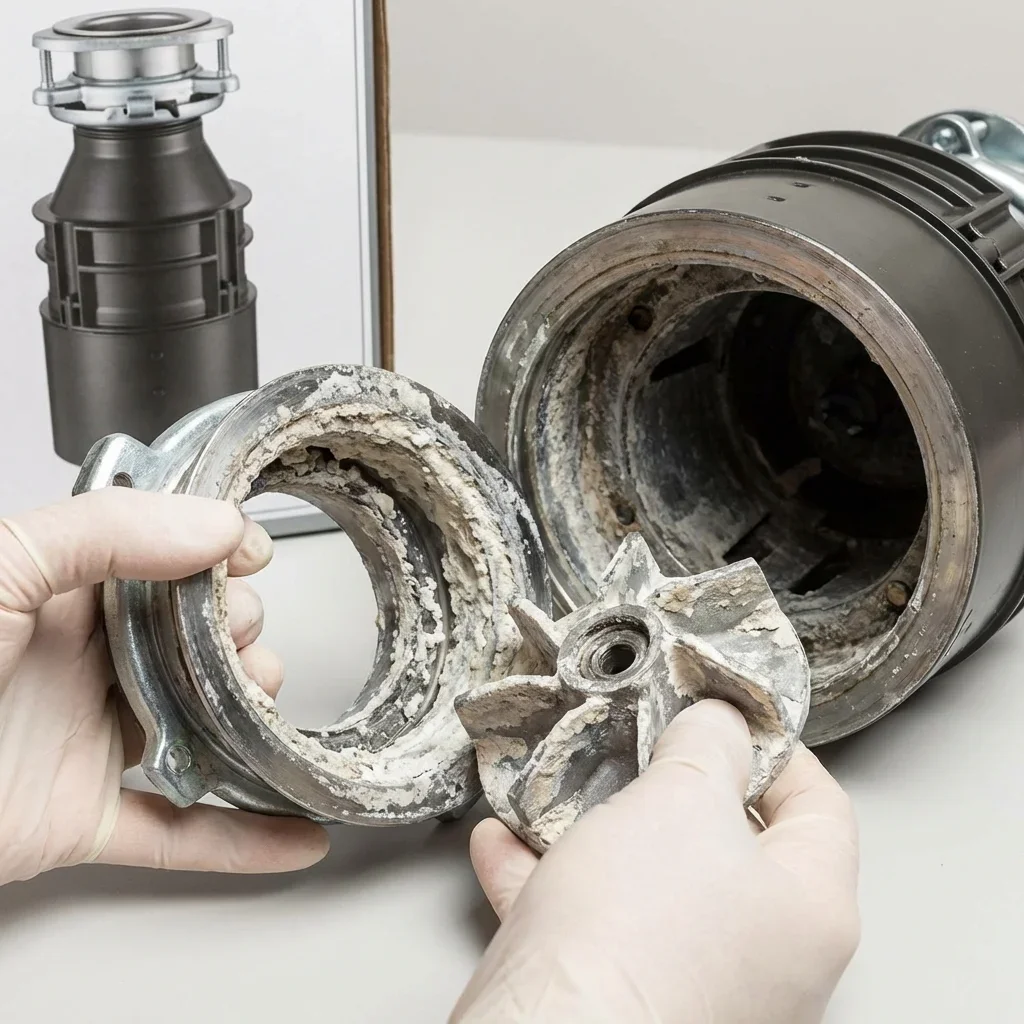
Hard water deposits create three problems you won't see in softer-water climates. First, calcium builds up on the grinding chamber walls, reducing clearance and making the motor work harder. Second, mineral scale corrodes the seal between the disposal body and the sink flange (that's where most leaks start). Third, sediment works into the motor bearings, causing the hum-but-won't-spin failure that homeowners assume means the motor's dead.
If your home was built before 2000 and still has the original copper supply lines, you're also dealing with accelerated corrosion throughout your plumbing system.
A disposal leak might be the first sign of broader issues that warrant looking at your whole drain and waste system.
When Repair Makes Sense
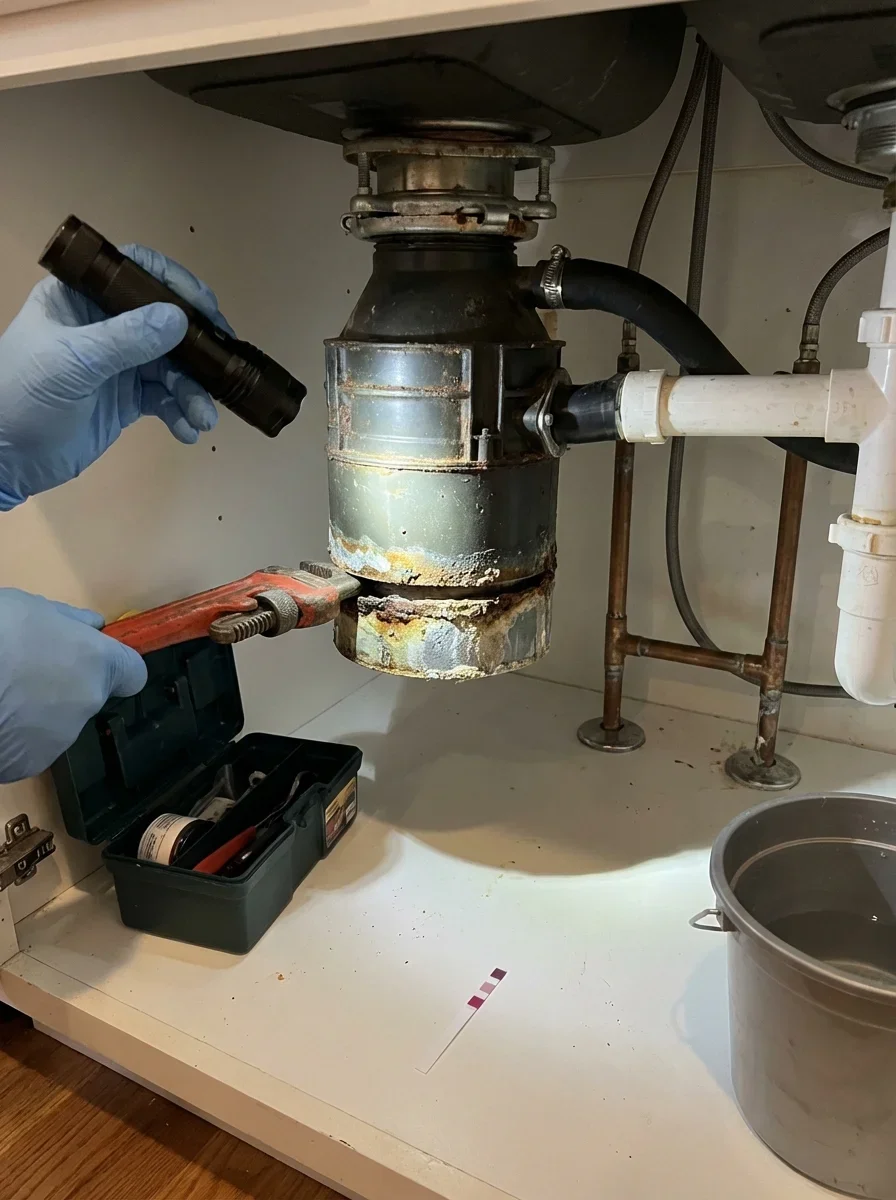
Repairs work best on units under 7 years old with a single, identifiable problem. If the reset button pops frequently but the unit otherwise works, you're looking at an overload issue (often fixable by clearing a jam or replacing the overload switch for $40-$80 in parts). If it leaks from the top flange, re-sealing with plumber's putty costs $75-$150 in labor and solves the problem for years.
Direct-drive jams clear easily with an Allen wrench (the hex socket on the bottom of the unit) and cost you nothing if you do it yourself. Professional unjamming runs $100-$150 and takes 15 minutes.
On a 5-year-old disposal, that's money well spent.
Repairs That Buy You Time vs. Repairs That Solve Problems
Some fixes genuinely restore function. Others delay the inevitable.
Replacing a worn splash guard ($25-$50) stops leaks from the top and works on any age unit. Replacing the internal impeller plate or shredder ring ($80-$150 installed) makes sense if the rest of the disposal is solid, but techs rarely recommend this on units over 10 years old. The motor and bearings are next.
Seal replacements fall in the gray zone. A disposal that's leaking from the body seam (not the flange or drain connection) has corrosion damage. You can replace the seal, but the metal erosion continues. You're buying 12-24 months, not 5 more years.
Arizona's mineral content ensures those seals fail faster than they would in, say, Oregon.
The $200 Decision Point
Here's the ROC-licensed plumber's rule of thumb: if the repair estimate exceeds half the cost of replacement, and the unit is over 7 years old, replace it. A $200 repair on a 9-year-old disposal doesn't make financial sense when a new 3/4 HP InSinkErator installed costs $350-$450.
You're not just comparing today's cost. That 9-year-old unit has corroded parts you can't see yet. The repair might fail in 18 months, and you'll pay for another service call. Or the motor dies and you replace it anyway.
The disposal itself becomes the recurring expense.
| Repair Scenario | Repair Cost | Unit Age | Replacement Cost | Best Choice |
|---|---|---|---|---|
| Simple jam clearing | $100-$150 | 5 years | $350-$500 | Repair |
| Flange seal replacement | $125-$200 | 8 years | $350-$500 | Repair (if otherwise healthy) |
| Multiple seal leaks + jams | $300-$400 | 9 years | $400-$650 | Replace |
| Motor failure (humming only) | $250-$350 | 11 years | $400-$650 | Replace |
When Replacement Is the Right Call
Age alone doesn't demand replacement, but age plus symptoms does. If your disposal is 10+ years old and showing two or more of these signs, repair is wishful thinking: persistent leaks from multiple points, frequent resets needed, slow drainage even after clearing visible jams, rust stains on the unit body, or a burning smell when it runs.
Motor failure presents as humming without grinding. The reset button won't help because the motor's running (the flywheel just won't turn). On units under 5 years, this might be a stuck impeller or seized bearing.
On older units, it's internal corrosion locking the mechanism. Replacement costs less than diagnosing and rebuilding an old motor.
The Hidden Cost of Keeping a Failing Unit
A disposal that jams weekly wastes your time and risks damage to your sink's drain assembly. Chronic jams force the unit to pull maximum current, which can trip breakers or overheat wiring. Leaks that start small grow as corrosion spreads, and that water damages your cabinet, subfloor, and anything stored underneath.
Homeowners who "make it work" with a dying disposal often discover secondary damage during replacement: rotted cabinet bases, corroded drain pipes, mold growth on the cabinet back wall.
What would've been a $400 disposal swap becomes an $800 project because the leak went unaddressed for months.
Disposal Replacement Red Flags
Some problems signal replacement even on newer units. If you've had two separate repairs in 12 months, the unit's failing systemically (fix one thing and another breaks). If the disposal develops a loud grinding noise (metal-on-metal scraping, not the normal food-processing sound), the impeller plate has broken free or bearings have disintegrated.
That's not repairable.
Corrosion visible on the exterior housing means the interior is worse. Desert UV exposure through under-sink gaps plus Arizona's mineral-heavy water creates aggressive oxidation. Once the body corrodes through, the leak is permanent.
Rust stains around the sink flange or drain tailpiece tell you the metal's compromised below the visible line.
Signs Your Disposal Needs Replacement (Not Repair):
- Unit age 10+ years with multiple active problems
- Visible rust or corrosion on the exterior housing
- Two or more repairs needed within 12 months
- Metal-on-metal grinding noise (not normal food processing sound)
- Persistent leaks from multiple connection points simultaneously
- Burning smell during operation
- Motor hums but won't turn (on units 8+ years old)
What Replacement Actually Costs in Phoenix
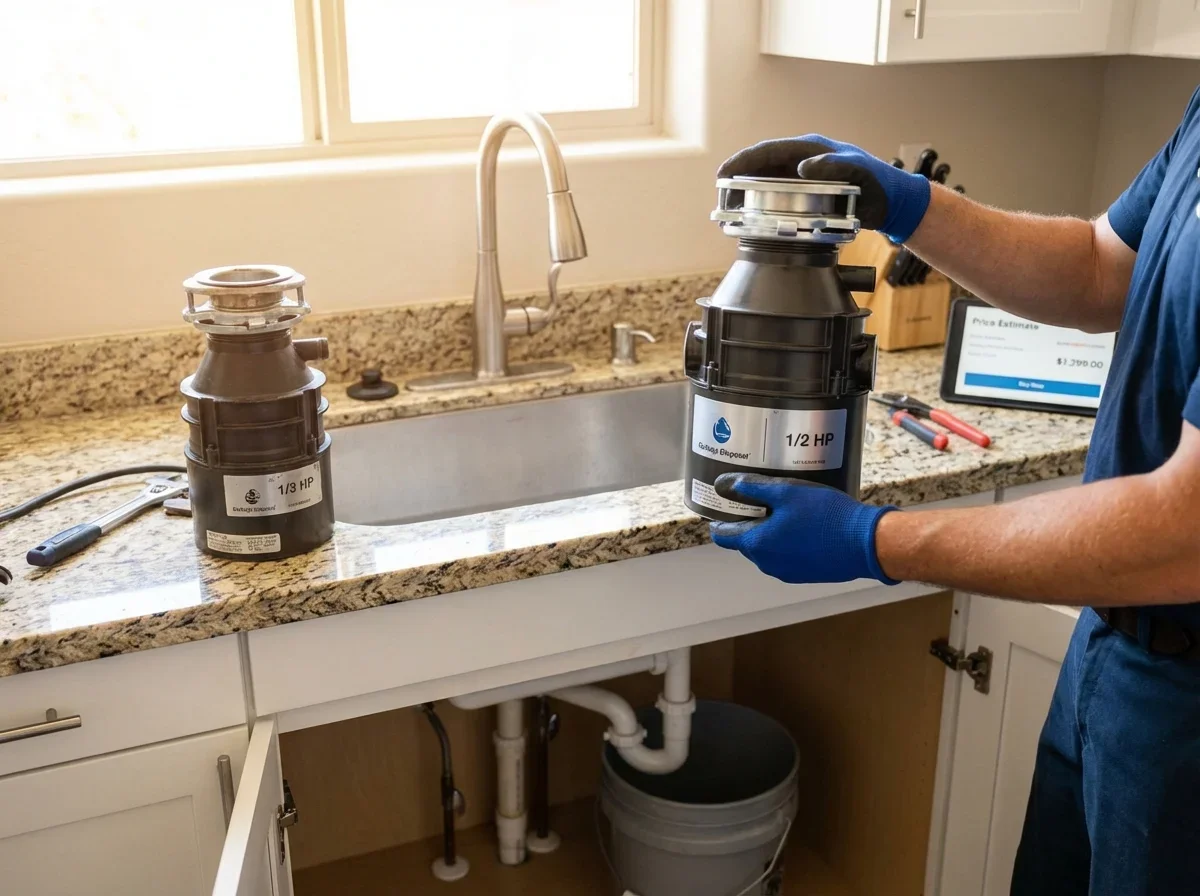
Basic 1/3 HP disposals installed run $250-$350. These work for light use (1-2 people, no heavy cooking), but struggle with fibrous vegetables and bone.
Most Phoenix plumbers recommend starting at 1/2 HP for typical family use. Installed cost runs $350-$500 depending on the brand.
The sweet spot for Arizona homes is a 3/4 HP or 1 HP unit with stainless steel grinding components and sound insulation. Installed prices run $450-$650 for quality models like InSinkErator Evolution series or Waste King Legend series. These handle hard-water corrosion better and last 2-4 years longer than builder-grade units.
Brand and Motor Power Matter in Hard Water
Bargain disposals ($80 retail, $200 installed) use galvanized steel chambers and basic motors. They corrode faster in Phoenix's water and jam more easily under normal use. You'll replace them in 5-7 years instead of 10-12.
Premium models ($200-$400 retail, $500-$800 installed) use stainless steel grinding chambers, reinforced mounts, and multi-stage grinding. The price difference buys you corrosion resistance, quieter operation, and better jam protection (all relevant in Arizona conditions).
An extra $300 upfront that delivers 5 additional years of life costs less than replacing a cheap unit twice.
Installation Variables That Affect Price
Standard replacement on existing plumbing runs $200-$300 in labor. If your drain tailpiece corroded (common in Phoenix), add $50-$100 for new drain fittings. If the mounting assembly rusted to the sink flange, add another $75-$150 to cut and replace the flange assembly without damaging your sink.
Homes with in-cabinet electrical outlets see faster installs (1-1.5 hours). Homes requiring hardwiring or new electrical circuits add $150-$300 depending on wire runs and panel capacity.
Some older Phoenix homes have disposals on 15-amp circuits shared with other kitchen appliances. Replacing with a higher-HP unit might require a dedicated 20-amp circuit per current code.
Repair Cost Breakdown vs. Replacement
Most repairs fall into these ranges: clearing jams and resetting motors ($100-$150), replacing leaking seals or flanges ($125-$200), fixing drain connection leaks ($80-$150), replacing the splash guard or baffle ($75-$125). These costs assume the tech's already at your home. Add $75-$125 for the service call if this is your only issue.
Compare that to full replacement at $350-$650 installed. If you're facing a $175 repair on a 6-year-old disposal, repair wins.
Same repair on an 11-year-old unit with visible corrosion? You're financing a temporary fix on borrowed time.
The Multi-Failure Scenario
Homeowners sometimes face stacked failures: a leak plus slow drainage plus frequent jams. Each problem alone might cost $100-$150 to repair, but you're not paying for three separate issues. You're seeing systemic failure. The tech might quote $300-$400 to address everything, which sounds better than replacement until you factor in age and future reliability.
A 9-year-old disposal with three active problems won't stop developing new ones. The grinding components wore out together, not sequentially. Repairing all three buys you 12-18 months before the motor goes or the chamber cracks.
Replacement costs $400-$500 and delivers 10 years. The math favors starting fresh.
DIY Repair vs. Professional Assessment
You can handle some disposal issues yourself. Jams clear with the hex wrench (look under the unit for the hex socket) or by manually rotating the flywheel with a broom handle inserted from above. Reset buttons restore power after overloads. Tightening the drain flange or tailpipe connections stops some leaks.
What you can't DIY effectively: internal seal replacement, electrical diagnosis beyond the reset button, motor testing, or assessing whether corrosion has compromised structural integrity.
A $125 service call from an ROC-licensed plumber gets you accurate diagnosis and a clear repair-vs-replace recommendation based on the unit's actual condition, not guesswork.
When DIY Turns Into Expensive Mistakes
Homeowners sometimes worsen disposal problems trying to fix them. Pouring chemical drain cleaners into a jammed disposal corrodes the grinding chamber and doesn't clear the jam. It just creates a caustic mess the plumber has to drain before working. Over-tightening drain connections cracks plastic tailpieces or strips threads on older metal fittings.
The biggest DIY risk is missing the real problem. You might clear a jam, but if the jam resulted from failed impeller lugs or a cracked flywheel, it'll jam again in days.
The tech who diagnoses the root cause saves you from repeating the same failed fix.
What Plumbers Look For During Assessment
Experienced techs check the unit's age (most have manufacture dates stamped on the body), test motor function with the power off (manually rotating the flywheel), inspect all connection points for active or past leaks, look for corrosion on visible metal, and listen to the motor under load if it runs. They're diagnosing whether the disposal has one fixable issue or multiple age-related failures happening at once.
They'll also check your drain line condition. If the disposal drains slowly even when empty and unjammed, you might have buildup in the drain line itself. Replacing the disposal won't fix slow draining caused by pipe issues.
Arizona's hard water creates scale buildup in drain pipes just like it does in disposal chambers.
Pro Tip: Before calling for service, check the manufacture date stamped on your disposal's body (usually visible from underneath). If your unit is 10+ years old and experiencing multiple issues, skip the diagnostic fee and go straight to replacement quotes. You'll save the $75-$125 service call cost and avoid paying to diagnose a unit that's reached end-of-life anyway.
The Hard Water Variable Arizona Homeowners Face
Phoenix's 300+ ppm calcium carbonate water accelerates every disposal failure mode. Mineral deposits coat grinding components, reducing efficiency and increasing jam frequency. Scale buildup narrows the grinding chamber, forcing the motor to work harder and shortening its lifespan. Calcium corrodes metal faster than neutral or soft water.
If your home doesn't have a water softener, your disposal fights chemistry every day. Softened water won't reverse existing damage, but it slows future corrosion significantly.
Homeowners who install water softeners after years of hard water often find their next disposal lasts 3-4 years longer than the previous one.
Maintenance That Actually Helps in Arizona
Running cold water during and after grinding (30 seconds after you turn off the disposal) helps flush minerals before they settle. Ice cubes once a month scour deposits off the grinding chamber. Not a deep clean, but enough to reduce buildup between the impeller plates.
Skip the citrus peels and baking soda "freshening" tricks. They don't clean or sharpen anything (disposals don't have blades, they have blunt impellers). Citrus acids can corrode already-weakened seals.
If your disposal smells, the issue is food residue stuck in the splash guard or slow drainage allowing bacterial growth in the tailpipe. Problems that need physical cleaning or drain attention.
Making the Decision: A Three-Question Framework
First question: how old is the unit? Under 7 years favors repair unless you're facing multiple simultaneous failures. Over 10 years favors replacement unless it's a single simple fix like a clogged drain connection.
Second question: what's the repair-to-replacement cost ratio? If repair costs more than 50% of replacement and the unit's over 7 years old, replace. If repair is under 30% of replacement cost and the unit's under 8 years old, repair.
The 30-50% middle zone depends on the unit's overall condition and your tolerance for risk.
Third question: how many problems does the disposal have right now? One issue suggests a fixable failure. Two or more suggests systemic breakdown. A 6-year-old disposal with a single leak might run another 4 years after repair. That same disposal with a leak, frequent jams, and slow drainage is showing age-related decline across multiple components.
Repair won't restore it to reliable operation.
When to Call for Professional Diagnosis
If your disposal won't run, leaks, jams weekly, or drains slowly even when empty, you need assessment before deciding anything. The tech can tell you whether you're looking at a $100 fix or a $400 replacement. That diagnosis visit costs $75-$125, but it prevents expensive guessing.
Schedule the call sooner rather than later. Leaks cause damage. Jammed disposals encourage homeowners to dump food down the regular drain, which creates drain clogs in pipes not designed to handle solids.
A disposal that hums without grinding can overheat and trip breakers if you keep trying to run it.
What to Expect During Disposal Replacement
A standard replacement on existing plumbing takes 1-2 hours. The tech shuts off power at the breaker, disconnects the drain tailpipe and dishwasher connection (if present), releases the mounting assembly, drops the old unit, installs the new mounting ring, connects the new disposal, and tests everything under load.
If your existing setup needs updates (corroded drain fittings, improper electrical connections, missing dishwasher knock-out plugs), the job takes 2-3 hours.
ROC-licensed plumbers pull permits for electrical work that involves new circuits or panel modifications, though simple disposal swaps on existing wiring rarely require permits.
Choosing the Right Replacement Unit
Match motor power to your household size and cooking habits. 1/3 HP handles light use (singles, couples who don't cook much). 1/2 HP works for small families with moderate cooking. 3/4 HP or 1 HP suits larger families, heavy cooking, or homes that frequently compost non-animal food waste through the disposal.
Prioritize stainless steel grinding components in Arizona. The upgrade costs $50-$100 but adds 3-5 years of life in hard water conditions.
Sound insulation matters if your kitchen sits near living spaces. Premium models run 20-30 decibels quieter than budget units.
Batch-feed models (activated by a stopper instead of a wall switch) cost more ($500-$800 installed) but eliminate the jam-your-hand-in-while-it's-running risk if you have young kids. Continuous-feed models (standard wall-switch operation) dominate Phoenix installations because they're faster and more convenient for daily use.
The ROC License Requirement for Installation
Arizona requires ROC licensing for any plumbing work over $1,000, but most disposal replacements fall under that threshold. Still, you want an ROC-licensed plumber for three reasons: they carry proper insurance, they pull permits when required, and they warranty their work under Arizona contractor law.
Verify any plumber's license at https://roc.az.gov/ before hiring. An active residential plumbing license (R-license classification) confirms they're bonded, and most reputable contractors carry liability insurance beyond the basic ROC bond.
That insurance matters if a botched installation floods your kitchen or causes electrical damage.
Warranty Expectations on Labor and Parts
Manufacturer warranties cover the disposal itself (typically 1-5 years depending on the model). The plumber's labor warranty covers installation defects: leaking connections, improper mounting, electrical errors. Expect 1-2 years on labor from reputable contractors.
Keep your installation receipt. If the disposal fails within the manufacturer warranty period, you'll need proof of installation date. Some manufacturers require professional installation to honor the warranty (DIY installs void coverage).
Arizona's heat and hard water can shorten even warrantied units, but documentation helps if you have a legitimate manufacturing defect.