Understanding Your Repiping Material Options
When you repipe a Phoenix home, you're replacing every supply line that brings water to your fixtures. That means choosing a material that will spend decades buried in your walls, running through your attic, or threaded under your slab.
The two materials ROC-licensed contractors install most often are Type L copper and cross-linked polyethylene (PEX). They behave very differently in the desert.
Copper has been the standard since the mid-20th century. It's rigid, solderable, and familiar to every plumber. PEX arrived in the U.S. in the 1980s and has steadily gained market share, especially in new construction and full-home repipes. Both are approved under the International Residential Code with Arizona amendments, so you won't face permit issues with either choice.
But approval doesn't mean they perform identically in your home.
How Phoenix's Hard Water Affects Each Material
Phoenix municipal water averages 300+ parts per million of calcium carbonate, well into the "very hard" range. That mineral load accelerates copper corrosion in ways you won't see in softer-water regions.
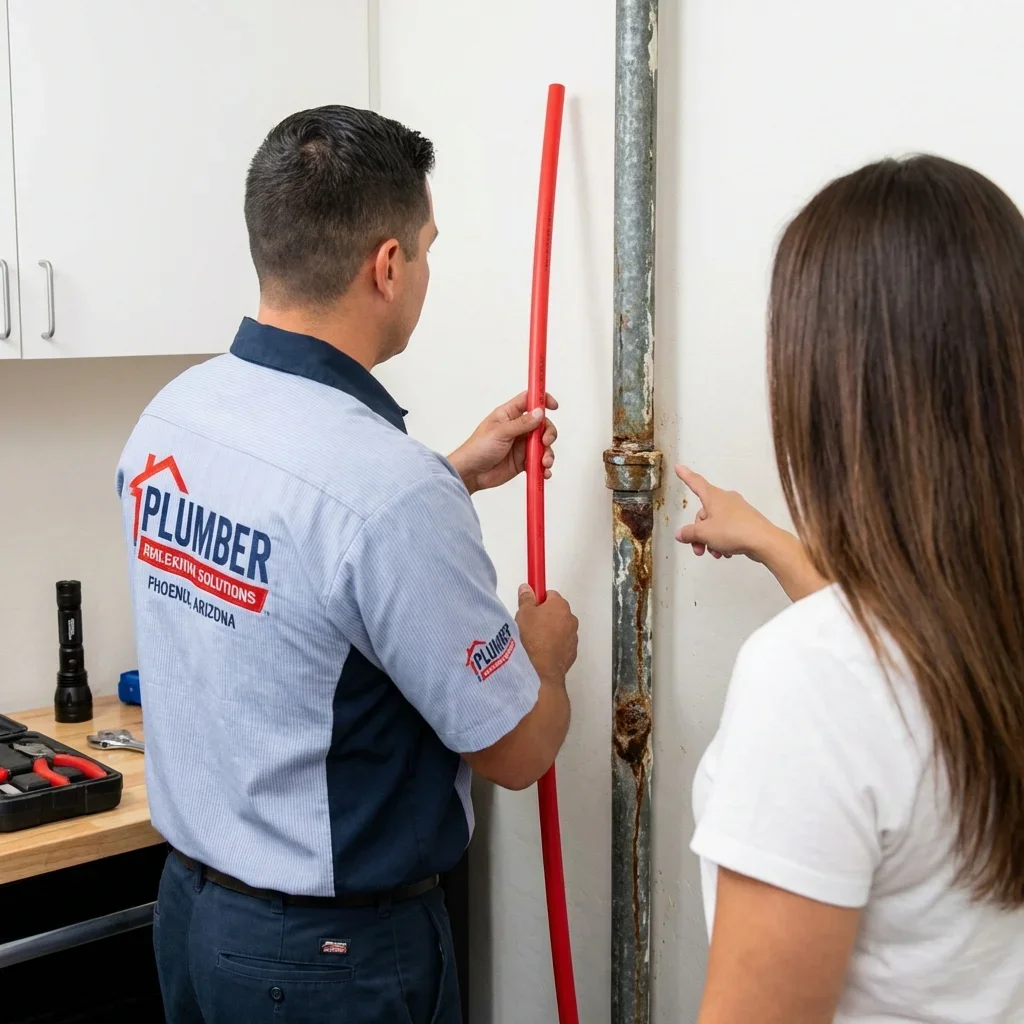
Scale builds up inside pipes, narrowing the flow. Pitting corrosion eats through pipe walls, especially where water velocity is high or pH fluctuates. Homeowners report pinhole leaks in copper lines as early as 15 years, particularly in homes built before 2000 when copper was the only option.[3]
PEX doesn't corrode.
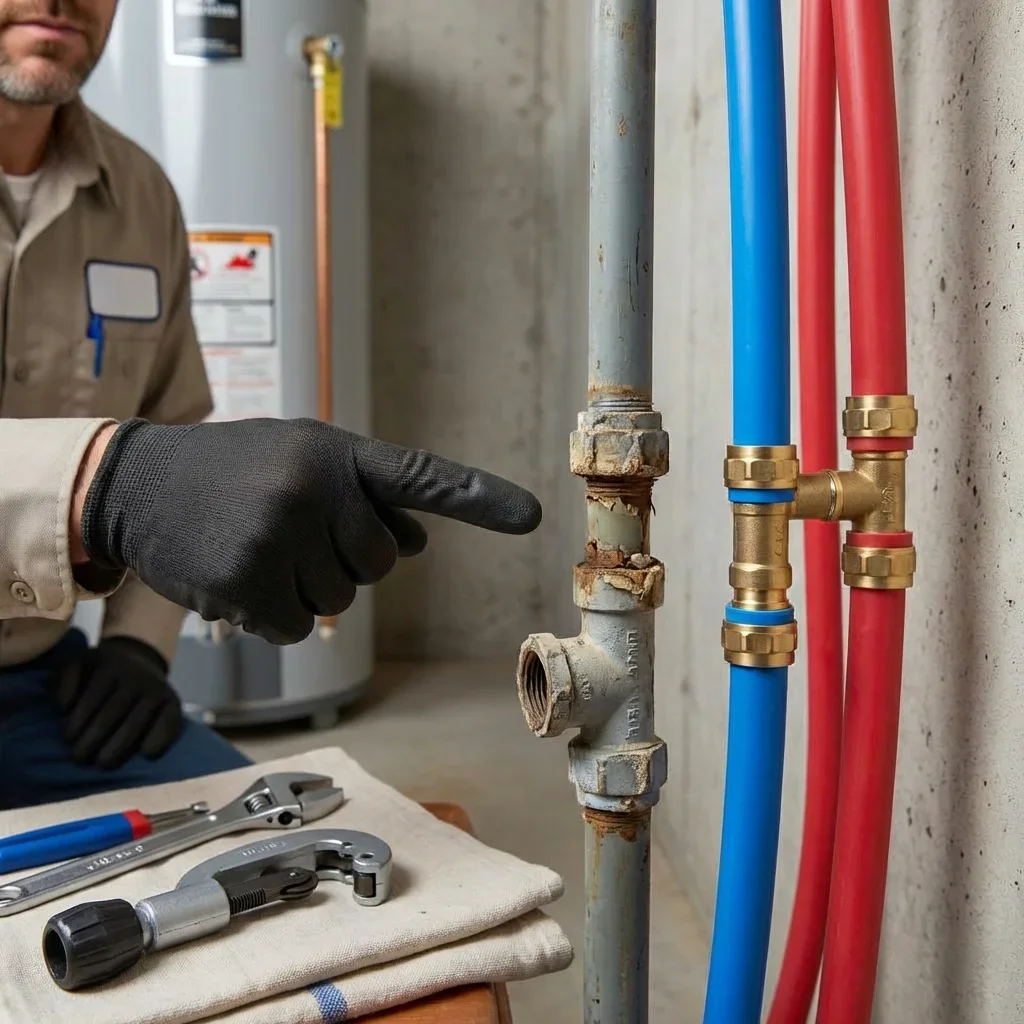
Its plastic composition is chemically inert, so minerals flow through without bonding to the pipe interior. You won't see the rust stains, green oxidation, or electrolysis damage common in copper systems exposed to hard water. This is the single biggest performance advantage PEX holds in Phoenix: it sidesteps the mineral chemistry that kills copper early.
Electrolysis and Dissimilar Metals
Copper systems often include brass fittings, galvanized steel transition points, or aluminum heat exchangers. When dissimilar metals contact in the presence of hard water, electrolysis accelerates corrosion at the junction. You'll see pinholes form near water heaters, at supply line connections, or where copper meets galvanized pipe.
PEX eliminates this problem entirely because it's non-metallic.
If you're repiping a 1980s block home with a mix of copper and galvanized remnants, switching to PEX removes electrolysis as a failure mode.
| Factor | Copper | PEX |
|---|---|---|
| Hard Water Resistance | Corrodes from mineral buildup; pinholes common after 15-25 years | Chemically inert; minerals don't bond to pipe walls |
| Electrolysis Risk | High when mixed with brass/galvanized fittings | None (non-metallic) |
| Typical Lifespan (Phoenix) | 25-40 years with hard water | 50+ years (manufacturer claim) |
| Scale Buildup | Significant; narrows flow over time | Minimal to none |
Upfront Cost Comparison
Material cost is where PEX pulls ahead decisively. Homeowners report PEX repipes running 40-60% cheaper than copper for the same square footage and fixture count.[3]
A typical 1,800-square-foot Phoenix home might see a copper repipe quoted at $8,000-$12,000, while PEX comes in around $5,000-$7,000. That gap narrows or widens depending on home layout, slab access, and whether you're repiping walls only or replacing under-slab lines too.
Labor drives most of that difference. Copper requires cutting, deburring, fluxing, and soldering every joint. PEX uses crimp rings, expansion fittings, or push-to-connect couplings, all faster to install. Contractors can complete a PEX repipe in about 25% of the time a copper job takes, which directly reduces your labor invoice.[2]
If you're working with a tight budget or want to minimize the days your water is shut off, PEX delivers clear advantages.
When Copper Costs More Than You Expect
Copper pricing fluctuates with commodity markets. A spike in copper futures can add 15-20% to your material cost overnight. PEX prices are more stable because the raw material (polyethylene) isn't traded as aggressively.
That predictability helps if you're locking in a quote months before the work starts.
On the flip side, if you're committed to copper for durability or resale perception, get multiple quotes. Prices vary widely between suppliers in the Phoenix metro.
Installation Speed and Home Disruption
A full-home copper repipe typically takes 4-7 days depending on square footage and complexity. The plumber needs to cut access panels in drywall, solder hundreds of joints, pressure-test the system, and patch walls back up. You'll have limited water access during most of that window, and soldering torch work near insulation or framing requires careful fire watch.
PEX installs in 1-3 days for most single-family homes.
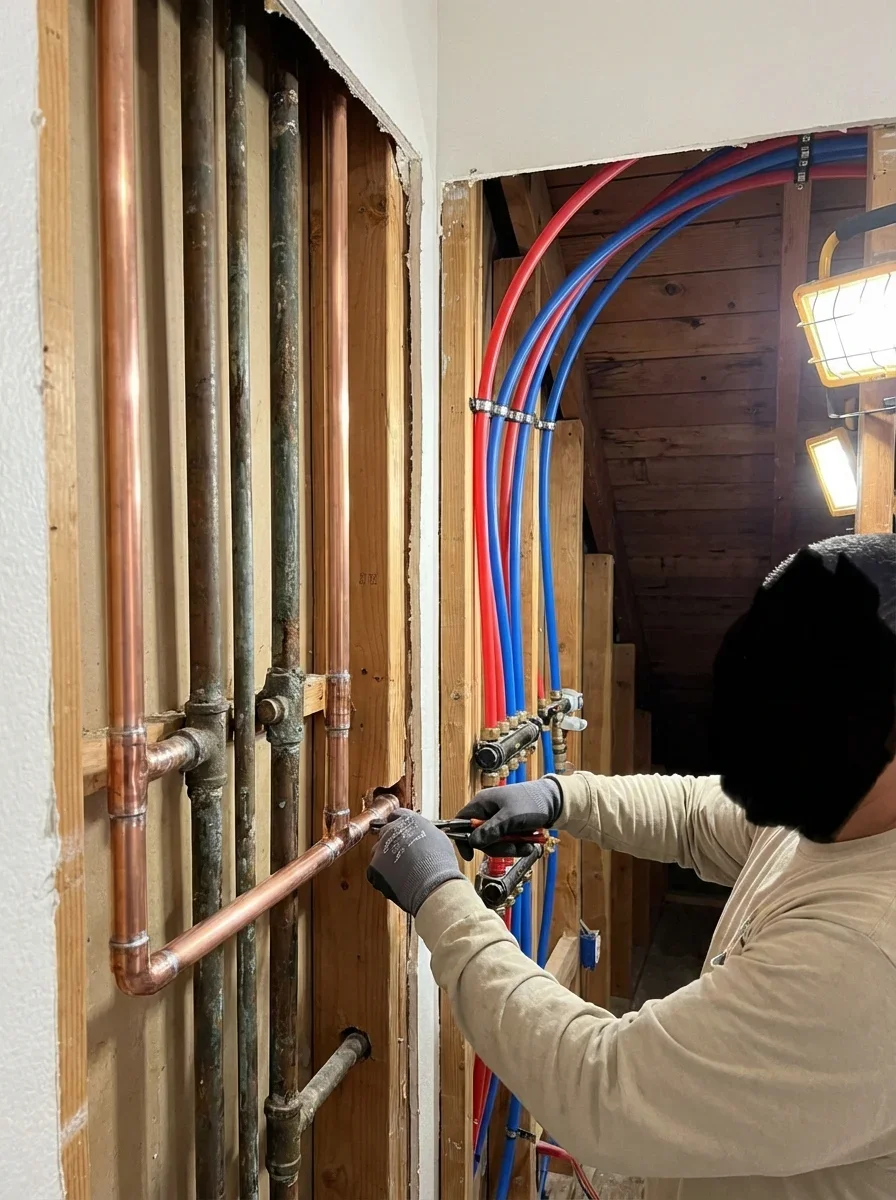
The flexible tubing snakes through walls and attics with fewer penetrations, reducing the number of access holes your contractor needs to cut. Fewer joints mean less leak risk and faster pressure testing. Homeowners consistently mention the speed factor as a major reason they chose PEX: less disruption, fewer days taking showers at a neighbor's house, and faster return to normal routines.
Phoenix Repipe Timeline Quick Facts:
- Copper installation: 4-7 days (1,800 sq ft home)
- PEX installation: 1-3 days (same size)
- Water shutoff periods: Intermittent throughout project
- Drywall access holes: 40-60% fewer with PEX
- Pressure testing: Same duration for both materials
- Typical project completion to livable: Copper adds 2-4 extra days for soldering/cooling
Durability and Expected Lifespan
Copper's track record speaks for itself: properly installed Type L copper can last 50-70 years in moderate water conditions. In Phoenix, hard water shortens that to 25-40 years depending on water chemistry and installation quality.
The biggest wild card is workmanship.
Soldered joints done poorly will leak. ProPress fittings (a mechanical crimping alternative to soldering) have shown higher failure rates in some Phoenix homes, with leaks appearing at joints within 5-10 years.[3] If you go copper, confirm your contractor will solder joints rather than rely on ProPress. It's more labor-intensive but more reliable long-term.
PEX manufacturers claim a 50-year lifespan, which aligns with warranty terms from major brands. Real-world data is thinner because PEX is newer to the U.S. market. One notable failure: a Phoenix homeowner reported full PEX system failure after 38 years in a home originally plumbed with early-generation PEX in 1988.[1]
That's earlier than copper would typically fail, but it's worth noting that 1980s PEX formulations (often polybutylene or early HDPE blends) differ from modern PEX-A and PEX-B. Today's cross-linked polyethylene is chemically distinct and performs better under UV exposure, chlorine, and thermal cycling.
Still, we don't have 50 years of Phoenix-specific field data yet. That's a trade-off you accept when choosing the newer material.
UV Degradation in Attic Runs
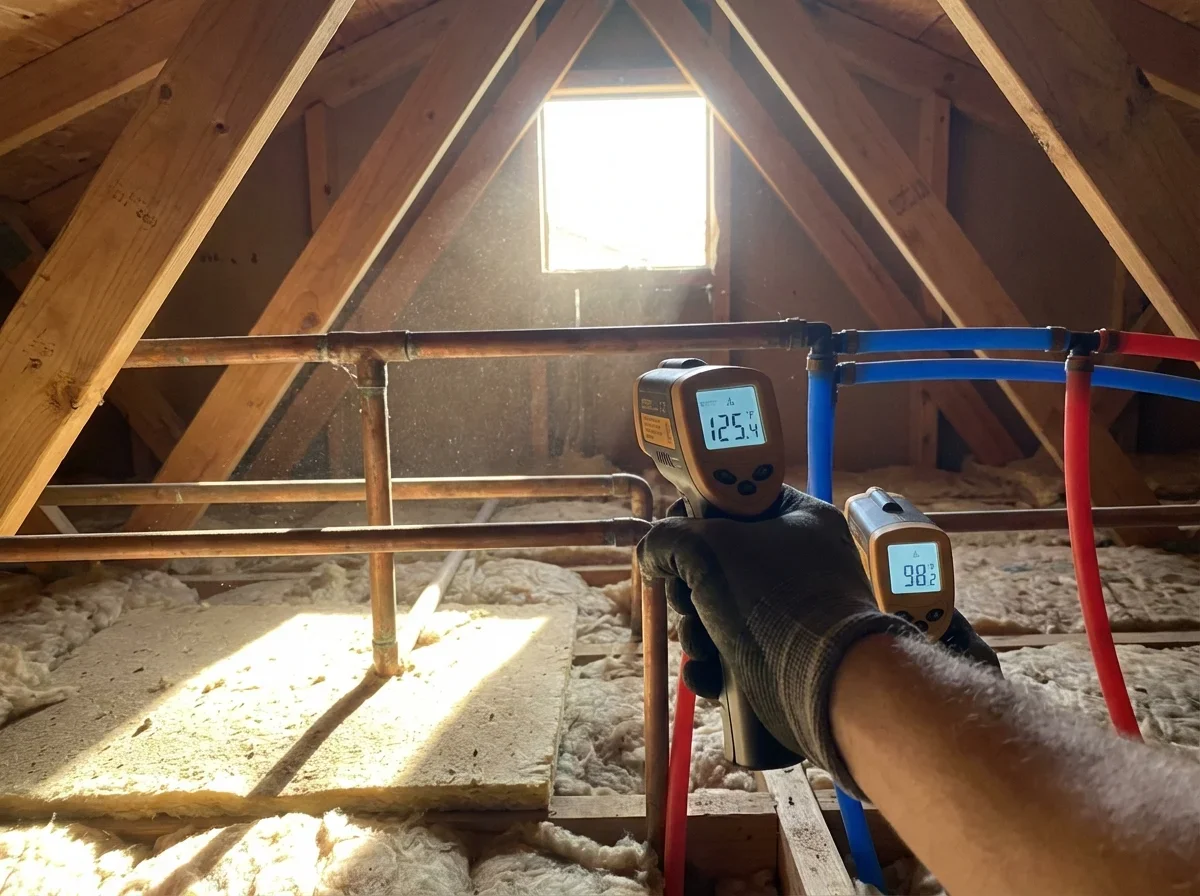
Phoenix attics see summer temperatures above 140°F, and any exposed piping faces intense UV exposure if roofing penetrations aren't sealed. PEX degrades when exposed to direct sunlight. Most manufacturers specify a maximum 30-day UV exposure window before the material must be sleeved or buried.
Copper doesn't care about UV.
If your repipe includes long attic runs with skylights or ventilation openings, make sure your contractor sleeves PEX lines or routes them through conduit. Unprotected PEX in direct sun will crack within a few years.
Heat Tolerance and Performance in Phoenix Summers
Copper conducts heat aggressively. When 110°F attic air surrounds a copper cold water line, the water inside warms up fast. You'll run the tap longer waiting for cool water, wasting gallons every time you fill a glass. Hot water lines lose heat just as quickly, so water cools in the pipe between the heater and your shower.
That thermal loss hits your gas or electric bill every month.
PEX insulates better. Its plastic composition has lower thermal conductivity than copper, so cold water stays cooler and hot water stays hotter as it travels through your home. Homeowners report noticeably better temperature retention with PEX: less wasted water waiting for temperature, and showers that don't go lukewarm mid-rinse when someone flushes a toilet.[2]
In a climate where water conservation matters and summer energy costs spike, that efficiency adds up.
Thermal Expansion and Slab Stress
Phoenix's extreme temperature swings (50°F at dawn, 110°F by 3 PM) cause materials to expand and contract daily. Copper is rigid, so thermal expansion stresses soldered joints and creates pressure at anchoring points. That's one reason slab leaks are common in Phoenix's pre-2000 copper-piped homes: the pipe expands against the concrete, fatigues over years, and eventually cracks.
PEX flexes.
It absorbs expansion without transferring stress to fittings, which reduces the long-term risk of slab leaks under your foundation.
Taste, Odor, and Water Quality Concerns
Some homeowners report a plastic taste or smell in water delivered through PEX, especially in the first few weeks after installation. That's leachate from the pipe material: plasticizers, antioxidants, or residual cross-linking byproducts entering the water.
Most manufacturers say the taste dissipates after the system flushes a few times, but it's a persistent complaint in online forums.[3] If you're sensitive to taste or worried about chemical leaching, copper eliminates that variable. It's inert and imparts no flavor.
Copper has its own water quality issue: if your home sits vacant for days (vacation, snowbird season), stagnant water in copper lines can pick up elevated copper ions, especially in acidic or aggressive water. That creates a metallic taste and slight blue-green tint. Flushing the system clears it, but it's a factor if you're gone frequently.
Chlorine Resistance
Phoenix municipal water is chlorinated to meet Safe Drinking Water Act standards. Chlorine breaks down some plastics over time, including older PEX formulations. Modern PEX-B and PEX-A grades include antioxidants to resist chlorine degradation, and manufacturers rate their products for 50 years of exposure to chlorinated water at drinking water concentrations.
Copper is unaffected by chlorine.
If your neighborhood sees higher-than-average chlorine residuals, copper won't degrade. PEX might show brittleness at fittings after decades, though no widespread failures have been documented in Phoenix's supply zones yet.
Which Material Handles Phoenix's Slab-on-Grade Construction Better?
Nearly every Phoenix home built after 1960 sits on a slab foundation: no basement, no crawlspace. Supply lines run under the slab or through walls.
When under-slab copper corrodes, you face a leak detection nightmare: water meter spinning when no fixtures are running, wet spots on the floor, or skyrocketing bills. Accessing a slab leak means jackhammering concrete, replacing the damaged section, pressure-testing, and re-pouring. It's disruptive and expensive, often $2,000-$5,000 depending on how many breaks you find.
PEX can be pulled through the slab in continuous runs with zero joints underground.
That means zero under-slab leak points if your contractor routes it correctly. Some repipes replace only the above-slab copper and cap the old under-slab lines, running new PEX through attics and walls instead. That approach avoids concrete demolition entirely and future-proofs your home against slab leak risk.
If you're repiping because of existing slab leaks in copper, switching to PEX with no under-slab joints is the most reliable fix.
Pro Tip: When repiping a Phoenix slab home, ask your contractor about "continuous-run PEX routing." This method eliminates all underground joints by running single lengths from manifold to fixture, drastically reducing future slab leak risk. Many contractors can route entirely through attics and walls, abandoning problematic under-slab copper in place.
Compatibility with Existing Plumbing and Fixtures
If you're doing a partial repipe (say, replacing corroded hot water lines but leaving cold lines intact), material compatibility matters. Mixing copper and PEX is common and code-compliant as long as you use proper transition fittings (brass or approved plastic). You can't solder PEX, and you can't crimp copper, so the junction requires a threaded or push-fit adapter.
Mixing materials does introduce a dissimilar-metal contact point if you use brass fittings, which can accelerate localized corrosion in hard water.
If you're planning a phased repipe over multiple years, commit to one material for the whole house to avoid long-term galvanic issues. If budget forces a partial repipe now, PEX-to-copper transitions work fine. Just make sure your plumber uses dielectric unions or plastic-lined fittings to isolate the metals.
Resale Value and Buyer Perception
Copper still carries a premium perception among some Phoenix homebuyers and appraisers, especially in older neighborhoods where copper was the original install. Listing a home as "fully repiped with Type L copper" signals quality and longevity.
Some buyers (particularly those buying pre-1980 block homes) specifically ask whether the copper has been replaced because they know hard water damage is inevitable.
PEX is increasingly common in new builds and repipes, so buyer resistance is fading. Younger buyers and investors often prefer PEX because they understand the cost and maintenance advantages.
If you're repiping a historic Phoenix neighborhood home (Willo, Encanto, Coronado) where buyers expect period-appropriate materials, copper might align better with market expectations. For tract homes built after 1990, PEX won't raise eyebrows.
Licensing, Permits, and Code Compliance
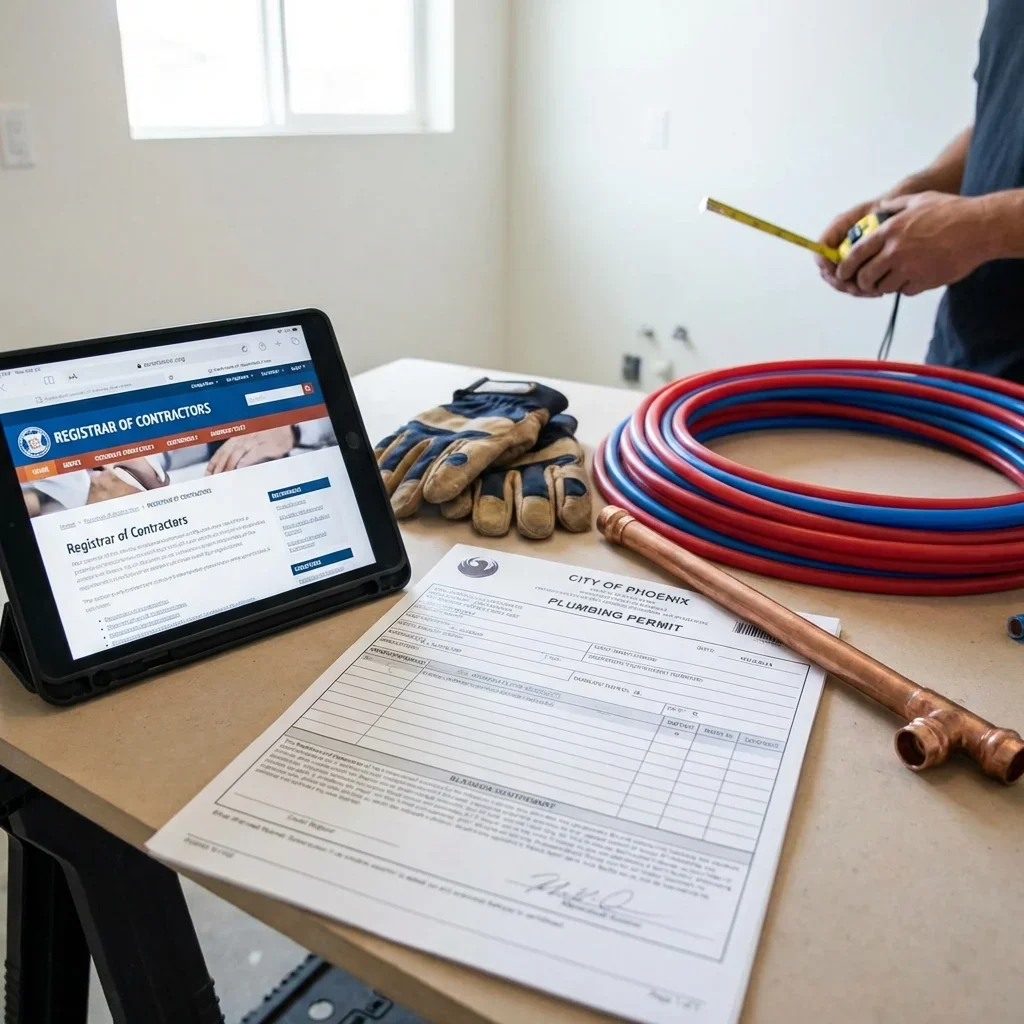
Any repiping project in Phoenix requires a plumbing permit, and the contractor performing the work must hold an active Arizona Registrar of Contractors (ROC) license. Verify your plumber's license status at https://roc.az.gov/ before signing a contract.
Both copper and PEX installations must meet International Residential Code (IRC) standards as amended by Arizona, and your city or county building department will inspect the work before issuing a final approval.
PEX installation requires specific training because improper crimping, over-expansion, or kinked tubing can cause failures. Copper soldering is a well-established trade skill, but even experienced plumbers can leave cold joints or flux residue that corrodes over time.
Either way, choose a contractor with verifiable repipe experience in Phoenix, not a generalist who mostly does drain cleaning and fixture swaps. Ask for references from recent whole-home repipes and confirm they pulled permits for those jobs.
Long-Term Maintenance and Repair Costs
Copper requires virtually no maintenance once installed, but when it fails, repairs are labor-intensive. A pinhole leak means cutting out the damaged section, soldering in a new piece, and pressure-testing.
If you develop multiple leaks (common in hard water zones), you're facing repeated drywall patches and escalating labor costs. At some point, full repiping becomes cheaper than ongoing spot repairs.
PEX rarely develops leaks in the tubing itself. Failures almost always occur at fittings due to improper installation or over-tightening. Replacing a PEX fitting is faster than soldering copper: cut the line, slide on a new crimp ring, insert the fitting, crimp, done. No torch, no flux, no fire risk.
That translates to lower service call costs if something does go wrong.
PEX's flexibility also means it's less likely to burst during a freeze (rare in Phoenix, but possible during extreme cold snaps in north Scottsdale or Cave Creek).
Making the Decision: When to Choose Copper
Choose copper if you're repiping a historic or high-value home where buyers expect traditional materials. Choose it if you're highly sensitive to plastic taste or concerned about long-term chemical leaching.
Choose it if your home has no attic access and all supply lines run in conditioned spaces where UV and extreme heat aren't factors. Choose it if you're working with a plumber who specializes in soldered copper and can demonstrate consistent, high-quality joints.
Copper makes the most sense when installation quality is guaranteed, when you're planning to stay in the home long enough to amortize the higher upfront cost, and when you've addressed Phoenix's hard water through a whole-home water softener.
Without softening, copper's lifespan in the Valley is measurably shorter than national averages. That's not a material flaw, just a chemistry reality.
Making the Decision: When to Choose PEX
Choose PEX if cost is a primary concern and you want to stretch your budget without sacrificing reliability. Choose it if you're repiping because of existing slab leaks and want to eliminate under-slab joints entirely.
Choose it if you need the job done fast with minimal disruption.
Choose it if Phoenix's hard water has already destroyed one copper system and you want a material that won't corrode.
PEX works best when your contractor has dedicated PEX installation training, when your home includes attic or wall routing that avoids UV exposure, and when you're less concerned about resale optics than long-term performance. It's the pragmatic choice for most Phoenix repipes, not because copper is bad, but because PEX addresses the specific failure modes (corrosion, electrolysis, slab leaks) that plague copper in this climate.
Getting Quotes and Comparing Proposals
When you request repiping quotes, ask each contractor to bid both copper and PEX so you can see the cost delta in writing. A detailed estimate should break out material cost, labor hours, permit fees, drywall repair, and pressure testing.
Watch for vague line items like "incidentals" or "unforeseen conditions." Those are often padding.
Confirm whether the copper bid specifies Type L (thicker wall, more durable) or Type M (thinner, cheaper, less corrosion-resistant). Type L is the standard for repipes in hard water areas. For PEX, ask which brand and grade: PEX-A (most flexible, best for tight bends), PEX-B (stiffer, less forgiving), or PEX-C (rarely used in repipes). Confirm the fitting method: crimp rings, expansion fittings, or push-to-connect. Expansion fittings generally perform best long-term but require specialized tools.
Get at least three quotes, verify ROC licenses, and ask how each contractor handles under-slab lines.
Some will recommend abandoning them in place and routing everything through walls or attics. Others will dig access trenches and replace them. The approach affects cost and future leak risk, so understand the trade-offs before signing.