Average Water Heater Replacement Costs in Phoenix
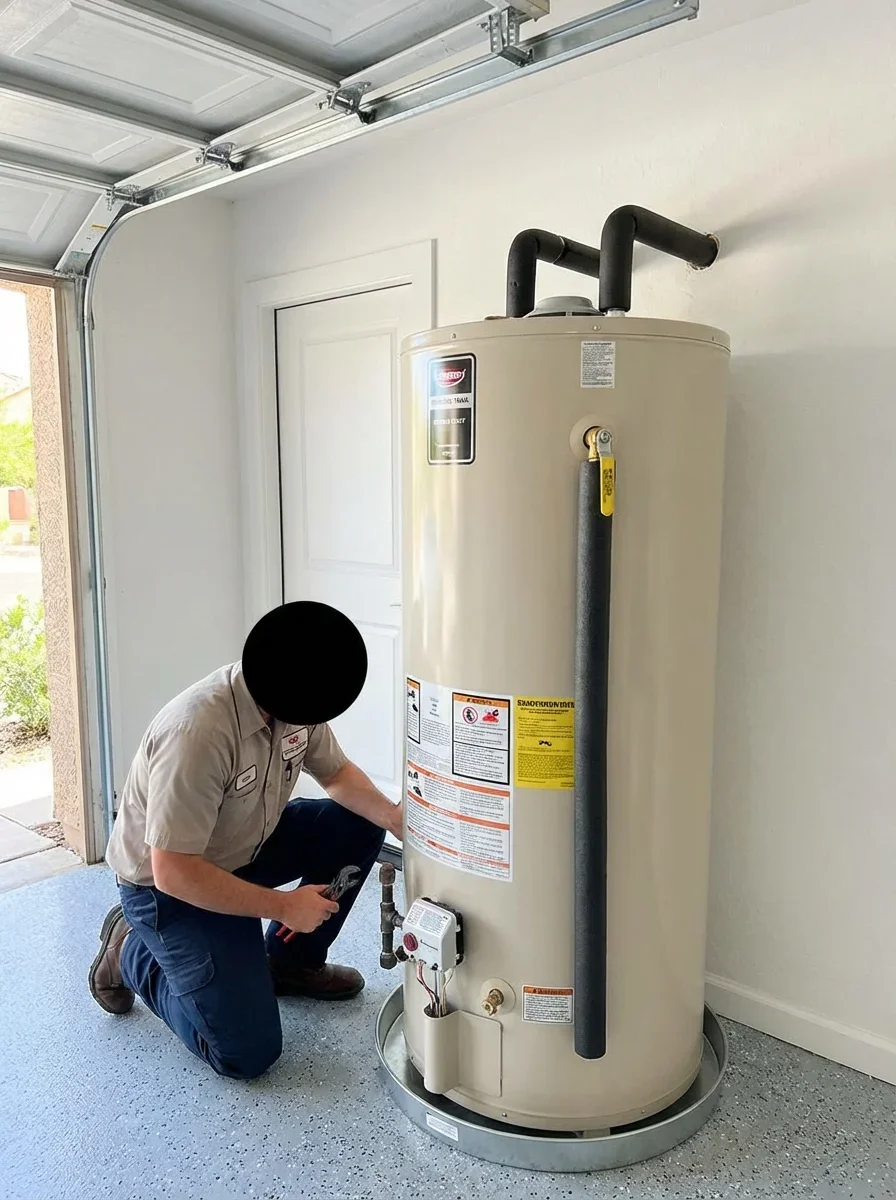
A standard 40-50 gallon gas tank water heater replacement runs $1,400 to $2,200 installed in Phoenix. That includes the tank, basic labor, permits, and code-compliant installation.
Electric tank models in the same capacity range cost slightly less upfront — $1,200 to $1,900 — because there's no gas line or venting work involved.
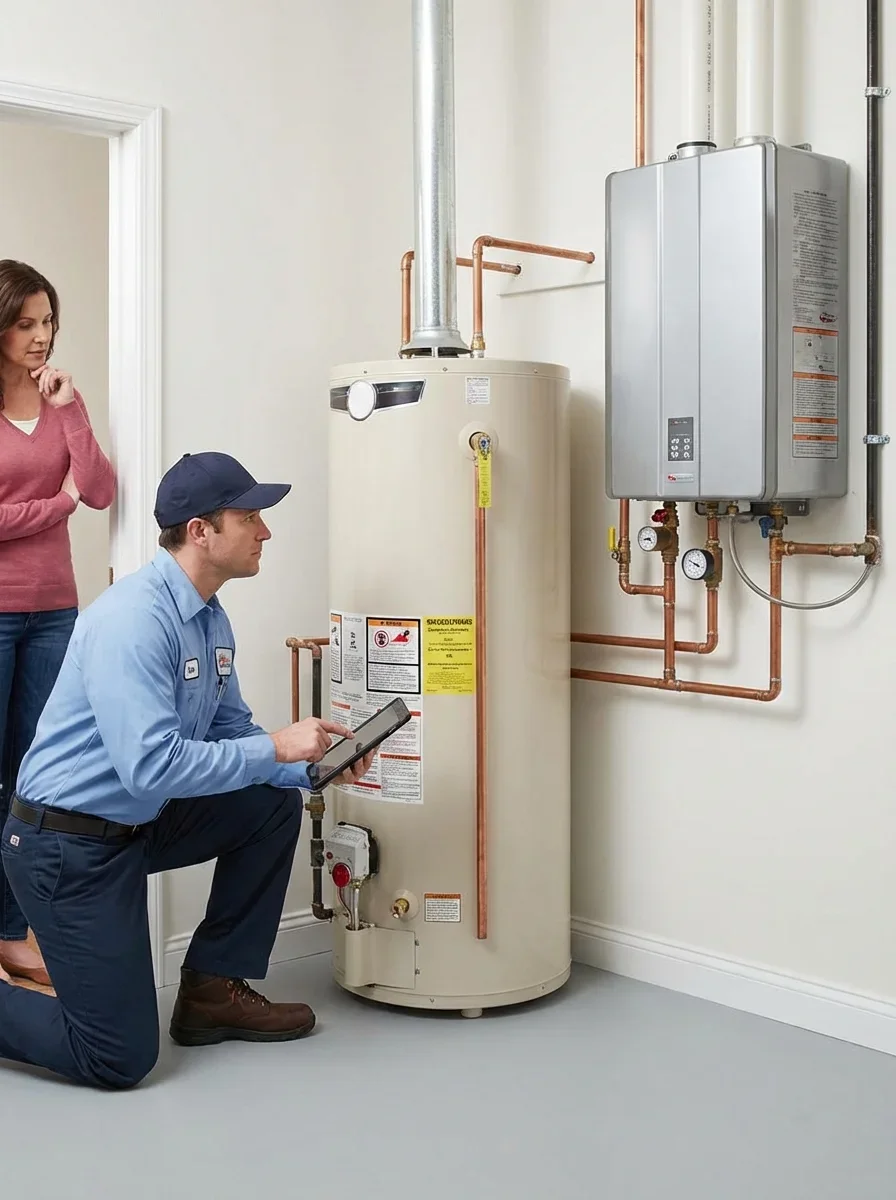
Tankless units start around $2,800 for a whole-house electric model and climb to $4,500+ for gas-fired units that require new gas lines, upgraded electrical for the ignition system, and sealed combustion venting. Most ROC-licensed contractors charge $450 to $750 for labor alone on a straightforward tank swap. That number jumps if you're dealing with access issues, caliche excavation for buried gas lines, or electrical panel upgrades.
Phoenix labor rates run 10-15% higher than the state average due to demand concentration in the metro area. Summer installations (June through August) sometimes carry $100-$200 surcharges because it's peak season for water heater failures. The combination of heavy AC use driving up hot water demand and thermal stress on aging tanks creates a late-summer spike in emergency replacements.
| Water Heater Type | Installed Cost | Operating Cost/Year | Lifespan | Best For |
|---|---|---|---|---|
| Gas Tank (40-50 gal) | $1,400-$2,200 | ~$350 | 8-10 years | Most Phoenix homes with gas access |
| Electric Tank (40-50 gal) | $1,200-$1,900 | $650-$800 | 8-10 years | All-electric homes, lower upfront budget |
| Gas Tankless | $3,200-$4,800 | ~$240 | 15-20 years | High demand, long-term ownership |
| Heat Pump Hybrid | $2,200-$3,200 | $250-$400 | 10-15 years | Electric homes, garages with good ventilation |
Tank Water Heater Replacement Costs
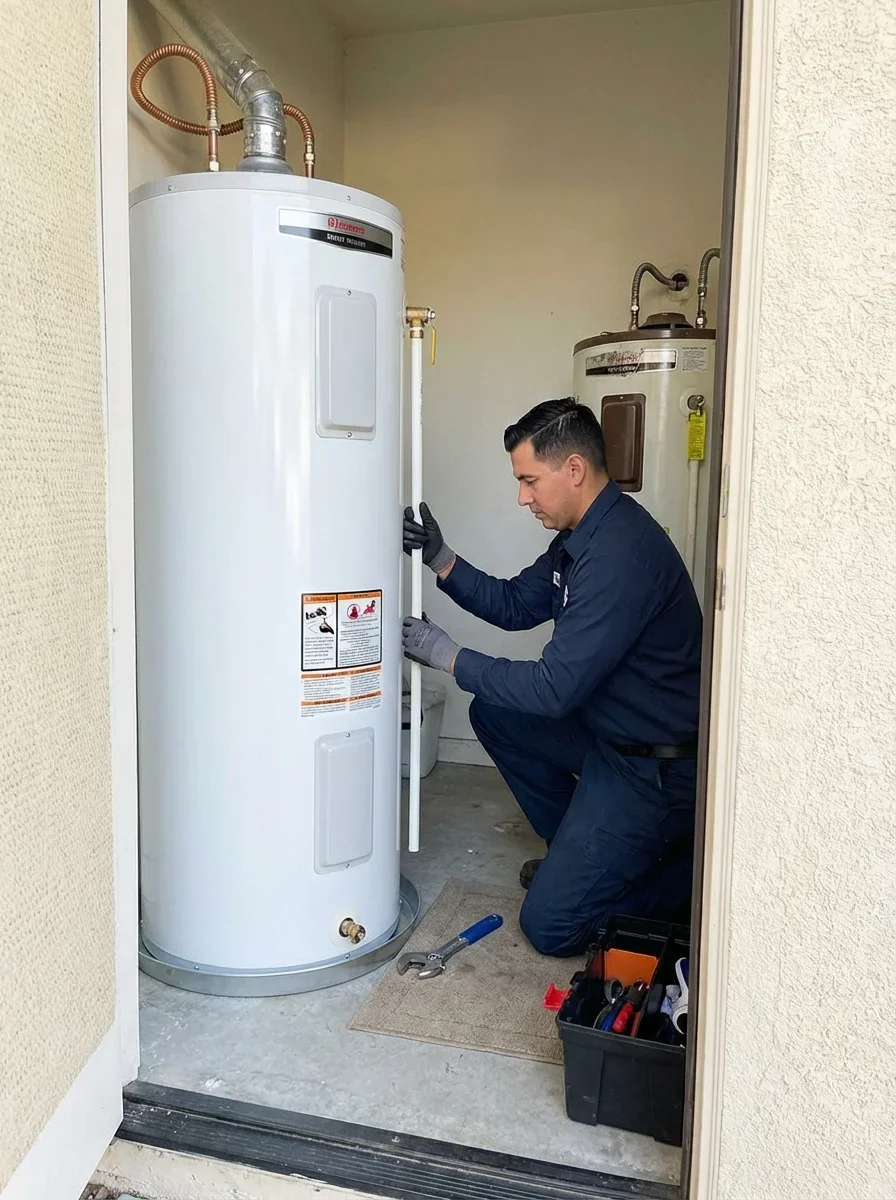
Gas Tank Water Heaters
Gas tank models dominate Phoenix installations because natural gas is widely available and operating costs are lower than electric. A 40-gallon atmospheric vent gas tank runs $1,400 to $1,800 installed.
50-gallon models (the most common residential size here) cost $1,600 to $2,200.
Power-vent gas tanks add $300 to $600 to the job. These units use a fan to push exhaust horizontally through a PVC pipe, which is common in newer construction where builders eliminated traditional flues. They're required when you don't have a suitable chimney or vertical vent path. Bradford White and Rheem power-vent models run $1,100 to $1,400 for the unit alone before labor.
If your existing tank is atmospheric-vented but your home's ventilation no longer meets current IRC code (which tightened in 2018), you may be required to upgrade to power-vent during replacement. That adds roughly $500 to your total cost but ensures you pass inspection.
Electric Tank Water Heaters
Electric tanks are simpler to install because there's no venting or gas line work. A 40-gallon electric tank costs $1,200 to $1,600 installed. 50-gallon models run $1,400 to $1,900.
The catch: operating costs in Phoenix are significantly higher with electric.
APS and SRP rates put electric water heating at roughly double the cost of gas over the unit's lifespan. If you're in an all-electric home or a manufactured home without gas infrastructure, you don't have a choice. But if gas is available, contractors typically steer you there for long-term savings.
Heat pump water heaters (hybrid electric models) are gaining traction in Phoenix's climate. They pull heat from ambient air rather than using resistance coils, cutting electric consumption by 60%. Installed cost runs $2,200 to $3,200, but the efficiency gain pays back in 4-6 years at current APS rates. These units work best in garages or unconditioned spaces where summer temperatures stay high.
Capacity and Size Variations
Capacity affects both unit cost and installation labor. A 30-gallon "lowboy" tank (common in older homes with tight closet installations) costs $1,300 to $1,700 installed.
75-gallon tanks for larger families or homes with high simultaneous demand run $2,000 to $2,800.
Taller tanks are easier to install than short-radius models because they match standard closet dimensions. If you're replacing a lowboy with a standard-height tank, you may need drywall work or closet modification, which adds $200 to $400 to the job.
Tankless Water Heater Replacement Costs
Gas Tankless Units
Whole-house gas tankless units deliver endless hot water but come with steep upfront costs. Expect to pay $3,200 to $4,800 installed for a Rinnai or Navien unit sized for a typical 3-4 bedroom Phoenix home.
The installation complexity drives the price.
Most existing homes need gas line upsizing. The old 1/2" line feeding your tank heater won't supply the 180,000+ BTU demand of a tankless unit. Running a new 3/4" gas line from the meter adds $600 to $1,200 depending on distance. If that line runs through your slab (standard in pre-2000 Phoenix homes), you're looking at trenching through caliche, which can hit $2,000+ for a 40-foot run.
Tankless units also require 120V power for the control board and ignition. If your old tank was gas-only with no electrical connection, you'll need a dedicated circuit run from your panel. That's another $300 to $500.
Outdoor installations are simpler and cheaper because venting isn't an issue. Indoor units require sealed combustion venting (two-pipe system) with specific clearances and termination requirements. That venting work alone runs $400 to $800.
Electric Tankless Units
Electric tankless models are less common for whole-house use in Phoenix because they demand massive electrical service. A Stiebel Eltron or EcoSmart unit sized for simultaneous showers needs a 150-200 amp circuit.
Most homes built before 2010 have 100-125 amp main panels, which means a panel upgrade before you can even install the heater.
Panel upgrades cost $1,800 to $3,500 in Phoenix. Add $2,000 to $2,800 for the tankless unit and installation, and you're at $4,500 to $6,000 total. The math only works if you're already planning a panel upgrade for other reasons or if you're installing point-of-use units (smaller tankless heaters serving a single fixture) rather than whole-house models.
Point-of-use electric tankless units run $400 to $900 installed. They work well for remote bathrooms or kitchen sinks where waiting for hot water from a distant tank wastes water and energy.
Efficiency and Long-Term Savings
Tankless units save 20-30% on water heating costs because they eliminate standby heat loss. In Phoenix's climate, where your garage or attic can hit 140°F in summer, a tank sitting in that space loses significant heat even with modern insulation.
The payback period for tankless runs 8-12 years at current Phoenix utility rates.
If you're staying in the house long-term and you have high hot water demand, the math works. If you're selling in 3-5 years, the premium won't pay back, though tankless installations do add perceived value to home listings.
Installation Labor Costs in Phoenix
Straightforward tank swaps (same location, same fuel type, no code changes) run $450 to $750 for labor. That includes hauling the old unit, setting the new one, making connections, and cleanup. Most licensed contractors include permit fees in that quote, though some charge permits separately at $75 to $150.
Complex installations push labor to $1,200 to $2,000.
Complex Installation Factors:
- Relocating the heater to a different room or garage
- Switching fuel types (electric to gas or vice versa)
- Upgrading from atmospheric to power-vent
- Installing expansion tanks or pressure-reducing valves to meet current code
- Running new gas lines, water lines, or electrical circuits
Phoenix's slab-on-grade construction affects labor costs when water line modifications are needed. Cutting concrete and trenching through caliche to reroute supply or drain lines adds $800 to $2,000 depending on length and depth. Most contractors subcontract concrete cutting to specialists, which adds coordination time and cost.
Emergency replacement (same-day or next-day service) carries a $200 to $400 premium during summer months. If your tank fails on a Friday afternoon in July, expect to pay top dollar for weekend labor.
Factors That Increase Replacement Costs
Fuel Type Conversion
Switching from electric to gas requires running a new gas line from your meter and installing proper venting. Budget $1,500 to $3,000 for the conversion work before the heater itself.
Gas-to-electric conversions need a new 240V circuit and panel capacity. Figure $800 to $1,500 for electrical work.
Most contractors recommend against fuel switching unless you're combining it with other upgrades. The added cost rarely justifies the conversion unless your current fuel type is creating ongoing problems (like an undersized electrical panel struggling with an electric tank).
Venting and Flue Modifications
Older Phoenix homes with atmospheric-vent gas heaters sometimes need flue relining or repair during replacement. A collapsed clay flue liner or corroded B-vent pipe forces an upgrade to power-vent or direct-vent units. Budget $600 to $1,200 for power-vent conversion if your existing flue is unusable.
Shared flues (one vent serving both the water heater and furnace) complicate replacements. Current code requires separate venting in most cases, which means new penetrations through your roof or exterior wall.
That work runs $400 to $900 depending on whether you're going through a tile roof or stucco wall.
Code Compliance Upgrades
Arizona adopted IRC amendments in 2021 requiring expansion tanks on all closed-loop water systems (systems with backflow preventers or pressure-reducing valves). Most Phoenix municipal supplies require backflow prevention, which means most homes need expansion tanks on new installations.
Expansion tank installation adds $150 to $300 to the job. It's not optional. Inspectors red-tag installations without them.
Earthquake strapping is required on all water heaters in Arizona, though enforcement varies by jurisdiction. Straps cost $30 to $60 in materials and 30 minutes of labor.
Drain pans (required for indoor installations above living space or in attics) run $80 to $150 installed. The pan needs a drain line terminating outside or to a floor drain, which can add $100 to $300 if you don't have existing drainage nearby.
Hard Water Considerations
Phoenix's 300+ ppm calcium carbonate water supply accelerates anode rod depletion and tank bottom corrosion. Contractors recommend powered anode rods (aluminum/zinc rods with impressed current) in new installs to extend tank life from 8-10 years to 12-15 years.
These rods cost $200 to $350 installed but pay for themselves if you avoid one early replacement.
If you don't have a whole-house water softener, expect sediment buildup to reduce your new tank's efficiency within 3-4 years. Flushing the tank annually helps, but a water softener solves the root problem. Most plumbers offer softener installation during water heater replacement at a bundled rate. Expect $1,200 to $2,200 for a basic salt-based softener added to the job.
Access and Location Challenges
Attic installations cost $200 to $500 more than garage or closet installations due to access difficulty and safety requirements. You'll also need a secondary drain pan and condensate pump if there's no gravity drain path. That's another $150 to $300.
Tight closet installations sometimes require door widening or wall modification to fit newer, code-compliant tanks that are physically larger than older models. That carpentry work adds $200 to $600 depending on scope.
Slab-on-grade homes with buried supply lines sometimes need concrete cutting and trenching to replace corroded or leaking pipes during heater replacement. Caliche excavation runs $60 to $100 per linear foot, and most jobs involve 10-20 feet of trenching if the existing lines are failing.
Tank vs. Tankless: Cost Comparison Over Time
A 50-gallon gas tank heater costs roughly $1,800 installed and uses approximately $350 worth of natural gas annually in Phoenix (based on average household consumption and current SRP/Southwest Gas rates). Over a 10-year lifespan, you're at $5,300 total cost.
A comparable gas tankless unit costs $4,200 installed and uses about $240 worth of gas annually.
Over 20 years (typical tankless lifespan), that's $9,000 total. The tank approach over the same 20 years requires one replacement at year 10, putting you at $10,600.
The tankless unit saves $1,600 over 20 years while delivering unlimited hot water. The gap widens if you factor in the space savings. A tankless unit frees up 12-16 square feet of floor space, which matters in smaller Phoenix homes where storage is tight.
Electric comparisons favor tankless even more heavily because standby heat loss is brutal in Phoenix garages. An electric tank uses $650-$800 worth of electricity annually. An electric tankless (or heat pump hybrid) cuts that to $250-$400.
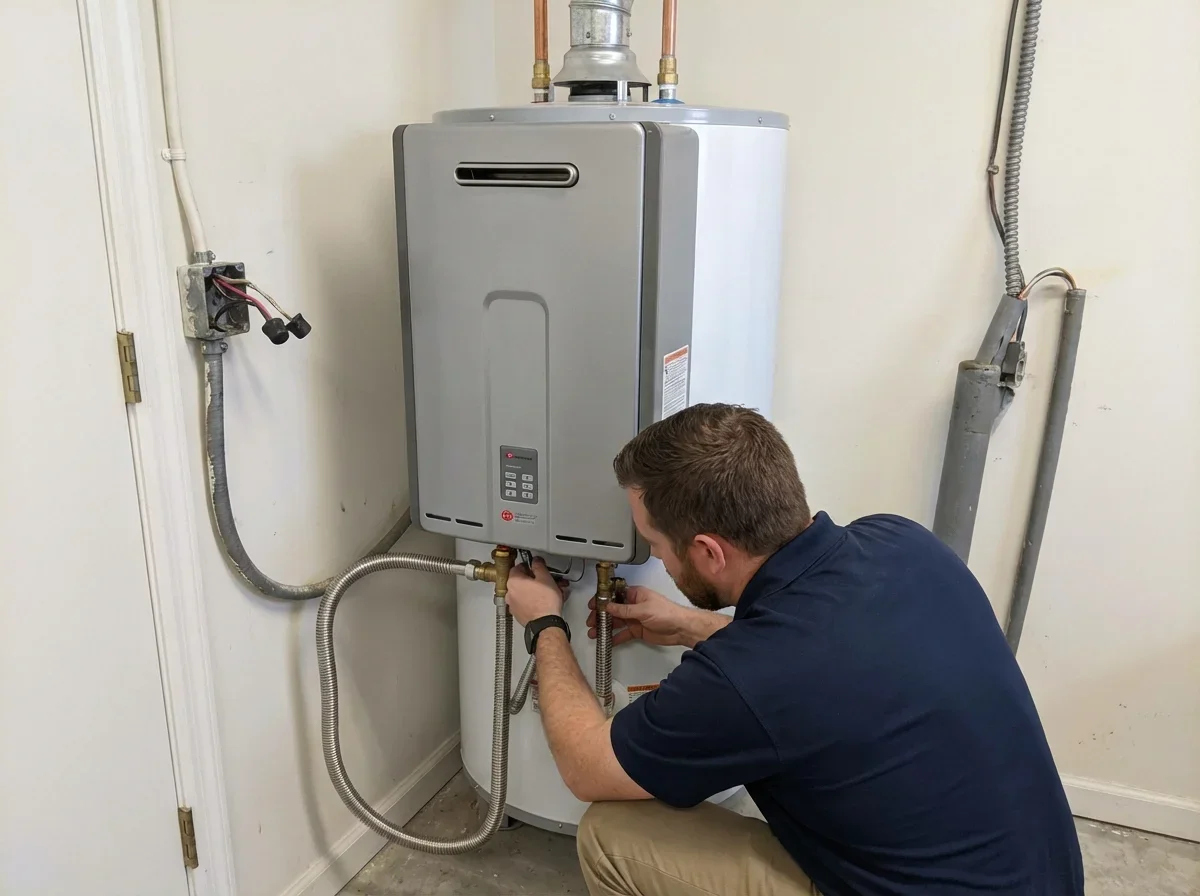
Permit and Inspection Costs
Phoenix requires permits for water heater replacement. The permit fee runs $75 to $150 depending on jurisdiction and whether you're in city limits or an unincorporated county area.
Scottsdale, Tempe, and Chandler have their own fee structures, typically in the $90 to $125 range.
Licensed contractors pull permits as part of the job. If you're doing a DIY install (not recommended unless you're experienced), you'll pull the homeowner permit yourself and schedule inspections directly.
Inspections verify proper venting, gas connections, electrical work, seismic strapping, drain pan installation, and temperature/pressure relief valve termination. Failed inspections cost you another inspection fee ($50-$75) and the contractor's time to return and correct issues.
Skipping permits is common but risky.
Unpermitted work can void your homeowner's insurance if a water heater failure causes damage. It also complicates home sales. Title companies and buyers increasingly require permit verification for major systems.
Pro Tip: Phoenix's hard water (300+ ppm calcium carbonate) is brutal on tank water heaters. Installing a powered anode rod during replacement extends tank life from 8-10 years to 12-15 years for just $200-$350 — essentially paying for itself by preventing one early replacement.
How to Reduce Your Replacement Costs
Buy the unit yourself and hire labor-only installation. This cuts $200 to $400 from contractor markup but voids their warranty on the equipment. You're responsible for warranty claims directly with the manufacturer, which can be a hassle if the unit fails.
Schedule during the slow season (December through February). Some contractors offer 10-15% discounts on winter installs because call volume drops. You'll also avoid the summer emergency surcharge.
Stick with your current fuel type and location. Every variable you change adds complexity and cost. A like-for-like replacement is always the cheapest path unless your existing setup creates ongoing problems.
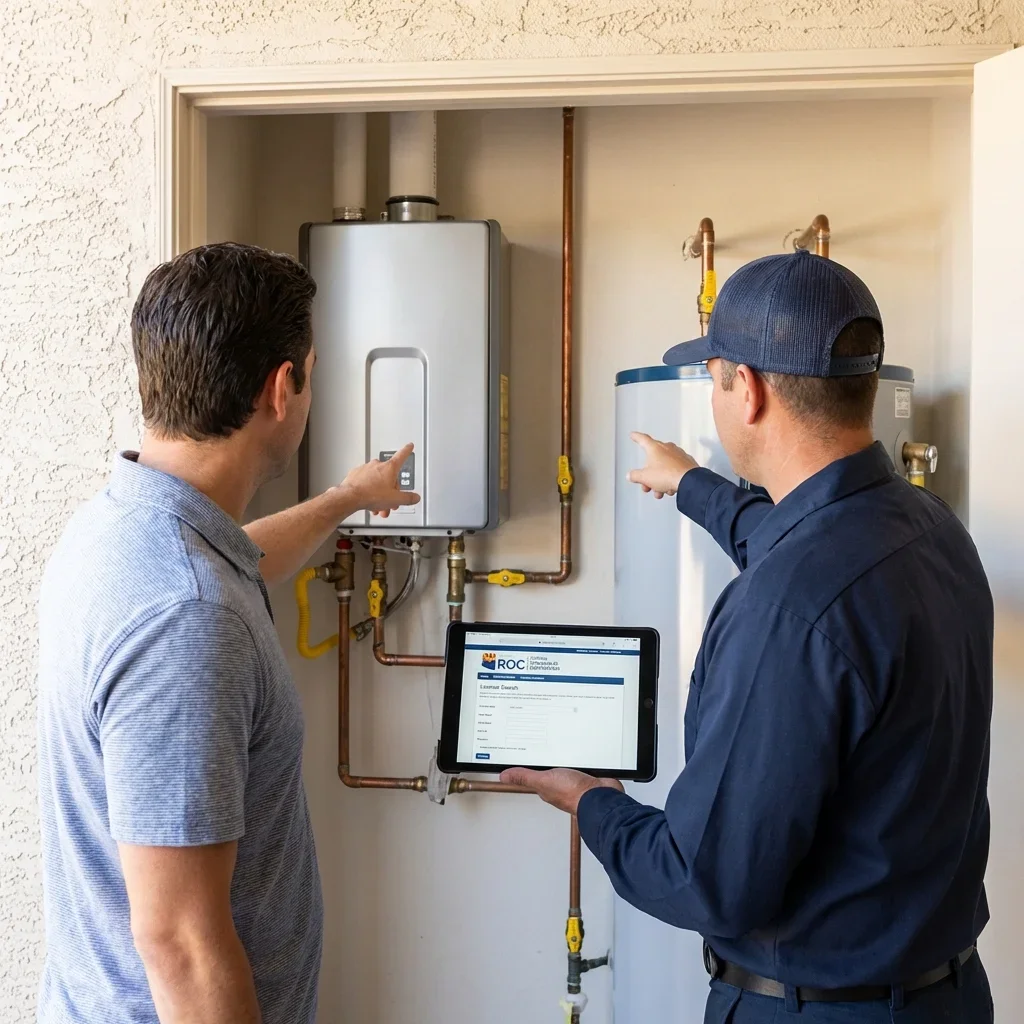
Compare quotes from at least three ROC-licensed contractors. Phoenix pricing varies more than you'd expect. The same job quotes at $1,600 from one contractor and $2,400 from another based on overhead, scheduling, and markup differences. Verify licenses at roc.az.gov before signing anything.
Skip unnecessary upgrades.
Contractors often push Wi-Fi-enabled tanks, premium warranty extensions, or oversized units beyond what you need. A standard 6-year warranty tank from Bradford White or Rheem performs just as well as a 12-year premium model for most homeowners. You'll likely replace the unit before the warranty expires anyway.
Choosing Between Repair and Replacement
If your water heater is under 6 years old, repair usually makes sense unless you're facing a tank leak or major component failure. Thermostat replacement runs $150 to $300. Heating element replacement on electric models costs $200 to $400.
Pressure relief valve replacement is $120 to $200.
Once a tank passes 8-10 years in Phoenix's hard water environment, replacement beats repair in most cases. The next failure is right around the corner, and you'll spend $200-$400 on repairs only to replace the unit 6-12 months later anyway.
Tank leaks and severe corrosion are always replacement situations. There's no repairing a corroded tank bottom or a failed seam weld. Emergency replacement costs more than planned replacement, so if your unit is 8+ years old and showing signs of decline (rusty water, rumbling sounds, slow recovery), budget for replacement in the next 12 months rather than waiting for catastrophic failure.
For a detailed breakdown of what constitutes a repair vs. replacement situation, see our guide on water heater lifespan and replacement signs.
Finding ROC-Licensed Contractors in Phoenix
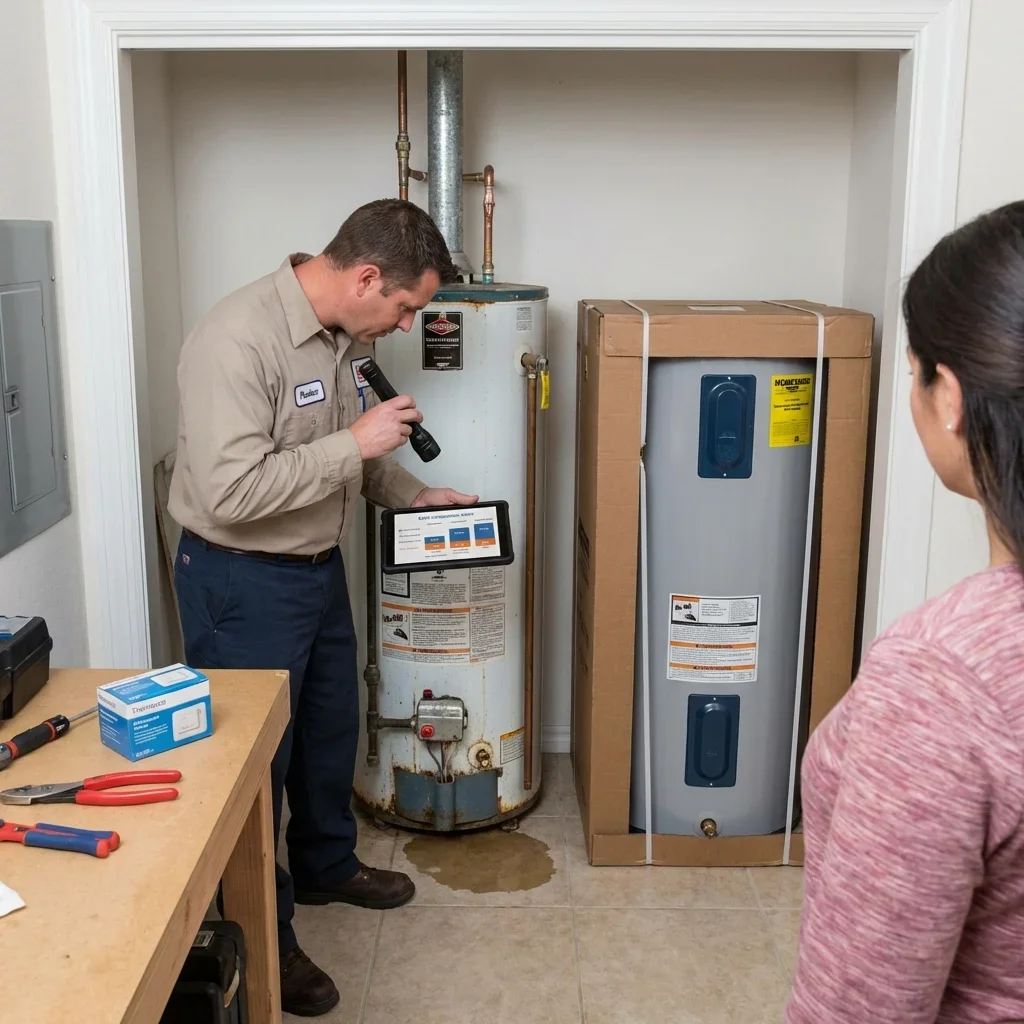
Every contractor performing water heater work in Arizona must hold an active ROC license. Specifically a K-38 classification for residential plumbing or a K-39 for commercial work.
Verify any contractor at https://roc.az.gov/ before hiring.
Check for complaints and disciplinary actions in the ROC database. A single complaint isn't disqualifying, but patterns of non-payment to suppliers or failed inspections are red flags.
Arizona doesn't require contractors to carry workers' compensation insurance, which is unusual. Ask for proof of general liability insurance and workers' comp coverage (if they have employees). The ROC bond ($4,000-$15,000 depending on license tier) won't cover major damage claims if something goes wrong.
Get itemized quotes showing unit cost, labor, permits, and any add-ons separately. Lump-sum quotes make it impossible to compare contractors or identify where you're overpaying.
Ask whether the contractor handles permit pulling and inspections. Reputable contractors include this in their scope and fee. If they ask you to pull permits, they're either unlicensed or trying to avoid inspection scrutiny.
For more guidance on contractor selection, visit our guide on how to choose a licensed plumber in Phoenix.
Regional Cost Variations Within Phoenix Metro
Central Phoenix and older neighborhoods (built pre-1980) see higher costs due to access challenges and outdated infrastructure. Block construction with buried copper lines and no easy attic or garage access pushes labor costs up 15-20%.
East Valley cities (Mesa, Chandler, Gilbert) have newer housing stock on average, which means easier installations and slightly lower labor rates.
Expect costs at the lower end of the ranges cited here.
North Scottsdale and other affluent areas see premium pricing because contractors factor in the clientele and property values. The same installation that costs $1,800 in Tempe might quote at $2,400 in Paradise Valley, even with identical scope.
West Valley (Glendale, Peoria, Surprise) tracks closest to metro averages. These areas have a mix of older and newer construction, and contractor competition keeps pricing moderate.
Rural areas outside the metro (Apache Junction, Queen Creek, Casa Grande) sometimes see lower unit costs but higher travel charges. Contractors bill for drive time on longer hauls, which can add $100 to $200 to the total.
When to Consider [Water Heater Repair](/services/water-heater-repair-installation/) Instead
Minor issues like a faulty thermostat, failing pressure relief valve, or tripped high-temperature cutoff are repair situations. These fixes cost $150 to $400 and buy you another 2-4 years on a mid-life unit.
If you're seeing inconsistent hot water, check the dip tube first.
Broken dip tubes are common in Rheem and GE models from 2010-2016 and cost $200 to $350 to replace. That's a worthwhile fix on a 7-year-old unit that's otherwise healthy.
Sediment buildup is a maintenance issue, not a replacement trigger. Annual flushing (DIY-friendly) or professional flushing ($100-$150) extends tank life and restores efficiency. If you've never flushed your tank and it's running inefficiently, try maintenance before jumping to replacement.
Anode rod replacement ($150-$250) is a preventive repair that adds years to tank life. Most homeowners never replace anode rods, which is why tanks fail early in Phoenix's hard water. If your unit is 5-7 years old and still heating well, an anode rod replacement is cheap insurance.