What Drives Slab Leak Repair Costs in Phoenix
Slab leak pricing isn't a single line item. You're paying for detective work (finding the leak), demolition (accessing the pipe), repair or replacement (fixing the problem), and restoration (making your floor look normal again). Each stage has variables, and Phoenix conditions add complexity at every step.
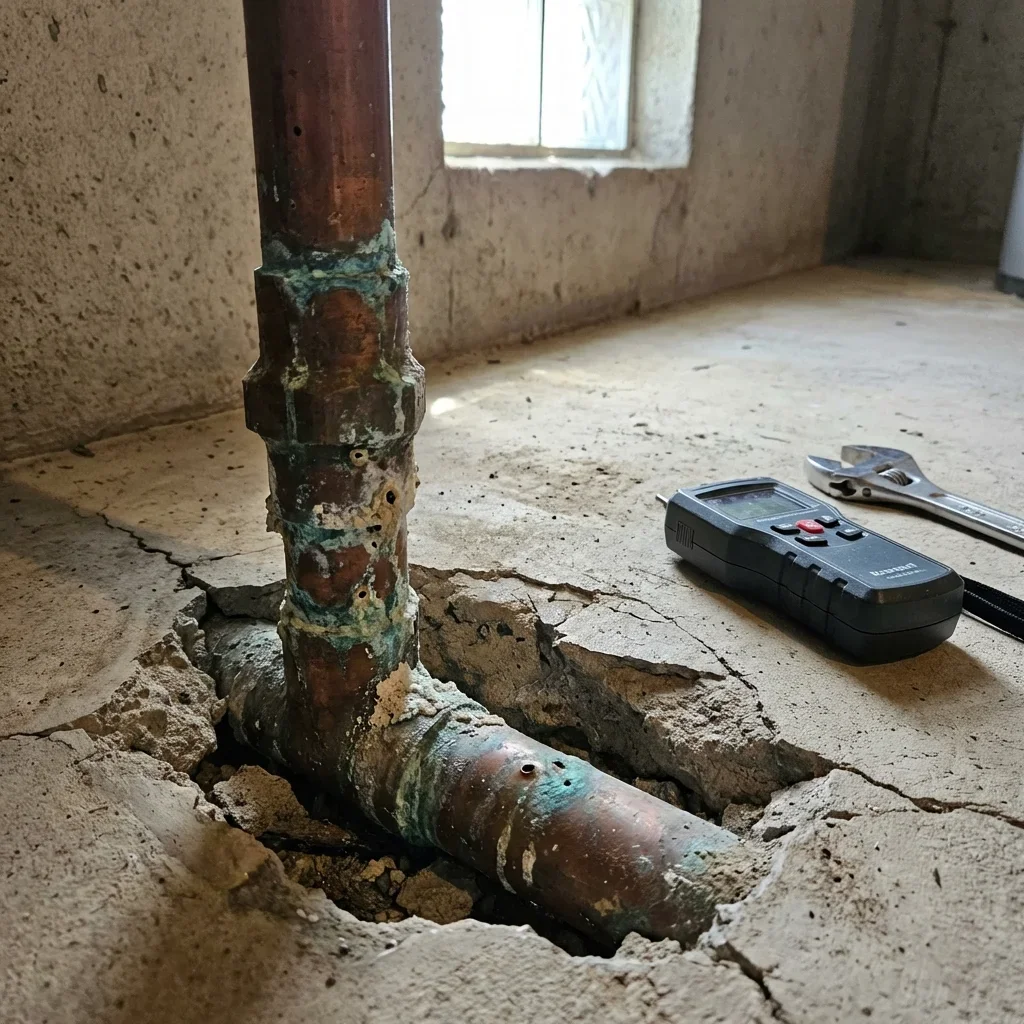
The city's water chemistry accelerates copper corrosion. Phoenix municipal water runs 300+ ppm calcium carbonate — classified as "very hard" — which creates scale buildup inside pipes and electrochemical reactions on the outside. Copper supply lines in pre-2000 homes develop pinhole leaks at 2-3x the national rate, often in clusters.
Fix one leak today, and you may face another six inches away next year.
That reality shapes repair vs. repipe decisions. Caliche soil makes excavation expensive. Unlike soft desert sand, caliche is a concrete-like calcium carbonate hardpan that sits 1-6 feet below the surface. Breaking through it requires jackhammers, specialized bits, and more labor hours. Contractors charge $150-$300 per linear foot to trench through caliche compared to $50-$100 in normal soil.
If your plumber suggests accessing the pipe from above (through the slab) rather than tunneling under the foundation, caliche is usually why. Slab-on-grade construction means no crawlspace alternative. Phoenix homes sit directly on concrete slabs — no basements, no crawlspaces. Every supply and drain line runs under or through that slab. When a pipe fails, you're cutting concrete or rerouting lines overhead.
There's no easy access hatch.
Electronic Leak Detection: $300-$600
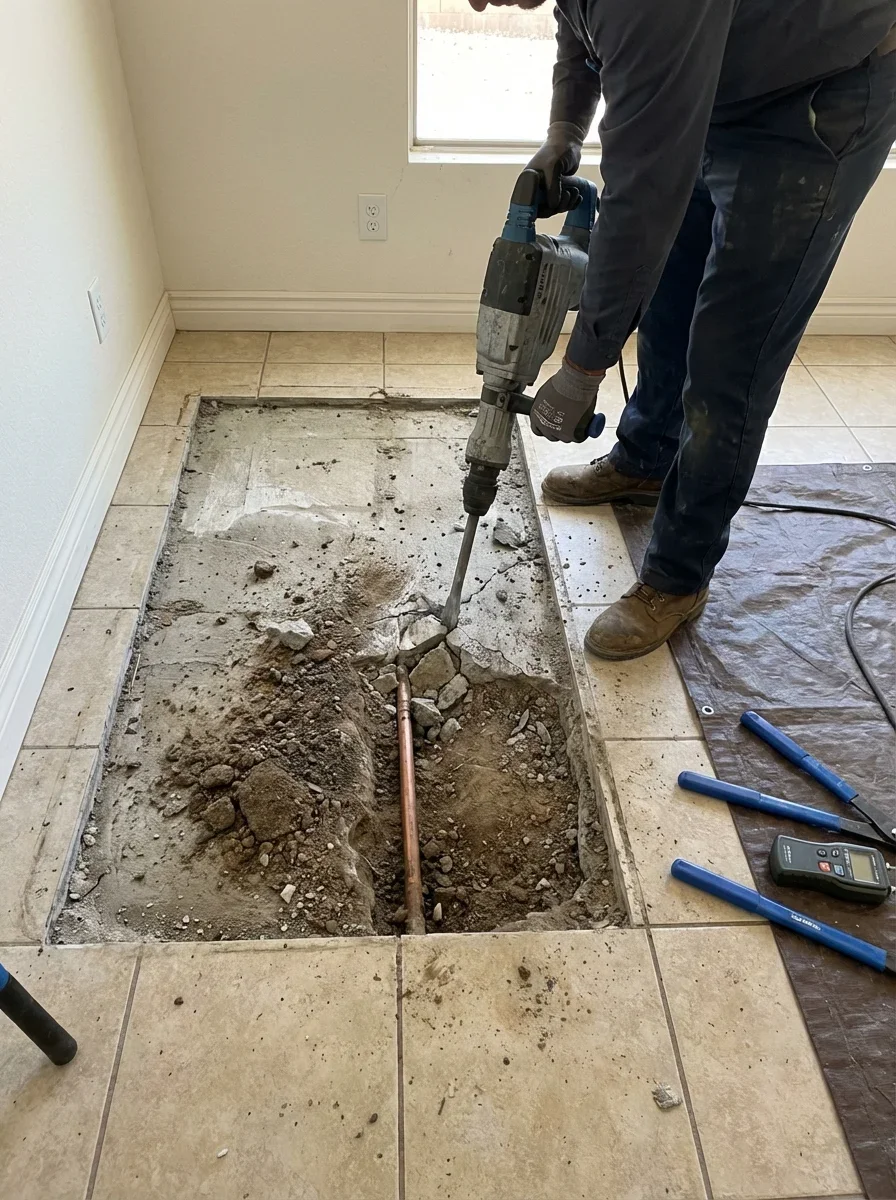
Before anyone swings a jackhammer, you need to know where the leak is. Most plumbing companies charge $300-$600 for electronic leak detection using acoustic listening devices, thermal imaging, or tracer gas. Some plumbers waive this fee if you hire them for the repair, but get that in writing.
Detection accuracy matters more than you'd think. A contractor who narrows the leak location to a 2-foot radius will cut far less concrete than one who guesses a 10-foot zone. Experienced Phoenix leak detection specialists often use multiple methods — listening for acoustic signatures in copper lines, then confirming with infrared cameras that show temperature differentials where water escapes.
If your plumber skips detection and goes straight to "let's open up the floor," you're rolling the dice.
Homeowners report cases where contractors cut in the wrong spot, then charged again to cut elsewhere. A proper leak detection service saves money by eliminating exploratory demolition.
Pro Tip: Always verify that leak detection fees are waived in writing before hiring. Some contractors advertise "free detection" but only apply the credit if you approve repairs above a certain dollar threshold — typically $2,000-$3,000.
Concrete Cutting and Access: $400-$1,500
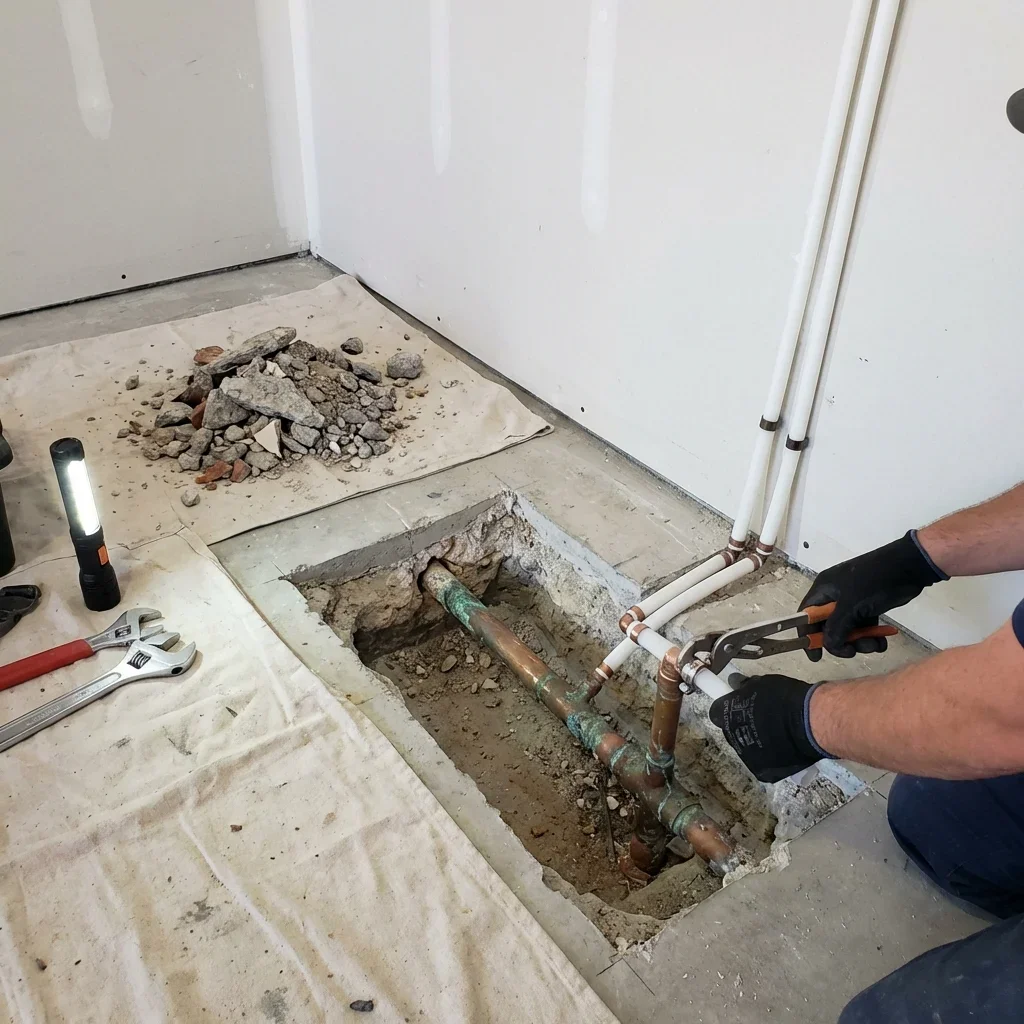
Once the leak is pinpointed, you're cutting through tile, concrete, and possibly rebar to reach the pipe. Concrete cutting costs $400-$1,500 depending on slab thickness (4-6 inches is standard in Phoenix), the size of the access area, and whether the contractor hits rebar or post-tension cables.
Most leaks require a 2x3-foot access hole for a single pipe repair. Larger repairs or situations where the plumber finds additional damage once they open the floor expand that footprint. Post-tension slab homes (common in newer Phoenix subdivisions) add risk and cost. Cutting a post-tension cable can compromise structural integrity, so contractors use metal detectors and X-ray imaging before cutting.
Expect to pay an extra $200-$400 for post-tension slab verification.
Tile removal adds another layer. If your leak is under ceramic or porcelain tile, the contractor must remove tiles without damaging surrounding ones (usually impossible) and source matching replacements (often discontinued). Many homeowners end up retiling the entire room because a perfect color match doesn't exist. Factor $800-$2,500 for tile replacement beyond the access hole itself.
Flooring Restoration: The Hidden Cost Multiplier
Contractors repair the pipe, not your floor.
Most plumbing quotes cover pouring concrete back into the access hole and nothing more. You'll hire a separate flooring contractor to match tile, refinish hardwood, or replace carpet. Homeowners consistently underestimate this cost, discovering after the plumber leaves that floor restoration doubles the project total.
If you have decorative tile or natural stone, save extra tiles from installation (if you have them) or plan for a visible patch. One homeowner in Ahwatukee reported spending $1,200 to retile a 15x15-foot bathroom because the original 1990s-era tile was discontinued and a 2x3-foot patch would have looked like a checkerboard mistake.
Pipe Repair Methods and Pricing
How your plumber fixes the leak determines long-term reliability and cost. You have three main options: spot repair, epoxy lining, or rerouting/repiping.
Spot Repair: $500-$2,500
Spot repair means cutting out the damaged section of pipe and splicing in a new piece. This is the cheapest option upfront — $500-$2,500 including access and concrete patching — but it doesn't prevent the next leak.
If you're in a home with 30-year-old copper and Phoenix's hard water has been eating the pipes from the inside, you're treating a symptom, not the disease.
Spot repair makes sense for newer homes with isolated leaks (a construction defect or accidental nail puncture during installation). It's a gamble in pre-2000 copper systems. Plumbers report that 60-70% of homeowners who choose spot repair call back within 2-4 years for another leak nearby.
Epoxy Pipe Lining: $2,000-$5,000
Epoxy lining coats the inside of existing pipes with a food-safe epoxy resin, sealing pinhole leaks and preventing future corrosion. The contractor accesses the pipe at two points, cleans the interior with abrasive tools, then pumps epoxy through the line and inflates a bladder to press the coating against the pipe walls.
Once cured, you have a smooth, corrosion-resistant interior.
This method costs $2,000-$5,000 for a single line (like the hot water supply from your water heater to the kitchen). It's less invasive than repiping — minimal concrete cutting, no attic access — but it only works for supply lines, not drain lines. Epoxy lining also reduces pipe diameter by 1-2mm, which can slightly decrease flow if your pipes were already undersized.
Not every Phoenix plumber offers epoxy lining. It requires specialized equipment and training. If you're considering this route, ask how many epoxy jobs the contractor has completed and whether they warranty the lining separately from the labor.
Rerouting Through the Attic: $1,500-$4,000
Instead of repairing the under-slab leak, some plumbers abandon the damaged line and run new pipe through your attic or walls. This approach costs $1,500-$4,000 depending on how many fixtures you're rerouting and how difficult the attic access is.
Rerouting eliminates the slab leak entirely and skips most concrete cutting (you still need a small access point to cap the old line). But it trades one risk for another.
Phoenix attics hit 140-160°F in summer. PEX pipe handles that heat, but connections can fail if not properly secured. Copper in the attic is less common but performs better in extreme heat. Make sure your contractor insulates hot water lines to prevent energy loss and secures pipes every 32 inches to prevent thermal expansion noise.
This method works best for isolated fixture groups — a master bathroom or kitchen island, for example. Rerouting your entire home's plumbing through the attic is rare. At that scope, you're looking at whole-home repiping.
| Repair Method | Cost Range | Best For | Longevity |
|---|---|---|---|
| Spot Repair | $500-$2,500 | Post-2005 homes, isolated leaks, selling soon | 2-4 years (older copper) |
| Epoxy Lining | $2,000-$5,000 | Single line corrosion, supply lines only | 10-15 years |
| Attic Reroute | $1,500-$4,000 | Specific fixture groups, accessible attic | 20+ years (new pipe) |
| Full Repipe | $4,500-$15,000+ | Pre-2000 copper, multiple leaks, staying 5+ years | 25-50 years |
Full Repiping: $4,500-$15,000+
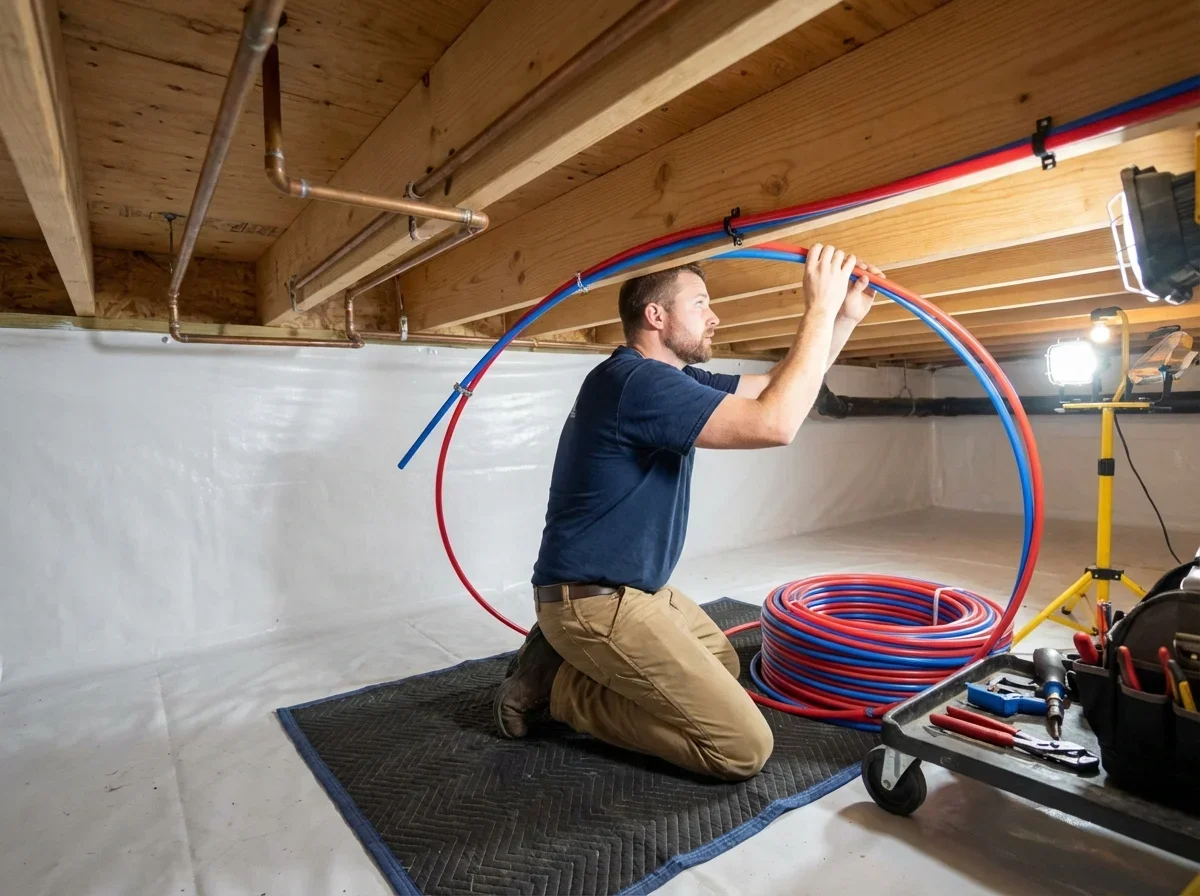
If your home was built before 2000, has copper supply lines, and you're facing your second or third slab leak, most plumbers recommend repiping. This means abandoning the under-slab lines and running new PEX or copper through the attic to every fixture.
Costs range from $4,500 for a small 2-bed, 1-bath home to $15,000+ for a 4-bed, 3-bath with complex layouts.
Repiping solves the slab leak problem permanently. You're replacing every inch of corroded copper with new pipe that won't interact with Phoenix's hard water the same way. PEX is the most common choice — it's flexible, freeze-resistant (not a Phoenix concern, but still rated for it), and costs 30-40% less to install than copper. Copper repiping runs $8,000-$20,000 for the same home due to material and labor costs.
What Repiping Includes
A repipe contract should cover new supply lines (hot and cold), connection to existing fixtures, pressure testing, attic cleanup, and wall patching where plumbers cut access holes. It does not include cosmetic paint touch-ups, fixture replacement, or drain line work unless stated in writing.
Read your quote carefully. Some contractors itemize attic insulation displacement, drywall repair, and trim painting as separate line items.
Repiping takes 2-5 days depending on home size. You'll lose water service during active work hours, but most plumbers restore service each evening so you can shower and cook dinner. Plan to be home or have someone available to let the crew in — they need attic and wall access throughout the house.
If you're repiping, consider whether your water heater is due for replacement. Contractors often discount bundled work, and you'll save money by replacing the water heater during the repipe rather than cutting new drywall holes six months later.
Insurance Coverage: What Pays and What Doesn't
Homeowners insurance in Arizona covers sudden, accidental water damage — the soaked carpet, ruined drywall, or damaged furniture from a slab leak. It does not cover the cost to access and repair the pipe itself.
Expect insurance to pay for water extraction, mold remediation, and floor replacement, but you're on the hook for the plumbing repair.
Some policies include a leak detection endorsement that covers the cost to locate the leak, even if it's under the slab. This add-on costs $30-$80 annually and can save you the $300-$600 detection fee. Check your policy declarations page or call your insurer to confirm what's covered before filing a claim.
Deductibles matter. If your policy has a $2,000 deductible and your total damage is $3,500, you're getting a $1,500 check, not enough to cover both the plumbing and the floor. Homeowners who skip the claim and pay out of pocket avoid premium increases and the hassle of claim documentation.
Run the numbers with your plumber's estimate before involving insurance.
What Insurance Typically Covers:
- Water damage to floors, walls, and furniture
- Emergency water extraction services
- Mold remediation (if damage is sudden/accidental)
- Temporary housing during major repairs
- Leak detection (only with specific policy endorsement)
What You Pay Out of Pocket:
- Accessing and repairing the actual pipe
- Concrete cutting and restoration
- Plumbing labor and materials
- Upgrades beyond basic repair (repiping, rerouting)
Hidden Costs and Add-Ons
Beyond the core repair, watch for these extras that inflate final invoices:
Weekend or After-Hours Service: Slab leaks don't wait for business hours. If you call a plumber on Saturday night or during a holiday, expect 1.5-2x standard rates. Emergency plumbing fees in Phoenix run $150-$250 just for the service call before any repair work.
If the leak isn't actively flooding your home, wait until Monday morning.
Permit Fees: Most slab leak repairs don't require permits, but full repiping does. Phoenix permit fees run $100-$300 depending on project scope. Verify that your contractor pulls permits for repipe work — unpermitted plumbing can complicate home sales and void insurance claims if future problems arise. Check permit status at phoenix.gov or contact the Phoenix Development Services Department.
Water Damage Restoration: Plumbers fix pipes. Restoration companies dry out your home. If your slab leak has been running for weeks, you're dealing with soaked drywall, baseboards, and subfloor. Water damage restoration costs $1,000-$5,000+ depending on affected square footage and whether mold has started growing.
Phoenix's dry climate helps — water evaporates faster here than in humid regions — but porous materials like drywall still need professional drying to prevent mold.
Mold Remediation: If your leak went undetected for months, mold is possible. Arizona's dry air keeps mold growth lower than coastal states, but it still happens in dark, damp spaces under slab edges or inside wall cavities. Mold remediation costs $500-$3,000 depending on the extent of contamination.
Don't let a contractor convince you that "Phoenix is too dry for mold." It's rare, but real.
ROC License Verification and Bonding: All Arizona contractors performing work over $1,000 must hold an active ROC license. Verify your plumber's license at roc.az.gov before signing a contract. Note that ROC bonds are only $4,000-$15,000 depending on license classification, not enough to cover a botched $10,000 repipe.
Ask if your contractor carries additional liability and workers compensation insurance. Arizona doesn't require workers comp for contractors, so if an unlicensed worker gets injured on your property, you could be liable.
Phoenix-Specific Cost Factors
Certain conditions unique to Phoenix affect slab leak pricing in ways that national averages don't capture.
Hard Water and Copper Corrosion
Phoenix water chemistry creates an aggressive environment for copper pipes. The 300+ ppm calcium carbonate doesn't just cause scale buildup, it also accelerates electrochemical corrosion, especially in homes with dissimilar metals (copper pipes connected to galvanized fittings or brass valves).
Plumbers see pinhole leaks most often in 20-40-year-old copper, typically in hot water lines where thermal expansion and contraction stress the pipe walls.
If you haven't installed a water softener, you're shortening your pipes' lifespan. Soft water won't reverse existing damage, but it slows future corrosion. Some homeowners install softeners after a slab leak as preventive maintenance — a $1,500-$3,000 investment that extends the life of new plumbing.
Thermal Expansion and Summer Heat
Phoenix summer temps hit 106-118°F, and your slab absorbs that heat. Pipes expand and contract daily, stressing joints and welds. Homes with poor attic ventilation see even higher under-slab temps.
This thermal cycling doesn't cause leaks overnight, but it accelerates fatigue in already-corroded pipes.
Plumbers report a spike in slab leak calls from June through August, not because heat creates leaks, but because it pushes borderline pipes over the edge. If you're shopping for a home in Phoenix, ask when the plumbing was last inspected. A 35-year-old house with original copper and no prior leaks is statistically due.
Caliche Excavation Challenges
If your plumber suggests accessing the pipe from below rather than cutting through the slab from above, caliche soil is the reason that plan fails. Caliche sits in layers — sometimes you'll hit 6 inches of hardpan, then sand, then another 12 inches of caliche.
Trenching costs $150-$300 per linear foot in caliche-heavy areas like Chandler, Gilbert, and parts of Scottsdale.
Contractors often refuse to trench entirely and default to overhead rerouting instead.
Monsoon Season and Emergency Timing
Phoenix monsoon season (July-September) brings sudden flooding and foundation shifts. Slab leaks discovered during monsoon often coincide with foundation movement, which can crack pipes or stress connections.
If you suspect a leak during monsoon, act quickly. Saturated soil increases hydrostatic pressure against your foundation, worsening leaks and water intrusion.
Emergency plumbing rates apply during peak storm periods. If heavy rain triggers a slab leak, you'll pay premium rates for immediate service. Some homeowners wait until the storm passes to call non-emergency dispatch, but that gamble depends on leak severity.
Choosing Between Repair, Reroute, and Repipe
Most homeowners face this decision tree: fix the immediate leak cheaply, reroute the damaged line, or repipe the whole house. Here's how to choose.
Spot repair makes sense if: Your home is newer than 2005, the leak is isolated (no history of prior leaks), and you're planning to sell within 2-3 years. A $1,500 spot repair buys you time without major investment.
Rerouting makes sense if: You have a small cluster of leaks (one bathroom, for example), your attic is accessible, and the rest of your plumbing shows no signs of corrosion. Rerouting costs less than whole-home repiping but solves the problem for the affected zone.
Repiping makes sense if: Your home was built before 2000, you're on your second or third leak, or a plumber's camera inspection shows widespread corrosion.
Repiping is the only fix that prevents the next leak.
If you're staying in the house 5+ years, the upfront cost beats paying for multiple spot repairs and ongoing stress. Get a sewer camera inspection before deciding. For $300-$500, a plumber can snake a camera through your supply lines and show you the pipe interiors. You'll see scale buildup, corrosion pits, and thin spots.
That visual evidence removes guesswork. Some plumbers include camera inspection free with repipe quotes.
Getting Multiple Quotes and Avoiding Lowball Traps
Slab leak repair attracts both skilled professionals and opportunistic flippers. Get 3-4 quotes before committing, and watch for these red flags:
Quotes that skip detection: If a plumber quotes you $1,200 to "fix your slab leak" without first locating it, they're guessing. You'll pay $1,200 for exploratory cutting, then more for the actual repair.
No ROC license or insurance: Verify every contractor at roc.az.gov. If they're not listed or their license is expired, walk away. Unlicensed work isn't covered by Arizona's Residential Contractors Recovery Fund, and you lose legal recourse if the job goes wrong.
Pressure to decide immediately: Slab leaks are urgent, but not so urgent that you can't compare quotes over 24-48 hours. A plumber who demands a deposit right now is selling fear, not service.
Lowball quotes that grow: A $900 quote that becomes $3,200 after the contractor "discovers additional damage" is a bait-and-switch. Reputable plumbers give ranges (e.g., "$2,000-$3,500 depending on pipe condition") and explain what could change the price before starting work.
No written warranty: Legitimate contractors warranty both labor and materials. Expect 1-2 years on labor, 10-25 years on materials (PEX manufacturers often provide 25-year warranties).
Get warranty terms in writing before you sign.
Ask each plumber how many Phoenix slab leak repairs they've completed in the past 12 months. A contractor with 50+ local jobs has seen Phoenix-specific issues — hard water corrosion, caliche soil, post-tension slabs — and knows how to navigate them. A national franchise with one local tech may follow a corporate script that doesn't fit Arizona conditions.
Maintenance and Prevention After Repair
Once you've paid for a slab leak repair, you want to prevent the next one. Start with water chemistry management.
Install a water softener if you haven't already. Soft water won't fix corroded pipes, but it prevents scale buildup and slows electrochemical reactions. Systems cost $1,500-$3,000 installed and pay for themselves in extended pipe life and improved water heater efficiency.
Phoenix's hard water reduces water heater lifespan by 20-30%, so softening protects that investment too.
Monitor your water bill for unexplained increases. A slab leak that drips 1 gallon per hour (barely enough to notice) wastes 720 gallons per month. In Phoenix, that's $8-$15 extra each month, enough to spot if you're paying attention. Compare month-over-month usage, and investigate spikes that don't align with landscaping or guests.
Schedule annual plumbing inspections for homes built before 2000. A plumber can pressure-test your lines, check for soft spots under sinks, and camera-inspect accessible sections.
Catching corrosion early means you can repipe on your schedule, not during an emergency at peak rates.
Keep records of all plumbing work. When you sell your Phoenix home, buyers will ask about slab leaks and repiping. Documented repairs and warranties add value and reduce buyer anxiety. If you've repiped, that's a selling point — "new PEX plumbing installed 2024" beats "original 1985 copper."
Real Phoenix Pricing Examples
To give you a benchmark, here are real-world Phoenix slab leak costs from 2025-2026:
Arcadia home, 1978 build, single pinhole leak in kitchen cold water line: $2,400 total (detection, concrete cutting, pipe repair, basic concrete patch). Homeowner retiled kitchen themselves, adding $800 in materials.
Chandler home, 1995 build, two leaks in master bathroom hot water line: $4,200 (detection, dual access points, reroute to attic with new PEX, drywall patching). Tile restoration by separate contractor: $1,600.
Tempe home, 1988 build, third slab leak in 5 years: $11,500 for full-home PEX repipe (3-bed, 2-bath, 1,650 sq ft). Included new supply lines to all fixtures, attic installation, wall patching. Homeowner upgraded water heater during repipe, adding $2,200.
Scottsdale home, 2003 build, isolated leak in guest bathroom: $1,800 (spot repair with epoxy lining for 15-foot section of hot water line). No floor tile damage — leak detected early via moisture sensor.
These examples show the range you'll encounter. Small leaks caught early run $1,500-$3,000. Larger repairs or multi-leak situations climb toward $4,000-$6,000.
Whole-home repiping lands between $8,000-$15,000 depending on home size and material choice.
Final Cost Breakdown: What You'll Actually Pay
Most Phoenix homeowners spend $2,000-$6,000 for slab leak repair when you include detection, access, plumbing work, and floor restoration. Here's a typical mid-range scenario:
- Leak detection: $400
- Concrete cutting and removal: $800
- Pipe repair (spot repair or small reroute): $1,200
- Concrete patching: $300
- Tile/flooring restoration: $1,500
- Total: $4,200
If you're repiping, expect $8,000-$12,000 for most single-story Phoenix homes with 2-3 bathrooms. Add $3,000-$5,000 for two-story homes or complex layouts with multiple fixture groups.
The single biggest variable is detection accuracy and how much concrete you cut.
A skilled leak detection tech saves you hundreds in unnecessary demolition. A cheap plumber who guesses wrong costs you thousands in extra cutting, patching, and flooring work.
Your home's age and pipe material determine whether you're fixing one leak or starting a multi-year cycle of spot repairs. If a plumber shows you corroded pipes during repair, listen. Repiping now beats three spot repairs over five years, both financially and in terms of stress and water damage risk.
Phoenix's hard water, extreme heat, and caliche soil make slab leaks more common here than most U.S. cities. Budget accordingly, ask the right questions, and verify every contractor's license before you sign.
The difference between a $2,500 repair and a $6,000 disaster often comes down to choosing the right professional at the start.