How Each Method Actually Works
Traditional Excavation and Replacement
Traditional sewer repair means digging a trench from your house to the street — or wherever the damaged section runs. Your contractor exposes the entire line, cuts out the failed pipe, and installs new PVC or ABS in sections. In Phoenix's slab-on-grade construction, this often requires breaking through concrete slabs, driveways, or sidewalks to access lines that run underneath.
The process starts with locating the line using sewer camera inspection, then bringing in excavation equipment. If your line runs under a pool deck, mature palo verde tree, or decomposed granite hardscaping, all of that comes out.
Caliche makes this exponentially harder. Phoenix's calcium carbonate hardpan layer sits 1-6 feet deep across most of the metro area, requiring jackhammers or specialized excavators to break through.
Once the trench is open, plumbers replace the damaged section (or the entire run if multiple weak points exist), backfill the trench, and restore the surface. Landscape restoration, concrete repair, and irrigation line reconnection happen after the plumbing work is done.
Trenchless Repair and Replacement
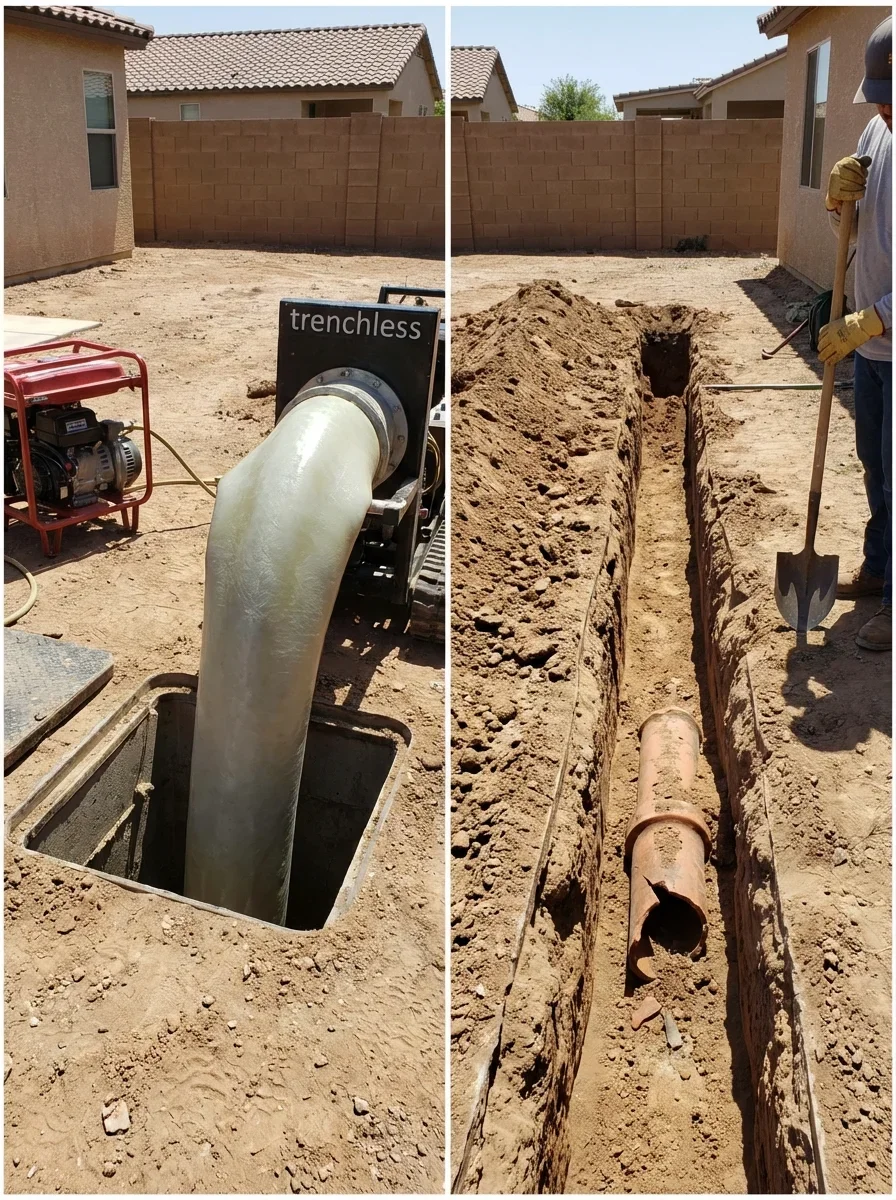
Trenchless methods avoid the continuous trench. Instead, contractors create two small access points — typically 4x4 feet — at either end of the damaged section. From there, they use one of two approaches depending on the damage extent.
Pipe lining (also called cured-in-place pipe or CIPP) works when your existing pipe is still structurally intact but cracked or leaking. The contractor inserts a resin-saturated fabric liner through the access point, inflates it against the interior walls of your old pipe, and cures it with heat or UV light.
The result is a new pipe inside your old pipe, sealing cracks and stopping leaks without removing the original line.
Pipe bursting replaces the entire line when damage is too severe for lining. A hydraulic bursting head pulls through the old pipe, fracturing it outward while simultaneously pulling new HDPE pipe into place behind it. The old pipe fragments stay in the ground — the new line takes its exact path.
Both methods require entry and exit pits, but you're digging 8 square feet total instead of a 50-foot trench. If your line runs under a concrete patio, the contractor cores two access holes instead of demolishing the entire slab.
| Feature | Traditional Excavation | Trenchless Repair |
|---|---|---|
| Excavation Size | 50-80 foot continuous trench | Two 4x4 foot access pits (8 sq ft total) |
| Caliche Impact | Adds $2,000-$5,000 for removal | Minimal — small pits often hand-dug |
| Project Duration | 3-7 days | 1-2 days |
| Landscape Disruption | 200+ sq ft typical | Under 10 sq ft |
Cost Breakdown: What You'll Actually Pay
Initial Service Costs
Traditional excavation in Phoenix runs $150-$250 per linear foot for basic yard access. That jumps to $250-$400 per foot when your line runs under structures, hardscaping, or asphalt. A typical residential sewer line replacement (50-80 feet from house to street) costs $7,500-$20,000 before restoration work.
Trenchless lining costs $80-$250 per foot depending on pipe diameter and access conditions. Trenchless pipe bursting runs $100-$300 per foot.
For that same 50-80 foot run, you're looking at $4,000-$15,000 for the plumbing work itself.
The math flips when caliche enters the picture. Phoenix excavation contractors charge $75-$150 per hour for caliche removal on top of base digging rates. A standard residential trench through caliche adds $2,000-$5,000 to traditional projects.
Trenchless methods avoid this entirely — the small access pits can often be hand-dug or cored with minimal caliche removal.
Phoenix-Specific Surcharges
If your line runs under a city sidewalk or right-of-way, you need a City of Phoenix excavation permit ($200-$500) plus ROW restoration fees. Traditional excavation requires full-width sidewalk replacement to current ADA standards if you break the concrete — budget $3,000-$6,000 for a standard 5-foot sidewalk section.
Trenchless access pits under sidewalks get patched with concrete cores, typically under $800 total.
Monsoon season (July-September) adds complications. Contractors charge 15-25% premiums for traditional excavation during monsoon because open trenches flood, delay projects, and create safety hazards. Trenchless work continues through monsoon with minimal weather impact since access pits can be covered between work sessions.
Restoration and Hidden Costs
This is where traditional excavation costs spiral.
Your quote covers plumbing, but landscape restoration is separate. Removing and replanting mature desert landscaping costs $15-$40 per square foot depending on plant maturity and hardscaping complexity. A 200-square-foot trench footprint runs $3,000-$8,000 to restore properly.
Concrete work adds up fast. Breaking and replacing a 20-foot driveway section costs $2,000-$4,500. Garage slab repairs where the line exits your foundation run $1,500-$3,500. Pool deck demolition and replacement can hit $5,000-$12,000 depending on surface material.
Irrigation systems rarely survive traditional excavation intact. Drip line replacement in the trench zone adds $500-$2,000. If your contractor cuts a main irrigation line, full system repair costs escalate.
Trenchless projects avoid 90% of this. You're patching two small pits, not rebuilding hardscaping.
Total restoration cost for trenchless typically runs under $1,500 unless access points happen to land in particularly expensive finishes.
True Total Cost Factors for Phoenix Sewer Repair:
- Plumbing work: $4,000-$20,000 depending on method and length
- Caliche removal surcharge: $2,000-$5,000 (traditional only)
- Landscape restoration: $3,000-$8,000 for 200 sq ft trench vs. under $1,500 for access pits
- Concrete repair: $2,000-$12,000 (structures/driveways) vs. $800 (pit patches)
- Permit fees: $200-$500 plus potential ROW restoration $3,000-$6,000
- Monsoon season premium: 15-25% surcharge (traditional only)
- Irrigation repair: $500-$2,000+ (traditional) vs. minimal (trenchless)
When Each Method Makes Sense
Traditional Excavation Works Better For
Complete line failure in older homes. If you have a pre-1980 Phoenix home with original cast iron drain lines, you're dealing with 40+ years of hard water corrosion. Phoenix's 300+ ppm calcium carbonate water accelerates iron pipe deterioration — these lines often have multiple failure points, severe scale buildup, and structural weakness that makes lining ineffective.
Lines with severe offset or bellied sections. Trenchless lining can't fix gravity flow problems.
If your sewer camera inspection shows sections that have settled or shifted — common in Phoenix's caliche soil as foundations move — excavation lets contractors re-grade the line to proper slope.
Root intrusion beyond repair. When tree roots have crushed or collapsed sections of your line, pipe bursting might work, but traditional replacement often costs less and gives you the option to reroute away from the root zone entirely.
Budget-constrained repairs with yard-only access. If your line runs through open desert landscaping with no structures, irrigation, or mature plants, and you're willing to trade disruption for lower upfront cost, traditional excavation can undercut trenchless pricing.
This only applies when restoration costs are minimal.
Trenchless Wins For
Lines under structures or expensive hardscaping. Any time your sewer line runs under a pool deck, stamped concrete patio, decomposed granite with pavers, or custom water features, trenchless saves you from demolition and reconstruction costs that dwarf the plumbing work itself.
Homes with mature desert landscaping. Removing and replanting established saguaros, ocotillos, or aged palo verdes costs more than the trenchless premium.
These plants don't transplant easily — you're replacing, not moving them.
Multiple small failures from pinhole corrosion. Phoenix copper supply lines develop pinhole leaks from hard water, and the same corrosion affects older drain lines. If your inspection shows several small cracks or pinhole failures along an otherwise intact line, CIPP lining seals all of them in one shot without cutting the pipe.
Timeline pressure. Traditional excavation takes 3-7 days depending on project scope and restoration complexity. Trenchless lining or bursting finishes in 1-2 days with minimal property disruption. If you need your sewer functional fast — say, before hosting family or closing a home sale — trenchless delivers.
Properties with challenging access. Lines that run under additions, attached casitas, or close to property lines where excavators can't maneuver favor trenchless approaches.
The small access pits can often be created where full excavation equipment couldn't operate.
Lifespan and Long-Term Performance
What Traditional Replacement Delivers
New PVC or ABS pipe installed through traditional excavation lasts 50-100 years in Phoenix conditions. Modern plastic pipe doesn't corrode from hard water, won't rust, and resists root intrusion better than older clay or iron lines.
You're getting a completely new system with proper grading and modern connections.
The weak points in traditional repairs aren't the pipe — they're the joints. Every section connection is a potential leak point decades down the road, especially if settling or ground movement creates stress. Phoenix's expansive caliche soil shifts as moisture levels change, putting pressure on rigid pipe joints.
Properly installed traditional systems require minimal maintenance beyond periodic drain cleaning or hydro jetting to clear accumulated debris. You're not dealing with a patched system — the entire replaced section is new material.
How Trenchless Repairs Hold Up
CIPP lining creates a seamless pipe-within-a-pipe with no joints along the repaired section. The cured epoxy liner is chemically resistant, immune to root intrusion, and doesn't corrode.
Properly installed lining systems carry 50-year manufacturer warranties and field data suggests they'll exceed that in non-aggressive soil conditions.
Phoenix's caliche and hard water don't affect cured epoxy the way they corrode metal pipes. The liner bonds to your existing pipe structure, and once cured, it's structurally independent — even if the host pipe continues degrading, the liner maintains integrity.
Pipe bursting installs new HDPE (high-density polyethylene) pipe with heat-fused joints that are stronger than the pipe itself. HDPE has a proven service life exceeding 100 years in utility applications. It's flexible enough to handle minor ground movement without cracking, which matters in Phoenix's shifting caliche soils.
The limitation: trenchless repairs address the specific section accessed.
If you have a 60-foot line and repair 40 feet trenchlessly, the remaining 20 feet of old pipe is still aging. This is why sewer camera inspection before repair matters — you need to know if you're fixing an isolated failure or postponing inevitable problems in adjacent sections.
Is Trenchless Sewer Repair Worth It?
For most Phoenix homeowners, yes — if your property conditions fit the method.
The upfront cost premium (when one exists) disappears when you factor in restoration savings. A $12,000 trenchless job beats a $9,000 traditional repair that requires $5,000 in concrete and landscape restoration.
The value equation changes based on what your sewer line runs under. If you have simple yard access with low-value landscaping, traditional excavation might cost less overall. But properties with pools, mature plantings, decorative hardscaping, or lines under slabs see clear cost advantages with trenchless — often saving $3,000-$8,000 on total project cost.
Performance-wise, properly executed trenchless repairs match or exceed traditional replacements for longevity.
You're not accepting a "patch job" — modern CIPP and pipe bursting create permanent solutions with warranty terms that back it up.
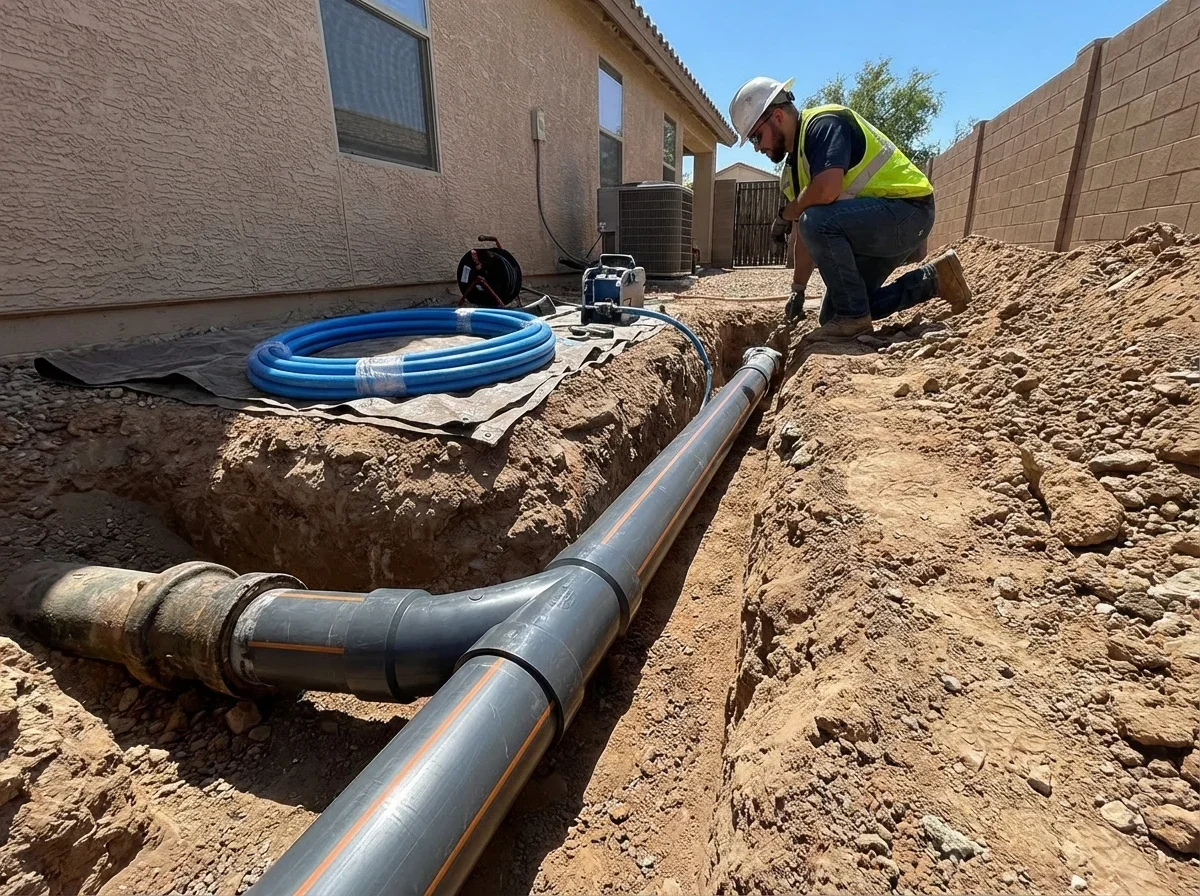
What Are the Disadvantages of Trenchless Pipe Replacement?
You can't fix severe structural collapse. If a section of your line has completely caved in or crushed flat, there's no intact pathway to line or burst through.
Traditional excavation becomes necessary to remove and replace that section.
Root intrusion might require pre-cleaning. Heavy root masses inside your pipe need removal before lining can proceed. This adds hydro jetting or mechanical cutting to your project scope and cost. Traditional excavation removes the pipe and roots simultaneously.
Access point placement can hit obstacles. Trenchless requires specific entry and exit locations. If the only viable access points land in particularly expensive areas — say, directly under a pool deck or through a load-bearing wall — the cost advantage evaporates.
Not all contractors do it well. Trenchless repair requires specialized equipment and training. Phoenix has plenty of experienced providers, but quality varies.
Poor lining installations can fail within years if the resin doesn't cure properly or the liner wasn't sized correctly for your pipe diameter. Always verify your contractor holds an active ROC license at https://roc.az.gov/ and ask for references on trenchless projects specifically.
Limited scope repair leaves old pipe intact. If you repair 30 feet of a 70-foot line, you still have 40 feet of aging pipe that might fail next year. Traditional full-line replacement solves everything at once.
Partial trenchless repairs make financial sense when the damaged section is isolated, but you're accepting that other sections might need work later.
Critical Planning Tip: Get your sewer camera inspection done before committing to either method. You can't make an informed decision about trenchless vs. traditional until you know exactly how much of your line is damaged, where it's located, and what's sitting on top of it. Many Phoenix homeowners discover their "simple sewer repair" runs directly under their pool deck or through caliche — information that completely changes the cost math.
How Long Does a Trenchless Sewer Line Last?
Modern CIPP liners carry 50-year warranties from major manufacturers, and field installations from the 1980s show intact performance 40+ years later.
The epoxy-saturated liner, once cured, doesn't degrade from sewage exposure, hard water, or typical soil conditions.
Pipe bursting installations using HDPE pipe have demonstrated 100+ year service lives in municipal water and sewer applications. The heat-fused joints create monolithic pipe sections without the weak points that plague traditional joined systems.
Phoenix-specific conditions favor trenchless longevity. The liner material doesn't corrode from hard water calcium the way copper or iron pipes do. Caliche soil, while hell to dig through, doesn't create corrosive conditions once the repair is complete.
UV exposure isn't a factor for buried lines.
The realistic expectation: a properly installed trenchless repair in Phoenix should outlast you as a homeowner. You're more likely to sell the house or remodel extensively before the liner fails from age.
Compare this to the original pipe that's failing — probably cast iron from the 1970s or clay tile from the 1960s, both with typical 40-60 year lifespans in Phoenix's hard water environment.
Will Insurance Pay for a New Sewer Line?
Probably not.
Standard homeowners insurance in Arizona excludes sewer line repair from coverage unless the damage results from a covered peril like a vehicle striking your cleanout or a tree falling directly on the line during a covered windstorm event.
Gradual deterioration isn't covered. If your 40-year-old cast iron pipe finally corroded through from decades of hard water exposure, insurance classifies this as normal wear and maintenance — your responsibility as the homeowner.
Same goes for root intrusion, settling damage, or age-related failure.
Sudden backup damage is different from line repair. If your sewer backs up and damages your interior (flooding a bathroom, ruining flooring), some policies cover the interior damage under water backup coverage. But they won't pay to fix the underlying sewer line that caused the backup.
You handle the line repair; insurance might cover interior restoration.
Sewer line endorsements exist but are rare. Some Arizona insurers offer optional sewer line coverage as a policy add-on, typically capping at $10,000-$25,000 in coverage. These endorsements cost $50-$150 annually and exclude pre-existing conditions — you can't add coverage after you already know your line is failing.
Check your policy declarations page for "sewer backup" coverage limits. If you don't see it listed, call your agent to add it before you need it.
Even with coverage, expect a separate deductible ($500-$1,000) and potential premium increases after a claim.
For planned repairs where you have time to evaluate options, consider this a cash expense. Most Phoenix plumbing contractors offer financing through third-party lenders if you need to spread the cost. Compare those terms carefully — APRs run anywhere from 0% promotional rates (if you pay off within 12-18 months) to 18%+ on longer terms.
Choosing the Right Contractor for Your Method
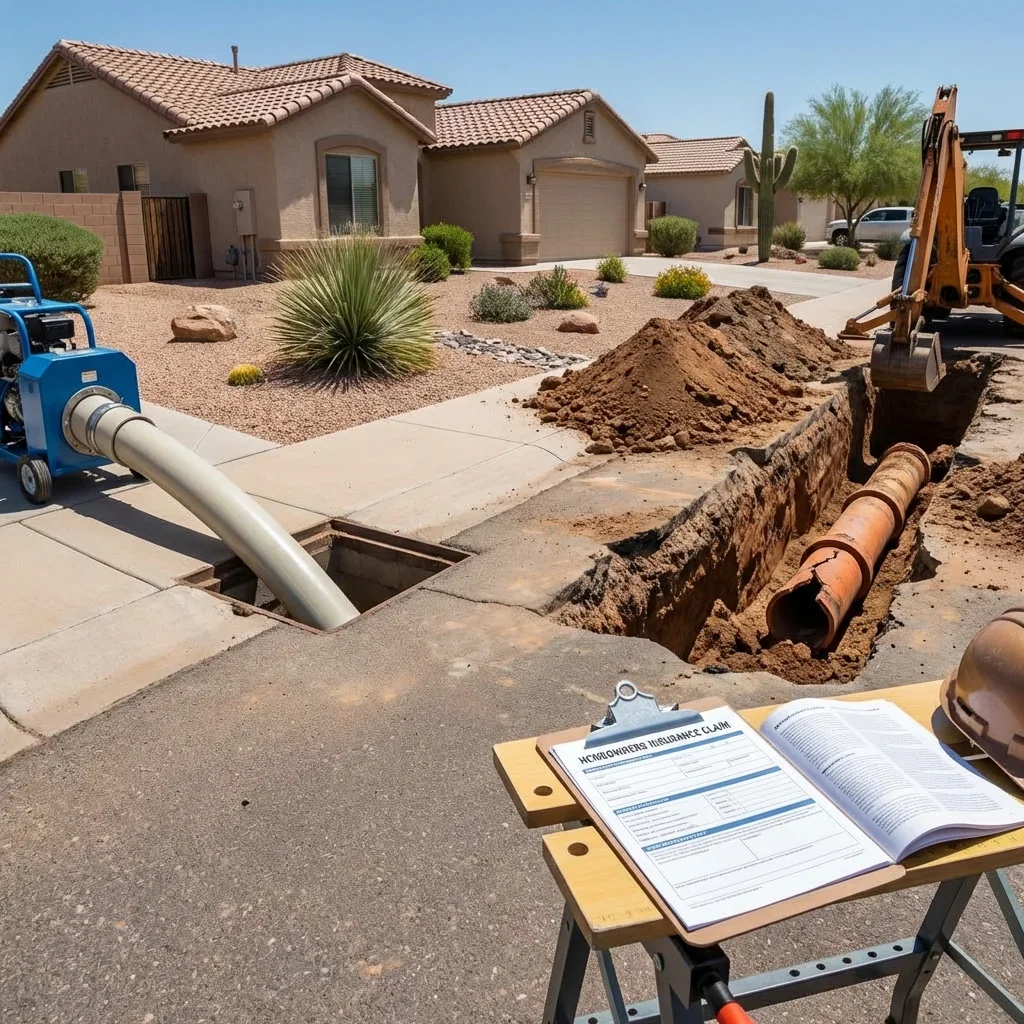
Not every plumber does both methods well.
Traditional excavation requires equipment relationships, crew size, and restoration coordination. Trenchless requires specialized lining equipment, pipe bursting rigs, and specific training certifications.
Ask potential contractors these method-specific questions:
For traditional excavation: Do you handle landscape restoration in-house or sub it out? Who handles concrete work, and is that included in your quote or separate? How do you protect adjacent structures during excavation?
Will you pull permits, and are those fees in your estimate?
For trenchless: What lining system do you use (manufacturer name), and what's the warranty? How many CIPP or pipe bursting jobs have you completed in Phoenix? Can you provide camera footage showing the before and after condition?
Do you handle the required sewer camera inspection in-house?
Verify every contractor's ROC license status regardless of method. Arizona requires anyone performing work over $1,000 to hold active licensing. Check at https://roc.az.gov/ — if they're not listed or their license is inactive, walk away.
Get at least three quotes for the same scope of work. Make sure each bid itemizes plumbing, excavation/access, restoration, and permits separately so you can compare apples-to-apples.
A $6,000 trenchless quote that includes everything might beat an $8,000 traditional quote that excludes restoration.
Read the scope of work carefully. "Repair sewer line" isn't detailed enough — you want pipe diameter, length, access method, materials, warranty terms, and who's responsible for what restoration.
Vague proposals create disputes when reality hits.
What to Expect During Each Project
Traditional Excavation Timeline
Day 1: Locating utilities (811 call required 2 business days before digging), marking the path, and beginning excavation.
If caliche is present, expect jackhammer noise and slower progress than normal soil.
Day 2-3: Completing the trench, removing old pipe, installing new sections, and testing for leaks. Your water will be shut off during connection work, typically 2-4 hours.
Day 4-5: Backfilling the trench, compacting soil, and beginning surface restoration.
Concrete work might happen on separate days if it's subcontracted.
Day 6-7+: Completing landscape restoration, replanting, and reconnecting irrigation (if applicable). Some restoration work might extend into week two depending on complexity.
You'll have limited yard access during this time. Equipment parked in driveways, trenches across walking paths, and piled dirt create hazards.
Plan on keeping kids and pets indoors or in unaffected areas.
Trenchless Project Timeline
Day 1: Creating access pits, inserting camera for final path confirmation, and beginning liner installation or pipe bursting setup.
If lining, the resin application and inflation happen same-day.
Day 2: Curing the liner (takes 2-6 hours depending on method), final camera inspection to verify complete coverage, and backfilling access pits.
Some single-day trenchless completions happen when conditions are ideal and the crew is experienced. More commonly, you're looking at a solid two days from access to final backfill.
Your water and sewer access might be limited during lining cure time, but it's hours, not days.
Most homeowners can stay in the home throughout trenchless projects without major lifestyle disruption.
Making Your Decision
Start with a detailed sewer camera inspection from an ROC-licensed plumber.
You can't make an informed choice between methods until you know exactly what's wrong, where it's wrong, and how much of your line is affected.
If inspection shows isolated damage in a structurally intact pipe under expensive hardscaping or structures, trenchless makes financial sense. If you have widespread deterioration across the entire line in open yard access, traditional replacement might cost less and solve everything permanently.
Get quotes for both approaches from contractors who specialize in each. The numbers will clarify which method fits your budget and timeline.
Remember to compare total project cost including restoration, not just the plumbing scope.
Factor in your property specifics: what's at the surface, what monsoon timing means for your schedule, and how long you plan to stay in the home. A permanent solution matters more if you're planning another 10+ years in the house. If you're selling within two years, the least-disruptive repair that satisfies disclosure requirements might be your priority.
Phoenix's slab-on-grade construction, caliche soil, and hard water create unique conditions that often tip the scale toward trenchless solutions.
But your specific situation determines the right call. Make it based on real inspection data, complete cost comparisons, and verified contractor credentials — not sales pitches about "cutting-edge technology" or "proven traditional methods."